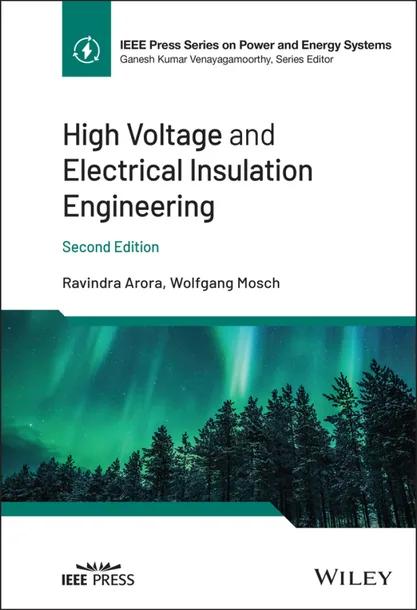
High Voltage and Electrical Insulation Engineering
by Ravindra Arora, Wolfgang Mosch
2nd Edition
Publisher: Wiley-IEEE Press
Book Details
| Print ISBN | 9781119568872 |
| eText ISBN | 9781119568940 |
| Publisher | Wiley-IEEE Press |
| Publishing Year | 2022 |
| Edition | 2nd Edition |
| Language | English |
| Pages | 512 |
High Voltage and Electrical Insulation Engineering, 2nd Edition, is a 2022 textbook published by Wiley-IEEE Press that delivers structured technical instruction on dielectric behavior and electric field management. The volume establishes physical foundations required for analyzing high-voltage insulation systems and understanding fundamental electrical stress factors.
The thematic scope addresses the general physical behavior of dielectric media alongside the specific field-dependent operational performance of gaseous, vacuum, liquid, and solid dielectrics. The text introduces systematic electric field classification methods and estimation techniques, providing technical framework material to assist in evaluating stress distributions and potential breakdown conditions across diverse physical configurations.
This second edition incorporates an entirely new section dedicated to the condition monitoring of electrical insulation systems. By explaining weakly nonuniform field behavior through both analytical formulations and conceptual frameworks, the text provides structured instructional support for university courses, ongoing academic research initiatives, and power industry engineering practice.
Table of Contents
Chapter 1: Introduction
- • 1.1 Electric Charge, Discharge, Current, and Potential
- • 1.2 Electric and Magnetic Fields
- • 1.3 Electromagnetism
- • 1.4 Dielectric and Electrical Insulation
- • 1.5 Electrical Breakdown
- • 1.5.1 Global Breakdown
- • 1.5.2 Local Breakdown or Partial Breakdown
- • 1.5.3 Breakdown Strength or Electric Strength
- • 1.6 Corona, Streamer, Star, and Leader
- • 1.6.1 Aurora
- • 1.6.2 Electric Arc
- • 1.7 Capacitance and Capacitor
- • 1.7.1 Stray Capacitance
- • 1.8 Forms of Voltages and Currents
- • 1.8.1 TravelingWaves
- • 1.8.2 Neutral and Ground
- • References
Chapter 2: Electric Fields, Their Control and Estimation
- • 2.1 Electric Field Intensity, “_E_”
- • 2.2 Breakdown and Electric Strength of Dielectrics, “_Eb_”
- • 2.2.1 Partial Breakdown in Dielectrics
- • 2.3 Classification of Electric Fields
- • 2.3.1 Degree of Uniformity of Electric Fields
- • 2.3.1.1 Effect of Grounding on Field Configuration
- • 2.4 Control of Electric Field Intensity (Stress Control)
- • 2.5 Estimation of Electric Field Intensity
- • 2.5.1 Basic Equations for Potential and Field Intensity in Electrostatic Fields
- • 2.5.2 Analytical Methods for the Estimation of Electric Field Intensity in Homogeneous Isotropic Single Dielectric
- • 2.5.2.1 Direct Solution of Laplace Equation
- • 2.5.2.2 “Gaussian Surface” Enclosed Charge Techniques for the Estimation and Optimization of Field
- • 2.5.3 Analysis of Electric Field Intensity in Isotropic Multidielectric System
- • 2.5.3.1 Field with Longitudinal Interface
- • 2.5.3.2 Field with Perpendicular Interface
- • 2.5.3.3 Field with Diagonal Interface
- • 2.5.4 Numerical Methods for the Estimation of Electric Field Intensity
- • 2.5.4.1 Finite Element Method (FEM)
- • 2.5.4.2 Charge Simulation Method (CSM)
- • 2.5.5 Numerical Optimization of Electric Fields
- • 2.5.5.1 Optimization by Displacement of Contour Points
- • 2.5.5.2 Optimization by Changing the Positions of Optimization Charges and Contour Points
- • 2.5.5.3 Optimization by Modification of “Contour Elements”
- • 2.6 Conclusion
- • References
Chapter 3: Field Dependent Behavior of Air and Other Gaseous Dielectrics
- • 3.1 Fundamental Process of Field Assisted Generation of Charge Carriers
- • 3.1.1 Impact Ionization
- • 3.1.2 Thermal Ionization
- • 3.1.3 Photoionization and Interaction of Metastables with Molecules
- • 3.2 Breakdown of Atmospheric Air in Uniform andWeakly Nonuniform Fields
- • 3.2.1 Uniform Field with Space Charge
- • 3.2.2 Development of Electron Avalanche
- • 3.2.3 Development of Streamer or “Kanal Discharge”
- • 3.2.4 Breakdown Mechanisms
- • 3.2.4.1 Breakdown in Uniform Fields with Small Gap Distances (Townsend Mechanism)
- • 3.2.4.2 Breakdown with Streamer (Streamer or Kanal Mechanism)
- • 3.2.5 Breakdown Voltage Characteristics in Uniform Fields (Paschen’s Law)
- • 3.2.6 Breakdown Voltage Characteristics inWeakly Nonuniform Fields
- • 3.3 Breakdown in Extremely Nonuniform Fields and Corona
- • 3.3.1 Development of Avalanche Discharge of Below Critical Amplification
- • 3.3.1.1 Positive Needle–Plane Electrode Configuration (Positive or Anode Star Corona)
- • 3.3.1.2 Negative Needle–Plane Electrode Configuration (Negative or Cathode Star Corona)
- • 3.3.2 Development of Streamer or Kanal Discharge
- • 3.3.2.1 Positive Rod–Plane Electrode (Positive Streamer Corona)
- • 3.3.2.2 Negative Rod–Plane Electrode (Negative Streamer Corona)
- • 3.3.2.3 Symmetrical Positive and Negative Electrode Configurations in Extremely Nonuniform Fields
- • 3.3.3 Development of Stem and Leader Corona
- • 3.3.3.1 Development and Propagation of Positive Leader Corona
- • 3.3.3.2 Development and Propagation of Negative Leader Corona and the Phenomenon of Space Leader
- • 3.3.3.3 Electromagnetic Interference (EMI) Produced by Corona
- • 3.3.4 Summary of the Development of Breakdown in Extremely Nonuniform Fields
- • 3.3.5 Breakdown Voltage Characteristics of Air in Extremely Nonuniform Fields
- • 3.3.5.1 Breakdown Preceded with Stable Star Corona
- • 3.3.5.2 Breakdown Preceded with Stable Streamer Corona
- • 3.3.5.3 Breakdown Preceded with Stable Streamer and Leader Coronas (Long Air Gaps)
- • 3.3.5.4 The Requirement of Time for the Formation of Spark Breakdown with Impulse Voltages
- • 3.3.5.5 Effect of Wave Shape on Breakdown with Impulse Voltages
- • 3.3.5.6 Conclusions from Measured Breakdown Characteristics in Extremely Nonuniform Fields
- • 3.3.5.7 Estimation of Breakdown Voltage in Extremely Nonuniform Fields in Long Air Gaps
- • 3.3.6 Effects of Partial Breakdown or Corona in Atmospheric Air
- • 3.3.6.1 Chemical Decomposition of Air by Corona
- • 3.3.6.2 Corona Power Loss in Transmission Lines
- • 3.3.6.3 Electromagnetic Interference (EMI) and Audible Noise (AN) Produced by Power System Network
- • 3.3.6.4 Other Effects of High Voltage Transmission Lines and Corona on the Environment
- • 3.4 Electric Arcs and Their Characteristics
- • 3.4.1 Static Voltage–Current, _U_–_I_, Characteristics of Arcs in Air
- • 3.4.2 Dynamic _U_–_I_ Characteristics of Arcs
- • 3.4.3 Extinction of Arcs
- • 3.5 Properties of Sulfurhexafluoride, SF6, Gas, and Its Application in Electrical Installations
- • 3.5.1 Properties of Sulfurhexafluoride, SF6 Gas
- • 3.5.1.1 Physical Properties
- • 3.5.1.2 Property of Electron Attachment
- • 3.5.2 Breakdown in Uniform and Weakly Nonuniform Fields with SF6 Insulation
- • 3.5.3 External Factors Affecting Breakdown Characteristics in Compressed Gases
- • 3.5.3.1 Effect of Electrode Materials and Their Surface Roughness on Breakdown
- • 3.5.3.2 Effect of Particle Contaminants in Gas Insulated Systems (GIS)
- • 3.5.3.3 Particle Initiated PB and Breakdown Measurements in GIS
- • 3.5.3.4 Preventive Measures for the Effect of Particles in GIS
- • 3.5.4 Breakdown in Extremely Nonuniform and Distorted Weakly Nonuniform Fields with Stable PB in SF6 Gas Insulation
- • 3.5.5 Electrical Strength of Mixtures of SF6 with Other Gases
- • 3.5.6 Decomposition of SF6 and Its Mixtures in Gas Insulated Equipment
- • 3.5.7 SF6 Gas and Environment
- • 3.5.8 Development in Gas Insulated Power Apparatus
- • 3.5.9 Mineral Oils Versus SF6 Gas
- • 3.5.10 Basic Electrical Insulation Requirements for GITs
- • 3.5.11 SF6 Gas Insulation, a Replacement for Oils
- • 3.5.12 Basic Cooling Requirements Met by Gas for GITs
- • 3.5.13 Environment Concerns and Future Trends
- • 3.6 Investigations for the Requirement of Optimum Clearance for 25 kV Electric Traction: A Case Study
- • 3.6.1 Field Estimation for the Traction Overhead Conductor at 25 kV
- • 3.6.2 Measurement of Breakdown/Withstand Voltage Characteristics
- • 3.6.3 Measurements with ac Power Frequency Voltage
- • 3.6.4 Measurements Under FairWeather, Natural Fog, and Natural Rain Conditions
- • 3.6.5 Measurements Under Artificial Rain
- • 3.6.6 Investigation of the Performance of Air-Gap Under System Overvoltages
- • 3.6.7 Measurements with Impulse Voltages
- • 3.6.8 Measurements with Insulating-Barrier in the Gap
- • 3.6.9 Choice of Solid Insulating Barrier
- • 3.6.10 Positioning and Fastening of the Solid Insulating Barrier in the Gap
- • 3.6.11 Measurement Results with Teflon Sheet as a Barrier
- • 3.7 Conclusions and Recommendations
- • References
Chapter 4: Lightning and Ball Lightning, Development Mechanisms, Deleterious Effects, Protection
- • 4.1 The Globe, a Capacitor
- • 4.1.1 The Earth’s Atmosphere and the Clouds
- • 4.1.1.1 The Troposphere
Chapter 5: Electrical Properties of Vacuum as High Voltage Insulation
Chapter 6: Liquid Dielectrics, Their Classification, Properties, and Breakdown Strength
Chapter 7: Solid Dielectrics, Their Sources, Properties, and Behavior in Electric Fields
Customer Reviews
0.0
0 reviews
No reviews yet. Be the first to review this book!
Write a Review
Reviewed by GradeFocus Editorial Team
▶Research Sources (13)
- High Voltage and Electrical Insulation Engineering
- High Voltage and Electrical Insulation Engineering
- Please verify you are human - Captcha
- Bound To Stay Bound Books, Inc. - Bookstore
- High Voltage and Electrical Insulation Engineering
- Electric Transmission from Sarawak to Singapore Using ...
- Electric Transmission from Sarawak to Singapore Using ...
- Education And Reference Book group
- (PDF) High Voltage and Electrical Insulation Engineering
- High Voltage and Electrical Insulation Engineering
- High Voltage and Electrical Insulation Engineering [2 
- High Voltage and Electrical Insulation Engineering
- High Voltage and Electrical Insulation Engineering (IEEE ...
Related Books

Electronics Use in Harsh Environments
Rajan Ambat

Digital Design using VerilogHDL
Shilpi Birla
Artificial Intelligence Empowered Smart Energy Systems
Qiang Yang
Stability Analysis of Converter-Rich Power Grids
Jun Liang

Multiphase Power Electronic Converters
Salman Ahmad
Robust Dynamic State Estimation of Power Systems
Junbo Zhao