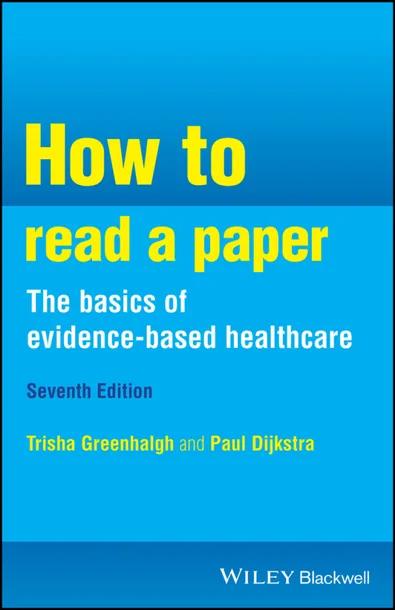
How to Read a Paper
the Basics of Evidence-Based Healthcare
by Trisha M. Greenhalgh, Paul Dijkstra
7th Edition
Publisher: Wiley-Blackwell
Book Details
| Print ISBN | 9781394206902 |
| eText ISBN | 9781394206926 |
| Publisher | Wiley-Blackwell |
| Publishing Year | 2024 |
| Edition | 7th Edition |
| Language | English |
| Pages | 352 |
The textbook How to Read a Paper: the Basics of Evidence-Based Healthcare, 7th Edition, offers structured instruction in evaluating medical research literature and applying scientific findings within clinical practice. The material targets healthcare students, established clinicians in medicine, nurses, and allied health professionals, as well as candidates preparing for undergraduate exams, postgraduate exams, or healthcare job interviews.
Core chapters detail distinct research study designs, including randomised controlled trials, cohort studies, case-control studies, cross-sectional surveys, and individual case reports. The text guides readers through modern literature searching techniques using federated search engines and artificial intelligence tools. These sections establish practical frameworks for identifying relevant papers and evaluating health data.
A defining feature of this seventh edition is its inclusion of new chapters covering consensus methods, mechanistic evidence, big data, and artificial intelligence applications in healthcare. The text aligns with university courses and professional training programs centered on evidence-based practice and critical research appraisal.
Table of Contents
Chapter 1: Why read papers at all?
- • Does ‘evidence- based medicine’ simply mean ‘reading papers in medical journals’?
- • Why do people sometimes groan when you mention evidence- based healthcare?
- • Before you start: formulate the problem
- • Exercises based on this chapter
- • References
Chapter 2: Searching the literature
- • The information jungle
- • What are you looking for?
- • Levels upon levels of evidence
- • Synthesised sources: systems, summaries and syntheses
- • Pre-appraised sources: synopses of systematic reviews and primary studies
- • Specialised resources
- • Primary studies: tackling the jungle
- • One-stop shopping: federated search engines
- • Using artificial intelligence to search the literature
- • Asking for help and asking around
- • Online tutorials for effective searching
- • Exercises based on this chapter
- • References
Chapter 3: Getting your bearings: what is this paper about?
- • The science of ‘trashing’ papers
- • Three preliminary questions to get your bearings
- • What are randomised controlled trials and why do they matter?
- • What are cohort studies?
- • What are case–control studies?
- • What are cross-sectional surveys?
- • What are case reports?
- • The traditional hierarchy of evidence
- • Exercises based on this chapter
- • References
Chapter 4: Assessing methodological quality
- • Was the study original?
- • Who is the study about?
- • Was the design of the study sensible?
- • Was bias avoided or minimised?
- • Was assessment ‘blind’?
- • Were preliminary statistical questions addressed?
- • A note on ethical considerations
- • Summing up
- • Exercises based on this chapter
- • References
Chapter 5: Statistics for the non-statistician
- • How can non-statisticians evaluate statistical tests?
- • Have the authors set the scene correctly?
- • Paired data, tails and outliers
- • Correlation, regression and causation
- • Probability and confidence
- • The bottom line (quantifying the chance of benefit and harm)
- • Summary
- • Exercises based on this chapter
- • References
Chapter 6: Papers that report clinical trials of simple interventions
- • What is a clinical trial?
- • Drug trials: ‘evidence’ and marketing
- • Making decisions about therapy
- • Surrogate endpoints
- • What information to expect in a paper describing a randomised controlled trial: the CONSORT statement
- • Getting worthwhile evidence from pharmaceutical representatives
- • A note on vaccine trials
- • Exercises based on this chapter
- • References
Chapter 7: Papers that report trials of complex interventions
- • Complex interventions
- • Ten questions to ask about a paper describing a complex intervention
- • Exercises based on this chapter
- • References
Chapter 8: Papers that report diagnostic or screening tests
- • Ten suspects in the dock
- • Validating diagnostic tests against a gold standard
- • Ten questions to ask about a paper that claims to validate a diagnostic or screening test
- • Likelihood ratios
- • Clinical prediction models
- • Exercises based on this chapter
- • References
Chapter 9: Papers that summarise other papers (systematic reviews and meta-analyses)
- • When is a review systematic?
- • Evaluating systematic reviews: five questions to ask
- • Meta-analysis for the non-statistician
- • Explaining heterogeneity
- • New approaches to systematic review
- • Exercises based on this chapter
- • References
Chapter 10: Papers that advise you what to do (guidelines)
- • The great guidelines debate
- • Ten questions to ask about a clinical guideline
- • Exercises based on this chapter
- • References
Chapter 11: Papers that estimate what things cost (health economic evaluations)
- • What is an economic evaluation?
- • Health economics studies: two key approaches
- • Costs and benefits of health interventions
- • Measuring the value of health states
- • Quality-adjusted life-years
- • Low-value health: choosing wisely
- • Twelve questions to ask about a health economic evaluation
- • Conclusion
- • Exercises based on this chapter
- • References
Chapter 12: Papers that go beyond numbers (qualitative research)
- • What is qualitative research?
- • Summarising and synthesising qualitative research
- • Nine questions to ask about a qualitative research paper
- • Conclusion
- • Exercises based on this chapter
- • References
Chapter 13: Papers that report questionnaire research
- • The rise and rise of questionnaire research
- • Ten questions to ask about a paper describing a questionnaire study
- • Exercises based on this chapter
- • References
Chapter 14: Papers that report quality improvement case studies
- • What are quality improvement studies and how should we research them?
- • Ten questions to ask about a paper describing a quality improvement initiative
- • Conclusion
- • Exercises based on this chapter
- • References
Chapter 15: Papers that describe genetic association studies
- • The three eras of human genetic studies (so far)
- • What is a genome-wide association study?
- • Clinical applications of genome-wide association studies
- • Direct- to- consumer genetic testing
- • Mendelian randomisation studies
- • Epigenetics: a space to watch
- • Ten questions to ask about a genetic association study
- • Exercises based on this chapter
- • References
Chapter 16: Applying evidence with patients
- • The patient perspective
- • Patient- reported outcome measures
- • Shared decision- making
- • Option grids
- • _n_-of-1 trials and other individualised approaches
- • Exercises based on this chapter
- • References
Chapter 17: Papers on artificial intelligence in healthcare
- • Introduction
- • Artificial intelligence
- • Big data
- • Machine learning
- • Generative artificial intelligence: large language and multimodal models
- • Ethical principles for the use of artificial intelligence for health
- • Appraising artificial intelligence papers: a plethora of checklists
- • Ten questions to ask about a paper that reports AI studies in healthcare
- • Summary
- • Exercises based on this chapter
- • References
Chapter 18: EBM+: the importance of mechanistic evidence
- • What is mechanistic evidence? An example
- • The many types of mechanistic evidence and a preliminary hierarchy
- • EBM+ means ‘both and’, not ‘either or’
- • Mechanistic evidence in the COVID-19 pandemic
- • Exercises based on this chapter
- • References
Chapter 19: Papers that report consensus exercises
- • Why are consensus method papers important?
- • How do experts choose and reach consensus on a specific topic?
- • Consensus methods
- • Ten questions to ask about a paper that reports a consensus statement
- • Exercises based on this chapter
- • References
Chapter 20: Criticisms of evidence-based healthcare
- • What’s wrong with evidence-based healthcare when it’s done badly?
- • What’s wrong with evidence-based healthcare when it’s done well?
- • Why is ‘evidence-based policymaking’ so hard to achieve?
- • Exercises based on this chapter
- • References
Chapter Appendix 1: Checklists for finding, appraising and implementing evidence
Chapter Appendix 2: Assessing the effects of an intervention
Customer Reviews
0.0
0 reviews
No reviews yet. Be the first to review this book!
Write a Review
Reviewed by GradeFocus Editorial Team
▶Research Sources (16)
- How to Read a Paper | Rent | 9781394206926 - Valore
- How to Read a Paper. The Basics of Evidence-Based Healthcare
- D2L-How to Read a Paper: the Basics of Evidence-Based Healthcare Ed. 7
- Evidence Based Medicine: Critical Appraisal - Research Guides
- How to Read a Paper by Dijkstra, Trisha M. Greenhalgh; Paul ...
- How to Read a Paper - Trisha M. Greenhalgh (9781394206926 ...
- How to read a paper : the basics of evidence-based healthcare.
- Health Sciences: Literature Reviews - Research Subject Guides
- How to read a paper : the basics of evidence-based healthcare / Trisha ...
- How to Read a Paper : Trisha Greenhalgh, : 9781394206902
- the basics of evidence-based healthcare / Trisha Greenhalgh ...
- How to Read a Paper: the Basics of Evidence-Based ...
- How to Read a Paper | Rent | 9781394206902
- How to Read a Paper: The Basics of Evidence-Based Medicine
- How to Read a paper, 7th ed. - Basics of Evidence-Based ...
- How to Read a Paper, 7th Edition by Trisha M. Greenhalgh