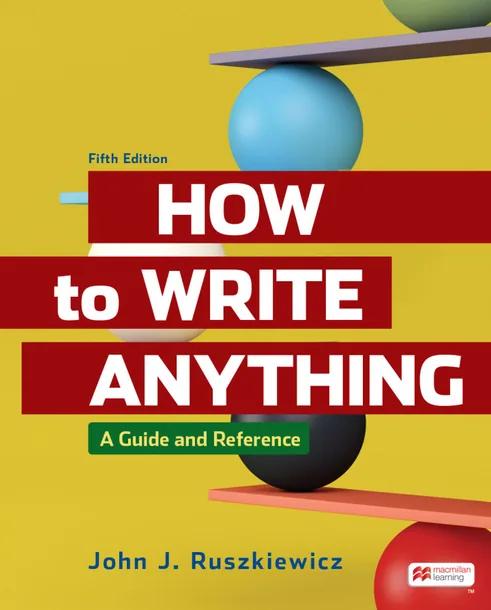
How to Write Anything
A Guide and Reference
by John J. Ruszkiewicz
5th Edition
Publisher: Bedford/St. Martin's
Book Details
| Print ISBN | 9781319412753 |
| eText ISBN | 9781319412791 |
| Publisher | Bedford/St. Martin's |
| Publishing Year | 2022 |
| Edition | 5th Edition |
| Language | English |
The textbook How to Write Anything: A Guide and Reference, 5th Edition, authored by John J. Ruszkiewicz, delivers practical writing guidance for students working across language arts and rhetoric disciplines. This reference helps readers analyze academic goals, evaluate writing contexts, and adapt their work for varied target audience expectations across different classroom environments.
Instruction progresses systematically through major composition genres, detailing how to draft clear narratives, factual reports, explanations, persuasive arguments, evaluations, and formal proposals. Specialized academic chapters explore literary analyses, rhetorical analyses, essay examinations, syntheses, and annotated bibliographies, offering actionable advice for structuring written ideas and presenting text with clear visual design.
Additional chapters focus on essential communication tools, including oral presentations, professional résumés, workplace emails, and writing portfolios. The text also covers foundational research preparation skills like smart reading, critical thinking, topic selection, and gathering source materials. Readers studying digital copies can access the text offline using the Bookshelf application.
Table of Contents
Chapter 1: Academic Goals and Expectations
- • Know that writing is more than avoiding grammar errors
- • Don’t make writing harder than it is
- • Take advantage of your instructor’s office hour
- • Use the writing center
- • Think of writing as a process
- • Think of yourself as a writer
- • VISUAL TUTORIAL: How to Use the Writing Center
Chapter 2: Defining Genres and Purposes
- • Appreciate what genres are
- • Understand why writers rely on genres
- • Using genres to meet assignments
- • Understand subgenres
- • Genres and subgenres in How to Write Anything
Chapter 3: Imagining Audiences
- • Consider what your audiences expect
- • Consider who else your readers might be
- • Make adjustments for your readers
- • Define who your readers should be
Chapter 4: Understanding Style and Design
- • Appreciate the choices you have
- • Strive for clarity in academic writing
- • Use language that respects audiences
- • Appreciate that design is part of style
Chapter 5: Narratives
- • Defining the genre
- • Make a point — usually
- • Tell a story
- • Offer details
- • Focus on people
- • LITERACY NARRATIVE: Laura Grisham, Literacy Narrative
- • Claiming a topic
- • Brainstorm
- • Choose a manageable subject
- • Choose a consequential subject
- • Choose a puzzling subject
- • Imagining your audience
- • Gathering materials
- • Talk to the people involved
- • Trust your experiences
- • Consult personal documents
- • Organizing ideas
- • Consider a conventional structure
- • Build toward a climax
- • Give your readers directions
- • Use headings and transitions
- • Choosing a style and design
- • Don’t hesitate to use first person
- • Use figures of speech, such as similes, metaphors, and analogies, to make memorable comparisons
- • In choosing verbs, favor active rather than passive voice
- • Keep the language simple
- • Examining models
- • ARGUMENTATIVE NARRATIVE: Leah Vann, Bald Is NOT Beautiful
- • PERSONAL STATEMENT: Michael Villaverde, Application Essay for Academic Service Partnership Foundation Internship
- • Assignments
Chapter 6: Reports
- • Defining the genre
- • Present information
- • Find reliable sources
- • Aim for objectivity
- • Present information clearly
- • FEATURE STORY: Cat Vasko, Grocery Store Economics: Why Are Rotisserie Chickens So Cheap?
- • Claiming a topic
- • Answer questions
- • Review what is already known about a subject
- • Report new knowledge
- • Imagining your audience
- • Suppose you are the expert
- • Suppose you are the novice
- • Suppose you are the peer
- • Gathering materials
- • Base reports on the best available sources
- • Base reports on diverse sources
- • Fact-check your report
- • Organizing ideas
- • Organize by date, time, or sequence
- • Organize by magnitude or order of importance
- • Organize by division
- • Organize by classification
- • Organize by position, location, or space
- • Organize by definition
- • Organize by comparison/contrast
- • Organize by thesis statement
- • Choosing style and design
- • Present the facts cleanly
- • Keep out of it
- • Avoid connotative language
- • Pay attention to elements of design
- • Examining models
- • ACADEMIC RESEARCH REPORT: Susan Wilcox, Marathons for Women
- • INFOGRAPHIC: Australian Academy of Science, Noise Pollution and Animals
- • Assignments
Chapter 7: Explanations
- • Defining the genre
- • Don’t jump to conclusions
- • Appreciate your limits
- • Offer sufficient evidence for claims
- • CAUSAL ANALYSIS: Kendall Powell, What Electronic Games Can Teach Us
- • Claiming a topic
- • Look again at a subject you know well
- • Look for an issue new to you
- • Examine a local issue
- • Choose a challenging subject
- • Tackle an issue that seems settled
- • Imagining your audience
- • Create an audience
- • Write to an existing audience
- • Gathering materials
- • Understand necessary causes
- • Understand sufficient causes
- • Understand precipitating causes
- • Understand proximate causes
- • Understand remote causes
- • Understand reciprocal causes
- • Organizing ideas
- • Explain why something happened
- • Explain the consequences of a phenomenon
- • Suggest an alternative explanation
- • Explain a chain of causes
- • Choosing style and design
- • Consider a middle style
- • Use appropriate supporting media
- • Examining models
- • RESEARCH STUDY: Alysha Behn, Where Have All the Women Gone?
- • FLOW DIAGRAM: U.S. Department of Transportation, Connected Vehicles
- • Assignments
Chapter 8: Arguments
- • Defining the genre
- • Offer levelheaded and disputable claims
- • Offer good reasons to support a claim
- • Understand opposing claims and points of view
- • Frame arguments powerfully—and not in words only
- • ARGUMENT TO ADVANCE A THESIS: Seth Templeton, An Open Letter to a Protester from a Baltimore County Police Officer
- • Claiming a topic
- • State a preliminary claim, if only for yourself
- • Qualify your claim to make it reasonable
- • Examine your core assumptions
- • Imagining your audience
- • Consider and control your ethos
- • Consider self-imposed limits
- • Consider the worlds of your readers
- • Gathering materials
- • List your reasons
- • Assemble your hard evidence
- • Cull the best quotations
- • Find counterarguments
- • Consider emotional appeals
- • Organizing ideas
- • Make a point or build toward one
- • Spell out what’s at stake
- • Address counterpoints when necessary, not in a separate section
- • Save your best arguments for the end
- • Choosing style and design
- • Invite readers with a strong opening
- • Write vibrant sentences
- • Ask rhetorical questions
- • Use images and design to make a point
- • Examining a model
- • REFUTATION ARGUMENT: Ryan Young, Self-Driving Cars: A Reality Check
- • Assignments
Chapter 9: Evaluations
- • Defining the genre
- • Explain your mission
- • Establish and defend criteria
- • Offer convincing evidence
- • Offer worthwhile advice
- • CRITICAL ASSESSMENT: Megan McArdle, Serena Williams Is Not the Best Tennis Player
- • Claiming a topic
- • Evaluate a subject you know well
- • Evaluate a subject you need to investigate
- • Evaluate a subject you’d like to know more about
- • Evaluate a subject that’s been on your mind
- • Imagining your audience
- • Write for experts
- • Write for a general audience
- • Write for novices
- • Gathering materials
- • Decide on your criteria
- • Look for hard criteria
- • Argue for criteria that can’t be measured
- • Stand by your values
- • Gather your evidence
- • Organizing ideas
- • Choose a simple structure when your criteria and categories are predictable
- • Choose a focal point
- • Compare and contrast
- • Choosing a style and design
- • Use a high or formal style
- • Use a middle style
- • Use a low style
- • Present evaluations visually
- • Examining models
- • MOVIE REVIEW: Roger Ebert, Review of Do The Right Thing
- • SOCIAL SATIRE/VISUAL ARGUMENT: Andy Singer, Intravenous Smartphones
- • Assignments
Chapter 10: Proposals
- • Defining the genre
- • Define a problem
- • Make specific recommendations
- • Target the proposal
- • Consider plausible alternatives
- • Make realistic recommendations
- • TRIAL BALLOON: Glenn Harlan Reynolds, To Reduce Inequality, Abolish Ivy League
- • Claiming a topic
- • Look for a genuine issue
- • Look for a challenging problem
- • Look for a soluble problem
- • Look for a local issue
- • Understanding your audience
- • Appeal to people who can make a difference
- • Rally people who represent public opinion
- • Gathering materials
- • Define the problem
- • Examine prior solutions
- • Outline a proposal
- • Defend the proposal
- • Figure out how to implement the proposal
- • Organizing ideas
- • Choosing style and design
- • Use a formal style
- • Use a middle style, when appropriate
- • Pay attention to elements of design
- • Examining models
- • MANIFESTO: Ellen Airhart, Join the Revolution: Eat More Bugs
- • VISUAL PROPOSAL: Jen Sorensen, Pod People
- • Assignments
Chapter 11: Literary Analyses
- • Defining the genre
- • Begin with a close reading
- • Make a claim or an observation
- • Use texts for evidence
- • Present literature in context
- • Draw on previous research
- • CULTURAL REFLECTION: Dana Gioia, Why Literature Matters: Good Books Help Make a Civil Society
- • Claiming a topic
- • Choose a text, genre, or literary/cultural perspective you connect with
- • Choose a topic you want to learn more about
- • Choose a text or topic you don’t understand
- • Imagining your audience
- • Clearly identify the author and works you are analyzing
- • Define key terms
- • Don’t aim to please professional critics
- • Gathering materials
- • Examine the “text” closely
- • Focus on the text itself
- • Focus on meanings, themes, and interpretations
- • Focus on authorship and history
- • Focus on genre
- • Focus on influences
- • Focus on social connections
- • Find good sources
- • Organizing ideas
- • Imagine a structure
- • Work on your opening
- • Choosing style and design
- • Use a formal style for most assignments
- • Use a middle style for informal or literacy narratives
- • Follow the conventions of academic literary analysis
- • Cite plays correctly
- • Explore alternative media
- • Examining a model
- • CLOSE READING: Kanaka Sathasivan, Insanity: Two Women
- • ARTS/CULTURE ANALYSIS: Soup Martinez, Review of Catcher in the Rye by J. D. Salinger
- • Assignments
Chapter 12: Rhetorical Analyses
- • Defining the genre
- • Take words and images seriously
- • Spend time with texts
- • Pay attention to audiences
- • Mine texts and rhetorical occasions for evidence
- • RHETORICAL ANALYSIS: Danielle Kurtzleben, When Republicans Attack “Cancel Culture,” What Does It Mean?
- • Claiming a topic
- • Make a difference
- • Choose a text you can work with
- • Choose a text you can learn more about
- • Choose a text with handles
- • Choose a text you know how to analyze
- • Imagining your audience
- • Gathering materials
- • Consider the ethos of the author
- • Consider how a writer plays to emotions
- • Consider how well reasoned a text is
- • Organizing ideas
- • Choosing style and design
- • Consider a high style
- • Consider a middle style
- • Make the text accessible to readers
- • Examining models
- • DISCOURSE/CRITICAL ANALYSIS: Bari Weiss, Resignation Letter
- • ANALYSIS OF AN ARGUMENT: Matthew James Nance, A Mockery of Justice
- • Assignments
Chapter 13: Essay Examinations
- • Understanding essay exams
- • Anticipate the types of questions to be asked
- • Read exam questions carefully
- • Sketch out a plan for your essay(s)
- • Organize your answers strategically
- • Offer strong evidence for your claims
- • Come to a conclusion
- • Keep the tone serious
- • Keep your eye on the clock
- • Getting the details right
- • Use topic sentences and transitions
- • Do a quick check of grammar, mechanics, and spelling
- • Write legibly or print
- • Examining a model
- • ESSAY EXAMINATION: Wade Lamb, Essay for Classical Modern Rhetoric
Chapter 14: Annotated Bibliographies
- • Understanding bibliographies
- • Begin with an accurate record of research materials
- • Record every detail you will need to create an accurate citation
- • Use annotations to assess the significance or quality of the work
- • Use annotations to explain the role a work plays in your research
- • Follow a single documentation style
- • Record the information on your sources accurately
- • Keep summaries and assessments brief
- • Follow the directions carefully
- • Examining a model
- • ANNOTATED BIBLIOGRAPHY: Annotated Bibliography from a Topic Proposal (Excerpt)
Chapter 15: Syntheses
- • Understanding synthesis papers
- • Pay close attention to the actual assignment
- • Identify reputable sources on your subject
- • Summarize and paraphrase the works you have identified
- • Look for connections between your sources
- • Provide a context for your topic
- • Tell a story
- • Acknowledge disagreements and rebuttals
- • Cite materials that both support and challenge your own thesis
- • Pay attention to language
- • Be sure to document your sources
- • Examining a model
- • SYNTHESIS PAPER: Lauren Chiu, Time to Adapt?
Chapter 16: Oral Presentations
- • Understanding oral reports
- • Choose your subject well
- • Know your stuff
- • Highlight arresting details
- • Organize your presentation
- • Keep your audience on track
- • Stay connected to your listeners
- • Use your voice and body
- • Adapt your material to the time available
- • Practice your talk
- • Prep for the occasion
- • Getting the details right
- • Be certain you need presentation software
- • Use slides to introduce points, not cover them
- • Use a simple and consistent design
- • Consider alternatives to slide-based presentations
- • Learn the rhetoric of poster sessions
- • Examining a model
- • ORAL PRESENTATION: PowerPoint Presentation on Giving an Oral Report
Chapter 17: Résumés
- • Understanding résumés
- • Gather the necessary information
- • Decide on appropriate categories
- • Arrange the information within categories strategically
- • Design pages that are easy to read
- • Getting the details right
- • Proofread every line in the résumé several times
- • Don’t leave unexplained gaps in your education or work career
- • Be consistent and efficient
- • Protect your personal data
- • Look for help
- • Examining a model
- • RÉSUMÉ: Taylor Rowane
Chapter 18: Emails and Business Letters
- • Understanding email
- • Assess the situation
- • Explain your purpose clearly and logically
- • Tell readers what you want or expect from them
- • Write for intended audiences
- • Write for unintended audiences too
- • Keep messages brief
- • Distribute your messages sensibly
- • Getting the details right: email
- • Use informative subject lines
- • Arrange your text sensibly
- • Include an appropriate signature
- • Use standard grammar
- • Check the recipient list before you hit send
- • Don’t be a pain
- • Getting the details right: conventional business letters
- • Use consistent margins and spacing for print documents
- • Finesse the greeting
- • Distribute paper copies of a letter, if necessary
- • Photocopy any paper letter as a record
- • Don’t forget any promised enclosures
- • Fold a paper business letter correctly and send it in a suitable
- • Examining models
- • EMAIL: Typical e-mail query
- • COVER LETTER: Typical cover letter
Chapter 19: Writing Portfolios
- • Understanding writing portfolios
- • Take charge of the portfolio assignment
- • Appreciate the audiences for a portfolio
- • Present authentic materials
- • Take reflections seriously
- • Getting the details right
- • Polish your portfolio
- • Understand the portfolio activities
- • Give honest feedback to classmates
- • Examining a model
- • WRITING PORTFOLIO: Desiree Lopez, Midterm Reflection on an Internship Course
Chapter 20: Smart Reading
- • Recall the basics
- • Read to deepen what you already know
- • Read above your level of knowledge
- • Read what makes you uncomfortable
- • Read against the grain
- • Read slowly
- • Annotate what you read
Chapter 21: Critical Thinking
- • Think in terms of claims and reasons
- • Think in terms of premises and assumptions
- • Think in terms of evidence
- • Anticipate objections
- • Avoid logical fallacies
Chapter 22: Claiming Topics
- • Follow routines that support invention
- • Browse course materials
- • Search online
- • Build from lists
- • Map your ideas
- • Try freewriting
- • Use memory prompts
- • VISUAL TUTORIAL: How to Browse for Ideas
Chapter 23: Gathering Materials
Customer Reviews
0.0
0 reviews
No reviews yet. Be the first to review this book!
Write a Review
Reviewed by GradeFocus Editorial Team
▶Research Sources (10)
- How to Write Anything: A Guide and Reference - John Ruszkiewicz
- How to Write Anything | Rent | 9781319412791 - Valore
- How to Write Anything by: John Ruszkiewicz - RedShelf
- Buy or Rent How to Write Anything 5th Edition | John Ruszkiewicz
- How to Write Anything A Guide and Reference - ISBN 9781319412753
- 9781319412791: How to Write Anything - BookScouter.com
- How to Write Anything, 5th Edition | Macmillan Learning US
- How to Write Anything : A Guide and Reference by John Ruszkiewicz
- How to Write Anything by John J. Ruszkiewicz
- How to Write Anything A Guide and Reference