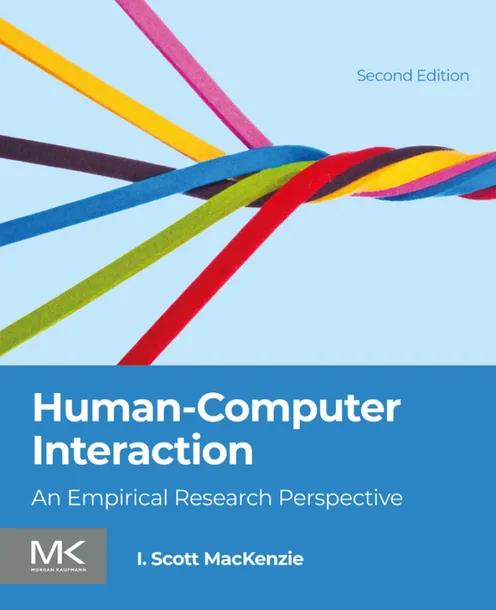
Human-Computer Interaction
An Empirical Research Perspective
by I. Scott MacKenzie
2nd Edition
Publisher: Morgan Kaufmann
Book Details
| Print ISBN | 9780443140969 |
| eText ISBN | 9780443140976 |
| Publisher | Morgan Kaufmann |
| Publishing Year | 2024 |
| Edition | 2nd Edition |
| Language | English |
| Pages | 466 |
Human-Computer Interaction: An Empirical Research Perspective, 2nd Edition, authored by I. Scott MacKenzie, serves as a reference volume dedicated to quantitative evaluation methods in human-computer interaction. The text provides structured scientific protocols for evaluating computer interfaces, interaction techniques, and interactive computing systems. It outlines empirical research practices for studying interactive technologies across scientific research contexts.
The thematic framework connects concepts, including historical context, the human factor, and interaction elements, directly to scientific research fundamentals. The work explores methodologies for empirical research in human-computer interaction, detailing practical techniques for executing user studies and designing controlled experiments across diverse computing environments.
To support active study and practical application, the reference volume integrates helpful pedagogical tools throughout its chapters. Built-in review exercises, summary checklists, key takeaway points, and real-world case studies assist readers in structuring empirical inquiries, framing investigative questions, and analyzing user interface interaction data.
Table of Contents
Chapter 1: Historical Context
- • 1.1 Introduction
- • 1.2 Vannevar Bush’s "As We May Think" (1945)
- • 1.3 Ivan Sutherland’s Sketchpad (1962)
- • 1.4 Invention of the Mouse (1963)
- • 1.5 Xerox Star (1981)
- • 1.6 Birth of HCI — 1983
- • 1.6.1 First ACM SIGCHI Conference (1983)
- • 1.6.2 "The Psychology of Human-Computer Interaction" (1983)
- • 1.6.3 Launch of the Apple Macintosh (1984, January)
- • 1.7 Growth of HCI and Graphical User Interfaces
- • 1.8 Growth of HCI Research
- • 1.9 Summary
- • 1.9.1 Other Readings
- • 1.10 Resources
Chapter 2: The Human Factor
- • 2.1 Time Scale of Human Action
- • 2.2 Human Factors
- • 2.3 Sensors
- • 2.3.1 Vision (Sight)
- • 2.3.2 Hearing (Audition)
- • 2.3.3 Touch (Tactition)
- • 2.3.4 Smell and Taste
- • 2.3.5 Other Senses
- • 2.4 The Brain
- • 2.4.1 Perception
- • 2.4.2 Cognition
- • 2.4.3 Memory
- • 2.5 Responders
- • 2.5.1 Limbs
- • 2.5.2 Voice
- • 2.5.3 Eyes
- • 2.5.4 The Brain As a Responder
- • 2.6 Language
- • 2.6.1 Redundancy in Language
- • 2.6.2 Entropy in Language
- • 2.7 Human Performance
- • 2.7.1 Reaction Time
- • 2.7.2 Visual Search
- • 2.7.3 Skilled Behaviour
- • 2.7.4 Attention
- • 2.7.5 Human Error
- • 2.7.6 Outliers
- • 2.7.7 Accidents
- • 2.8 Summary
Chapter 3: Interaction Elements
- • 3.1 Pointing and Selecting
- • 3.2 Keying – Text Input
- • 3.3 Gesture Input
- • 3.4 Hard Controls and Soft Controls
- • 3.5 Control-Display Relationship
- • 3.5.1 Spatial Relationships
- • 3.5.2 CD Gain and Transfer Function
- • 3.5.3 Latency
- • 3.5.4 Property Sensed and Order of Control
- • 3.6 Natural vs. Learned Relationships
- • 3.7 Mental Models and Metaphor
- • 3.8 Modes
- • 3.9 More About Degrees of Freedom
- • 3.10 Mobile Context
- • 3.11 Interaction Errors
Chapter 4: Scientific Foundations
- • 4.1 What is Research?
- • 4.1.1 Research Must Be Published
- • 4.1.2 Citations, References, Impact
- • 4.1.3 Research Must Be Reproducible
- • 4.1.4 Research vs. Engineering vs. Design
- • 4.1.5 The Nature of Research
- • 4.2 What is Empirical Research?
- • 4.3 Research Methods
- • 4.3.1 Observational Method
- • 4.3.2 Experimental Method
- • 4.3.3 Correlational Method
- • 4.3.4 Precision and Relevance in Experimental Methodology
- • 4.3.5 User Study vs. Usability Evaluation
- • 4.4 Observe and Measure
- • 4.4.1 Observation
- • 4.4.2 Measurement Scales
- • 4.5 Research Questions
- • 4.6 Internal Validity and External Validity
- • 4.7 Comparative Evaluations
- • 4.8 Relationships: Circumstantial and Causal
- • 4.9 Research Topics
- • 4.9.1 Ideas
- • 4.9.2 Finding a Topic
Chapter 5: Designing HCI Experiments
- • 5.1 What Methodology?
- • 5.2 Ethics Approval
- • 5.3 Experiment Design
- • 5.4 Independent Variables
- • 5.5 Dependent Variables
- • 5.6 Other Variables
- • 5.6.1 Control Variables
- • 5.6.2 Random Variables
- • 5.6.3 Confounding Variables
- • 5.7 Task and Procedure
- • 5.8 Participants
- • 5.9 Questionnaire Design
- • 5.10 Within-Subjects, Between-Subjects
- • 5.11 Order Effects, Counterbalancing, and Latin Squares
- • 5.12 Group Effects and Asymmetric Skill Transfer
- • 5.13 Longitudinal Studies
- • 5.14 Running the Experiment
- • 5.15 Summary
Chapter 6: Hypothesis Testing
- • 6.1 Utility Software: GoStats
- • 6.2 Analysis of Variance
- • 6.2.1 Why Analyse the Variance?
- • 6.2.2 More Than Two Test Conditions
- • 6.2.3 Post Hoc Comparisons
- • 6.2.4 Between-Subjects Designs
- • 6.2.5 Two-Way Analysis of Variance
- • 6.2.6 Doing an ANOVA with GoStats
- • 6.2.7 Counterbalancing and Testing for a Group Effect
- • 6.3 Chi-square Test
- • 6.4 Test For Normality
- • 6.4.1 Example 1
- • 6.4.2 Example 2
- • 6.4.3 Example 3
- • 6.5 Non-parametric Tests for Ordinal Data
- • 6.5.1 Example 1
- • 6.5.2 Example 2
- • 6.5.3 Example 3
- • 6.5.4 Example 4
- • 6.6 Discussion
- • 6.7 Parametric vs. Non-parametric Tests
- • 6.8 Conclusions
Chapter 7: Modeling Interaction
- • 7.1 Descriptive Models
- • 7.1.1 Delineating a Problem Space
- • 7.1.2 Quadrant Model of Groupware
- • 7.1.3 Key-Action Model (KAM)
- • 7.1.4 Model of Bimanual Control
- • 7.1.5 Three-State Model for Graphical Input
- • 7.2 Predictive Models
- • 7.2.1 Linear Regression Model
- • 7.2.2 Fitts’ Law
- • 7.2.3 Choice Reaction Time
- • 7.2.4 The Keystroke-Level Model
- • 7.2.5 Skill Acquisition
- • 7.2.6 More Than One Predictor
- • 7.3 A Model Continuum Model
Chapter 8: Writing and Publishing a Research Paper
- • 8.1 Conference Papers, Journal Papers
- • 8.2 Parts of a Research Paper
- • 8.2.1 Title
- • 8.2.2 Abstract
- • 8.2.3 Keywords
- • 8.2.4 Introduction
- • 8.2.5 Method
- • 8.2.6 Results and Discussion
- • 8.2.7 Conclusion
- • 8.2.8 References
- • 8.3 Preparing the Manuscript
- • 8.3.1 Formatting
- • 8.3.2 Citations and References
- • 8.3.3 Visual Aids
- • 8.3.4 Writing for Clarity
Customer Reviews
0.0
0 reviews
No reviews yet. Be the first to review this book!
Write a Review
Reviewed by GradeFocus Editorial Team
▶Research Sources (16)
- Human-Computer Interaction, 2nd Edition [Book] - O'Reilly
- Human-Computer Interaction : An Empirical Research Perspective ...
- Human-Computer Interaction: An Empirical Research Perspective
- Chapter 1: Historical context - Human-Computer Interaction, 2nd ...
- Human-computer interaction : an empirical research perspective
- Human-Computer Interaction, eBook by I. Scott MacKenzie - Booktopia
- Computer human interaction print books and ebooks - Elsevier Shop
- [PDF] Human-Computer Interaction by I. Scott MacKenzie | 9780124071650
- Human-Computer Interaction
- Human-Computer Interaction: An Empirical Research ...
- The Encyclopedia of Human-Computer Interaction, 2nd Ed.
- Human-Computer Interaction - 2nd Edition
- Human-Computer Interaction
- Books - Course guide: Human Computer Interaction
- Human-Computer Interaction: An Empirical Research ...
- HCI Literature Resources