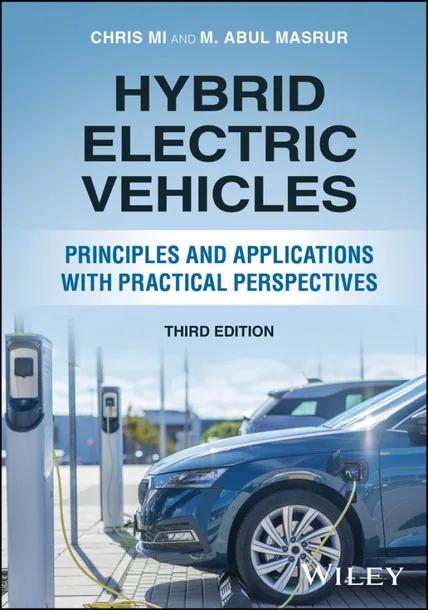
Hybrid Electric Vehicles
Principles and Applications with Practical Perspectives
by Chris Mi, M. Abul Masrur
3rd Edition
Publisher: Wiley-Blackwell
Book Details
| Print ISBN | 9781394295128 |
| eText ISBN | 9781394295135 |
| Publisher | Wiley-Blackwell |
| Publishing Year | 2026 |
| Edition | 3rd Edition |
| Language | English |
| Pages | 573 |
Hybrid Electric Vehicles: Principles and Applications with Practical Perspectives, 3rd Edition delivers a structured textbook introducing electrified transportation systems to upper-level undergraduate students, graduate students, and course instructors. Authors Chris Mi and M. Abul Masrur examine foundational engineering principles across hybrid-electric, hybrid-hydraulic, plug-in hybrid, fuel-cell, and off-road vehicular systems.
The text structures its presentation around the physical and electrical mechanisms that govern modern propulsion. This revised edition incorporates recent engineering developments, featuring expanded analytical coverage of planetary gears, synchronous reluctance motors, fast-charging battery methods, and vehicle cybersecurity across electrified platforms.
To connect academic concepts with active manufacturing standards, the authors incorporate empirical data and design specifications from commercial platforms including the Toyota Prius, Honda Civic, Ford Escape, and two-mode hybrid vehicles. This practical orientation makes the text an effective resource for dedicated university courses in vehicle electrification and electric propulsion design.
Table of Contents
Chapter 1: Introduction
- • 1.1 Sustainable Transportation
- • 1.2 A Brief History of HEVs
- • 1.3 Why EVs Emerged and Failed in the 1990s, and What We Can Learn
- • 1.4 Architectures of HEVs
- • 1.5 Interdisciplinary Nature of HEVs
- • 1.6 State of the Art of HEVs
- • 1.7 Challenges and Key Technology of HEVs
- • 1.8 The Invisible Hand–Government Support
- • 1.9 Latest Development in EV and HEV, China’s Surge in EV Sales
- • References
Chapter 2: Concept of Hybridization of the Automobile
- • 2.1 Vehicle Basics
- • 2.2 Basics of the EV
- • 2.3 Basics of the HEV
- • 2.4 Basics of PHEV
- • 2.5 Basics of FCVs
- • Reference
Chapter 3: HEV Fundamentals
- • 3.1 Introduction
- • 3.2 Vehicle Model
- • 3.3 Vehicle Performance
- • 3.4 EV Powertrain Component Sizing
- • 3.5 Series Hybrid Vehicle
- • 3.6 Parallel Hybrid Vehicle
- • 3.7 Wheel Slip Dynamics
- • References
Chapter 4: Advanced HEV Architectures and Dynamics of HEV Powertrain
- • 4.1 Principle of Planetary Gears
- • 4.2 Toyota Prius and Ford Escape Hybrid Powertrain
- • 4.3 GM Two-mode Hybrid Transmission
- • 4.4 Dual-clutch Hybrid Transmissions
- • 4.5 Hybrid Transmission Proposed by Zhang et al.
- • 4.6 Renault IVT Hybrid Transmission
- • 4.7 Timken Two-mode Hybrid Transmission
- • 4.8 Tsai’s Hybrid Transmission
- • 4.9 Hybrid Transmission with Both Speed and Torque Coupling Mechanism
- • 4.10 Toyota Highlander and Lexus Hybrid, E-four-wheel Drive
- • 4.11 CAMRY Hybrid
- • 4.12 Chevy Volt Powertrain
- • 4.13 Nonideal Gears in the Planetary System
- • 4.14 Dynamics of the Transmission
- • 4.15 Conclusions
- • References
Chapter 5: Plug-in Hybrid Electric Vehicles
- • 5.1 Introduction to PHEVs
- • 5.2 PHEV Architectures
- • 5.3 Equivalent Electric Range of Blended PHEVs
- • 5.4 Fuel Economy of PHEVs
- • 5.5 Power Management of PHEVs
- • 5.6 PHEV Design and Component Sizing
- • 5.7 Component Sizing of EREVs
- • 5.8 Component Sizing of Blended PHEVs
- • 5.9 HEV to PHEV Conversions
- • 5.10 Other Topics on PHEVs
- • 5.11 Vehicle-to-grid Technology
- • 5.12 Conclusion
- • References
Chapter 6: Special Hybrid Vehicles
- • 6.1 Hydraulic Hybrid Vehicles
- • 6.2 Off-road HEVs
- • 6.3 Diesel HEVs
- • 6.4 Electric or Hybrid Ships, Aircraft, and Locomotives
- • 6.5 Other Industrial Utility Application Vehicles
- • References
- • Further Readings
Chapter 7: HEV Applications for Military Vehicles
- • 7.1 Why HEVs Can Be Beneficial for Military Applications
- • 7.2 Ground Vehicle Applications
- • 7.3 Nonground-vehicle Military Applications
- • 7.4 Ruggedness Issues
- • References
- • Further Readings
Chapter 8: Diagnostics, Prognostics, Reliability, EMC, and Other Topics Related to HEVs
- • 8.1 Diagnostics and Prognostics in HEVs and EVs
- • 8.2 Reliability of HEVs
- • 8.3 EMC Issues
- • 8.4 NVH, Electromechanical, and Other Issues
- • 8.5 End-of-life Issues
- • References
- • Further Readings
Chapter 9: Power Electronics in HEVs
- • 9.1 Introduction
- • 9.2 Principles of Power Electronics
- • 9.3 Rectifiers Used in HEVs
- • 9.4 Buck Converter Used in HEVs
- • 9.5 Nonisolated Bidirectional DC–DC Converter
- • 9.6 Voltage Source Inverter
- • 9.7 Current Source Inverter
- • 9.8 Isolated Bidirectional DC–DC Converter
- • 9.9 PWM Rectifier in HEVs
- • 9.10 EV and PHEV Battery Chargers
- • 9.11 Modeling and Simulation of HEV Power Electronics
- • 9.12 Emerging Power Electronic Devices
- • 9.13 Circuit Packaging
- • 9.14 Thermal Management of HEV Power Electronics
- • 9.15 Conclusions
- • References
Chapter 10: Electric Machines and Drives in HEVs
- • 10.1 Introduction
- • 10.2 Induction Motor Drives
- • 10.3 PM Motor Drives
- • 10.4 Switched Reluctance Motors
- • 10.5 Doubly Salient Permanent Magnet Machines
- • 10.6 Design and Sizing of Traction Motors
- • 10.7 Thermal Analysis and Modeling of Traction Motors
- • 10.8 Conclusions
- • References
Chapter 11: Electric Energy Sources and Storage Devices
- • 11.1 Introduction
- • 11.2 Characterization of Batteries
- • 11.3 Comparison of Energy Storage Technologies
- • 11.4 Ultracapacitors
- • 11.5 Electric Circuit Model for Batteries and Ultracapacitors
- • 11.6 Flywheel ESS
- • 11.7 Fuel Cell-based Hybrid Vehicular Systems
- • 11.8 Summary and Discussion
- • References
- • Further Reading
Chapter 12: Battery Modeling
- • 12.1 Introduction
- • 12.2 Modeling of Nickel Metal Hydride (NiMH) Battery
- • 12.3 Modeling of Lithium-Ion (Li-Ion) Battery
- • 12.4 Parameter Estimation for Battery Models
- • 12.5 Example Case of Using Battery Model in an EV System
- • 12.6 Summary and Observations on Modeling and Simulation for Batteries
- • References
- • Further Readings
Chapter 13: EV and PHEV Battery Charger Design
- • 13.1 Introduction
- • 13.2 Main Features of the LLC Resonant Charger
- • 13.3 Design Considerations for an LLC Converter for a PHEV Battery Charger
- • 13.4 Charging Trajectory Design
- • 13.5 Design Procedures
- • 13.6 Experimental Results
- • 13.7 Fast Charging of Electric Vehicles
- • 13.8 Conclusions
- • References
Chapter 14: Modeling and Simulation of Electric and Hybrid Vehicles
- • 14.1 Introduction
- • 14.2 Fundamentals of Vehicle System Modeling
- • 14.3 HEV Modeling Using ADVISOR
- • 14.4 HEV Modeling Using PSAT
- • 14.5 Physics-based Modeling
- • 14.6 Bond Graph and Other Modeling Techniques
- • 14.7 Consideration of Numerical Integration Methods
- • 14.8 Conclusion
- • References
Chapter 15: HEV Component Sizing and Design Optimization
- • 15.1 Introduction
- • 15.2 Global Optimization Algorithms for HEV Design
- • 15.3 Model-in-the-loop Design Optimization Process
- • 15.4 Parallel HEV Design Optimization Example
- • 15.5 Series HEV Design Optimization Example
- • 15.6 Conclusion
- • References
Chapter 16: Wireless Power Transfer for Electric Vehicle Applications
- • 16.1 Introduction
- • 16.2 Fundamental Theory
- • 16.3 Magnetic Coupler Design
- • 16.4 Compensation Network
- • 16.5 Power Electronics Converters and Power Control
- • 16.6 Methods of Study
- • 16.7 Additional Discussion
- • 16.8 A Double-sided LCC Compensation Topology and its Parameter Design
- • 16.9 An LCLC-based Wireless Charger Using Capacitive Power Transfer Principle
- • 16.10 Summary
- • References
Chapter 17: Vehicular Power Control Strategy and Energy Management
- • 17.1 A Generic Framework, Definition, and Needs
- • 17.2 Methodology to Implement
- • 17.3 Benefits of Energy Management
- • References
- • Further Reading
Chapter 18: Commercialization and Standardization of HEV Technology and Future Transportation
- • 18.1 What Is Commercialization and Why Is It Important for HEVs?
- • 18.2 Advantages, Disadvantages, and Enablers of Commercialization
- • 18.3 Standardization and Commercialization
- • 18.4 Commercialization Issues and Effects on Various Types of Vehicles
- • 18.5 Commercialization of HEVs for Trucks and Off-road Applications
- • 18.6 Commercialization and Future of HEVs and Transportation
- • Further Readings
Chapter 19: A Holistic Perspective on Vehicle Electrification
- • 19.1 Vehicle Electrification – What Does it Involve?
- • 19.2 To What Extent Should Vehicles Be Electrified?
- • 19.3 What Other Industries Are Involved or Affected in Vehicle Electrification?
- • 19.4 Latest Technologies and Their Impact on Vehicular Electrification
- • 19.5 A More Complete Picture Toward Vehicle Electrification
- • 19.6 The Ultimate Issue: To Electrify Vehicles or Not?
- • Further Readings
Customer Reviews
0.0
0 reviews
No reviews yet. Be the first to review this book!
Write a Review
Reviewed by GradeFocus Editorial Team
▶Research Sources (13)
- Hybrid Electric Vehicles, eBook by Chris Mi
- Hybrid electric vehicles : - Sadie Hartzler Library Catalog
- Hybrid Electric Vehicles - Chris Mi, M. Abul Masrur - e-bok ...
- Details zu: Hybrid electric vehicles : principles and applications ...
- Captcha - Erie2 BOCES | Erie BOCES
- Hybrid electric vehicles : principles and applications with ...
- Thompson Learn.
- Professor Leah Litman shares 3 Books (ahem, 4) that she's ...
- [PDF] Hybrid Electric Vehicles by Chris Mi, 3rd edition - Perlego
- Hybrid Electric Vehicles - Principles and Applications with Practical ...
- HYBRID ELECTRIC VEHICLES PRINCIPLES AND APPLICATIONS ...
- (PDF) Hybrid and Electric Vehicles - A Comprehensive Guide
- Hybrid, Electric and Fuel-Cell Vehicles, 3rd Edition - 9781305952577