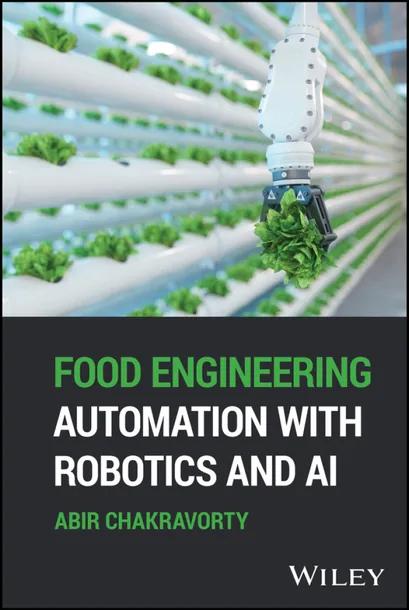
Food Engineering Automation with Robotics and AI
by Abir Chakravorty
1st Edition
Publisher: Wiley-Blackwell
Book Details
| Print ISBN | 9781394316564 |
| eText ISBN | 9781394316571 |
| Publisher | Wiley-Blackwell |
| Publishing Year | 2025 |
| Edition | 1st Edition |
| Language | English |
| Pages | 496 |
Authored by Abir Chakravorty, Food Engineering Automation with Robotics and AI, 1st Edition, is a textbook providing a comprehensive introduction to artificial intelligence and robotic applications in food manufacturing. The content pairs foundational food engineering principles with system automation techniques implemented across industrial production stages.
Specific subject coverage addresses automated control systems for food chilling, freezing, cold storage, and refrigerated transport operations. Additional chapters examine smart sensors, Internet of Things integration, machine learning models for food safety and quality prediction, and computer vision technologies designed for automated sorting and grading of agricultural produce such as fruits and vegetables.
Featuring real-world case studies, the textbook aligns its material with United Nations Sustainable Development Goals targeting Zero Hunger, Responsible Consumption and Production, and Industry, Innovation, and Infrastructure. The text supports study and reference for university students, academic researchers, and industry professionals in food engineering, robotics, and computer science.
Table of Contents
Chapter 1: Robotics and Automation in Food Processing, Developments Prompted by the Present Era Industrial Revolution
- • 1.1 Abridgement of the Existing Obstacles and Opportunities Presented by the Present Era Industrial Revolution in the Food Processing Sector
- • 1.2 Adoption of Technology in Food Processing and Key Industry Technologies
- • 1.3 Definition of Robot and Its Various Classification
- • 1.4 Use of Robotics in Food Processing
- • 1.5 Use of Smart Sensors in Food Processing
- • 1.6 Applications of AI in Food Processing
- • 1.7 Homogeneous Transformation Matrices
- • 1.8 Denavit–Hartenberg Parameters
- • 1.9 Degrees of Freedom
- • 1.10 Applications of IoT in Food Processing
- • 1.11 Prediction Models in Measuring Color and Food Quality
- • 1.12 AI/ ML Prediction Modeling in Food Processing and Food Safety
- • 1.13 AI/ ML Prediction Modeling in Food Processing and Food Safety
- • 1.14 Case Studies
- • 1.15 Review Questions
Chapter 2: Automation in Food Processing Applications
- • 2.1 Automatic Control of Food Chilling and Freezing
- • 2.2 Introduction: Main Forces Behind and Obstacles to Automated Food Freezing and Chilling Control
- • 2.3 Challenges to Automation in Food Chilling and Freezing Include
- • 2.4 Automation in Refrigerated Food Retail Display
- • 2.5 Automation of Refrigeration and Freezing Operations in Food Catering
- • 2.6 Automation in Refrigerated Food Transport Systems
- • 2.7 Automation in Food Chilling and Freezing Systems
- • 2.8 Automation in Food Cold Storage Systems
- • 2.9 Advances in Research and Future Trends
- • 2.10 Case Study
- • 2.11 Review Questions
Chapter 3: Robot Types and Their Classification
- • 3.1 Categories of Robots
- • 3.2 Design of IoT-based Pick-and-place Robot
- • 3.3 Direct Kinematics
- • 3.4 Inverse Kinematics
- • 3.5 Inverse Kinematics of a T hree-degrees-of-freedom Spatial Manipulator with a Unique Geometry
- • 3.6 Splines in Robotics
- • 3.7 Automation and Its Types
- • 3.8 Basic Image Processing Techniques
- • 3.9 Robot Kinematics
- • 3.10 AI/ML Basics for Food Processing
- • 3.11 Mapping, Navigation, and Obstacle Avoidance
- • 3.12 Fuzzy Logic Control Case Study in Food Processing
- • 3.13 Dijkstra's Algorithm for a Grid Map
- • 3.14 Path Planning with the A* Algorithm
- • 3.15 Path Following and Obstacle Avoidance
- • 3.16 Fuzzy Logic Control
- • 3.17 Robotic Motion and Odometry
- • 3.18 Gripper: Its Various Types and Applications
- • 3.19 Robotics and Automation for Packaging and Handling
- • 3.20 Review Questions
Chapter 4: AI/ML and Robotics Applications in Food Safety, Quality, and Challenges
- • 4.1 Food Safety and Quality Detection Using Robotics and AI/ML
- • 4.2 Automation of Fruit and Vegetable Sorting, Grading
- • 4.3 Prediction Models in Measuring Color and Food Quality
- • 4.4 Data Management and Its Importance
- • 4.5 Ethics and Safety
- • 4.6 Adoption of Automation in Food Process Engineering
- • 4.7 Automation, Economic Return, Food Manufacturing Sector, Increased Safety Assurance, and Quality of Products
- • 4.8 AI, Robotics, and Automation for UN Sustainable Development Goals
- • 4.9 AI in Food Supply Chain, Tracing/ Warehouse/ Distribution
- • 4.10 Data Analysis, Discrete and Continuous Data on Classification and Regression
- • 4.11 Case Studies
- • 4.12 Review Questions
Chapter 5: Application of Robotics in Processing Meat, Fish, and Poultry
- • 5.1 Introduction
- • 5.2 Application of Robotics in Processing Meat, Fish, and Poultry
- • 5.3 Robotic Manipulator in Food Processing
- • 5.4 End Effectors in Food Industry
- • 5.5 Robotic and Vision Systems in Use for Fish Processing
- • 5.6 Review Questions
Chapter 6: Principles of Fuzzy PID and Its Algorithm
- • 6.1 Fresh Food Atmosphere Packaging Gas Distribution System Utilizing Fuzzy PID Control
- • 6.2 A Fuzzy-PID Controller for Temperature Control in a Shell and Tube Heat Exchanger Simulation
- • 6.3 An Introduction to Automated Process Control in the Food Sector Using Supervisory Control and Data Acquisition and Associated Systems
- • 6.4 Introduction to SCADA
- • 6.5 SCADA and Its History
- • 6.6 SCADA Standards and Applications
- • 6.7 SCADA in Food Processing
- • 6.8 Laboratory Study: Implementation of SCADA
- • 6.9 Future Trends in SCADA
- • 6.10 Review Questions
Chapter 7: Robots, Ladder Elements, Logic Gates, 3D Food Printing, SCADA, Automation Pyramid in Food Processing
- • 7.1 3D Printing Technology: The New Era for Food Customization and Elaboration
- • 7.2 Environmentally Friendly and Sustainable Technology
- • 7.3 Autonomous Mobile Robots
- • 7.4 Review Questions
Chapter 8: PID Control Techniques in Food Processing
- • 8.1 Process Control Methods in the Food Industry
- • 8.2 Industrial PID Control
- • 8.3 Variations of PID Controller Algorithms
- • 8.4 Three-term Control, or Proportional, Integral, or Derivative Control
- • 8.5 Parallel PID Controllers in Food Processing
- • 8.6 Review Questions
Chapter 9: Online Spectroscopy Techniques to Access Food Quality and Safety, SCADA and HMI Examples
- • 9.1 AI/ML Techniques for Food Safety Case Studies
- • 9.2 Sensors for Automated Food Process Control
- • 9.3 Review Questions
Chapter 10: Case Studies
- • 10.1 Modeling Simulation and Practical Application of Robotics in Food Manufacturing Different Simulation Scenario
- • 10.2 Robotic Cooking
- • 10.3 Robotic Arm Control and Task Training Through Deep Reinforcement Learning
- • 10.4 Sensors for Automated Food Process Control
- • 10.5 Indirect Teaching of the Robot Hand
- • 10.6 Tuning Humanoid Walking Parameters for Food Service Robots for Better Performance
- • 10.7 Sensorized Compliant Robot Gripper for Estimating the Cooking Time of Boil-cooked Vegetables
- • 10.8 Multiple Object Detection and Segmentation for Automated Removal in Additive Manufacturing with Service Robots
- • 10.9 Miscellaneous Case Studies
- • 10.10 Review Questions
Customer Reviews
0.0
0 reviews
No reviews yet. Be the first to review this book!
Write a Review
Reviewed by GradeFocus Editorial Team
▶Research Sources (14)
- Food Engineering Automation with Robotics and AI
- Food Engineering Automation with Robotics and AI
- Captcha - Erie2 BOCES | Erie BOCES
- PaperPie
- https://lernerbooks.com/products/search_results?se...
- Sourcebooks, LLC.
- Thompson Learn.
- Sign In
- Food Engineering Automation with Robotics and AI
- Automating Food Production with AI-Enabled Robots
- Food Engineering Automation with Robotics and AI
- Robotics and Automation in the Food Industry - 1st Edition
- Dexai
- Books under the series of Automation, Control and Robotics