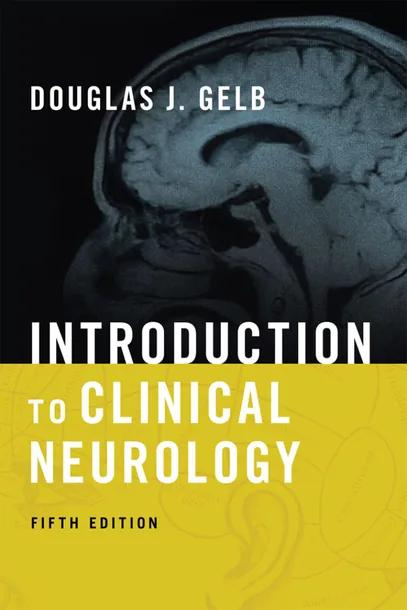
Introduction to Clinical Neurology
by Douglas J. Gelb, MD
5th Edition
Publisher: Oxford University Press
Book Details
| Print ISBN | 9780190467197 |
| eText ISBN | 9780190467210 |
| Publisher | Oxford University Press |
| Publishing Year | 2016 |
| Edition | 5th Edition |
| Language | English |
| Pages | 544 |
Introduction to Clinical Neurology, 5th Edition, provides a systematic and practical framework for diagnosing and managing common neurologic conditions. The textbook focuses on the clinical rationale behind practice, explaining why patients receive specific management strategies.
Coverage outlines the clinical examination and lesion localization alongside diverse clinical presentations, including movement disorders, sleep disorders, and acute mental status changes. The volume also addresses common clinical complaints such as dizziness, disequilibrium, visual symptoms, and back and neck pain.
Designed for clinicians assessing patients in general medical practice, this edition incorporates practice cases and highlights key take-home points reflecting medical discoveries up to its 2016 publication.
Table of Contents
Chapter 1: Where's the Lesion?
- • I. Sample Localization Problems
- • II. The Game
- • III. The Rules
- • IV. The Play: The Long Version
- • V. The Play: The Abbreviated Version
- • VI. Rules for Speed Play
Chapter 2: The Neurologic Examination
- • I. More Localization Problems
- • II. General Comments on the Neurologic Examination
- • III. How to Do the Neurologic Examination
- • IV. Additional Comments on Terminology and Examination Technique
- • V. Interpretation of the Neurologic Examination
- • VI. Modi?cations of the Neurologic Examination
- • VII. Discussion of Localization Problems
Chapter 3: What's the Lesion?
- • I. Case History
- • II. Beyond Localization
- • III. Etiology
- • IV. Discussion of Case Histories
Chapter 4: Stroke
- • I. Case Histories
- • II. Approach to Stroke
- • III. Background Information
- • IV. Diagnosis
- • V. Management of Acute Stroke
- • VI. Primary Prevention
- • VII. Secondary Prevention of Ischemic Stroke
- • VIII. Secondary Prevention of Cerebral Hemorrhage
- • IX. Discussion of Case Histories
Chapter 5: Seizures
- • I. Case Histories
- • II. Approach to Seizures
- • III. Background Information
- • IV. Diagnosis
- • V. Determining the Cause of Seizures
- • VI. Management of Seizures and Epilepsy
- • VII. Special Clinical Problems
- • VIII. Discussion of Case Histories
Chapter 6: Neuromuscular Disorders
- • I. Case Histories
- • II. Approach to Neuromuscular Diseases
- • III. Background Information
- • IV. Speci?c Neuromuscular Diseases
- • V. Symptomatic Treatment
- • VI. Discussion of Case Histories
Chapter 7: Dementing Illnesses
- • I. Case Histories
- • II. Approach to Dementing Illnesses
- • III. Primary Dementing Illnesses
- • IV. Discussion of Case Histories
Chapter 8: Movement Disorders
- • I. Case Histories
- • II. Approach to Movement Disorders
- • III. Background Information
- • IV. Speci?c Movement Disorders
- • V. Discussion of Case Histories
Chapter 9: Sleep Disorders
- • I. Case Histories
- • II. Approach to Sleep Disorders
- • III. Background Information
- • IV. Trouble Staying Awake
- • V. Trouble Sleeping
- • VI. Abnormal Behavior During Sleep
- • VII. Discussion of Case Histories
Chapter 10: Multifocal Central Nervous System Disorders
- • I. Case Histories
- • II. Approach to Multifocal Disorders
- • III. Focal Diseases with Multifocal Propagation
- • IV. Inherently Multifocal Diseases
- • V. Discussion of Case Histories
Chapter 11: Acute Mental Status Changes
- • I. Case Histories
- • II. Background Information
- • III. Approach to Acute Changes in Level of Consciousness
- • IV. Special Circumstances
- • V. Discussion of Case Histories
Chapter 12: Headache
- • I. Case Histories
- • II. Approach to Headache
- • III. Background Information
- • IV. Headache Emergencies: Subarachnoid Hemorrhage and Bacterial Meningitis
- • V. Other Secondary Headaches
- • VI. Primary Headaches
- • VII. Discussion of Case Histories
Chapter 13: Visual Symptoms
- • I. Case Histories
- • II. Background Information
- • III. Approach to Visual Symptoms
- • IV. Monocular Vision Loss
- • V. Transient Vision Loss (Monocular or Binocular)
- • VI. Persistent Binocular Vision Loss
- • VII. Diplopia
- • VIII. Discussion of Case Histories
Chapter 14: Dizziness and Disequilibrium
- • I. Case Histories
- • II. Approach to Dizziness
- • III. Localization
- • IV. Differential Diagnosis
- • V. Disequilibrium
- • VI. Discussion of Case Histories
Chapter 15: Back Pain and Neck Pain
- • I. Case Histories
- • II. Approach to Back or Neck Pain
- • III. Speci?c Conditions Causing Back or Neck Pain
- • IV. Discussion of Case Histories
Chapter 16: Incontinence
- • I. Case Histories
- • II. Background Information
- • III. Approach to Incontinence
- • IV. Discussion of Case Histories
Chapter 17: Pediatric Neurology
- • I. Case Histories
- • II. Developmental Considerations
- • III. Hypotonic Infants
- • IV. Developmental Delay and Developmental Regression
- • V. Paroxysmal Symptoms
- • VI. Gait Disturbance
- • VII. Discussion of Case Histories
Chapter 18: Geriatric Neurology
- • I. Case Histories
- • II. Geriatric Issues
- • III. The Neurologic Examination in Normal Aging
- • IV. Common Neurologic Symptoms in the Elderly
- • V. Discussion of Case Histories
Chapter 19: Practice Cases
- • I. Case Histories
- • II. Answers
Customer Reviews
0.0
0 reviews
No reviews yet. Be the first to review this book!
Write a Review
Reviewed by GradeFocus Editorial Team