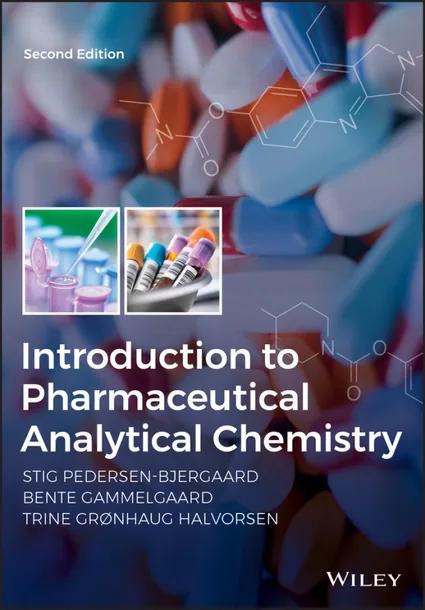
Introduction to Pharmaceutical Analytical Chemistry
by Stig Pedersen-Bjergaard, Bente Gammelgaard, Trine G. Halvorsen
2nd Edition
Publisher: Wiley-Blackwell
Book Details
| Print ISBN | 9781119362722 |
| eText ISBN | 9781119362753 |
| Publisher | Wiley-Blackwell |
| Publishing Year | 2019 |
| Edition | 2nd Edition |
| Language | English |
Introduction to Pharmaceutical Analytical Chemistry, 2nd Edition, is an undergraduate textbook exploring the core principles and methodologies of chemical analysis across the pharmaceutical sciences. It examines the characterization of raw drug substances, finished medicinal products, and active compounds in biological fluids.
The text introduces foundational qualitative and quantitative methodologies, emphasizing practical laboratory techniques such as sample preparation and separation procedures. It also incorporates essential statistical tools alongside regulatory standards established by the European Pharmacopoeia and the United States Pharmacopeia.
Supplied with practice problems and modern applied examples, this volume provides structured study support for students in chemical and pharmaceutical disciplines as well as analytical chemists entering the pharmaceutical sector.
Table of Contents
Chapter 1: Introduction to Pharmaceutical Analytical Chemistry
- • 1.1 Introduction
- • 1.2 Pharmaceutical Analytical Chemistry
- • 1.3 This Textbook
Chapter 2: Marketing Authorizations, Pharmaceutical Manufacturing, and International Pharmacopoeias
- • 2.1 Introduction
- • 2.2 Marketing Authorization and Industrial Production
- • 2.3 Pharmacopoeias
- • 2.4 Life Time of Pharmaceutical Preparations and Ingredients
Chapter 3: Fundamentals of Bases, Acids, Solubility, Polarity, Partition, and Stereochemistry
- • 3.1 Acids, Bases, pH, and pKa
- • 3.2 Buffers
- • 3.3 Acid and Base Properties of Drug Substances
- • 3.4 Distribution Between Phases
- • 3.5 Stereoisomers
- • 3.6 Active Pharmaceutical Ingredients – A Few Examples
- • 3.7 Stability of Drug Substances
Chapter 4: Fundamentals of Pharmaceutical Analytical Chemistry
- • 4.1 Pharmaceutical Analytical Chemistry
- • 4.2 How to Specify Quantities, Concentrations, and Compositions of Mixtures
- • 4.3 Laboratory Equipment
- • 4.4 How to Make Solutions and Dilutions
- • 4.5 Errors, Accuracy, and Precision
- • 4.6 Statistical Tests
- • 4.7 Linear Regression Analysis
- • 4.8 How to Present an Analytical Result
- • 4.9 Additional Words and Terms
Chapter 5: Titration
- • 5.1 Introduction
- • 5.2 Potentiometric Titration and Electrodes
- • 5.3 Aqueous Acid–Base Titrations
- • 5.4 Titration in Non-aqueous Solvents
- • 5.5 Redox Titrations
- • 5.6 Alternative Principles of Titration
Chapter 6: Introduction to Spectroscopic Methods
- • 6.1 Electromagnetic Radiation
- • 6.2 Molecules and Absorption of Electromagnetic Radiation
- • 6.3 Absorbing Structures – Chromophores
- • 6.4 Fluorescence
- • 6.5 Atoms and Electromagnetic Radiation
Chapter 7: UV-Vis Spectrophotometry
- • 7.1 Areas of Use
- • 7.2 Quantitation
- • 7.3 Absorbance Dependence on Measurement Conditions
- • 7.4 Identification
- • 7.5 Instrumentation
- • 7.6 Practical Work and Method Development
- • 7.7 Test of Spectrophotometers
- • 7.8 Fluorimetry
Chapter 8: IR Spectrophotometry
- • 8.1 IR Spectrophotometry
- • 8.2 Instrumentation
- • 8.3 Recording by Transmission, Diffuse Reflectance, and Attenuated Total Reflection
- • 8.4 Instrument Calibration
- • 8.5 NIR Spectrophotometry
Chapter 9: Atomic Spectrometry
- • 9.1 Applications of Atomic Spectrometry
- • 9.2 Atomic Absorption Spectrometry (AAS)
- • 9.3 AAS Instrumentation
- • 9.4 AAS Practical Work and Method Development
- • 9.5 Atomic Emission Spectrometry (AES)
- • 9.6 Flame Photometry
- • 9.7 Inductively Coupled Plasma Emission Spectrometry
- • 9.8 Inductively Coupled Plasma Mass Spectrometry
Chapter 10: Introduction to Chromatography
- • 10.1 Introduction
- • 10.2 General Principles
- • 10.3 Retention
- • 10.4 Efficiency
- • 10.5 Selectivity
- • 10.6 Resolution
- • 10.7 Peak Symmetry
- • 10.8 The Dynamics of Chromatography
Chapter 11: Separation Principles in Liquid Chromatography
- • 11.1 Introduction
- • 11.2 Reversed-Phase Chromatography
- • 11.3 Ion-Pair Chromatography
- • 11.4 Normal-Phase Chromatography
- • 11.5 Thin-Layer Chromatography
- • 11.6 Hydrophilic Interaction Chromatography
- • 11.7 Ion Exchange Chromatography
- • 11.8 Size Exclusion Chromatography
- • 11.9 Chiral Separations
- • 11.10 Supercritical Fluid Chromatography
Chapter 12: High Performance Liquid Chromatography
- • 12.1 Introduction
- • 12.2 The Column
- • 12.3 Scaling Between Columns
- • 12.4 Pumps
- • 12.5 Injectors
- • 12.6 Detectors
- • 12.7 Mobile Phases
- • 12.8 Solvents for Sample Preparation
Chapter 13: Gas Chromatography
- • 13.1 Introduction
- • 13.2 Basic Principle
- • 13.3 Instrumentation
- • 13.4 Carrier Gas
- • 13.5 Stationary Phases
- • 13.6 Retention
- • 13.7 Columns
- • 13.8 Injection
- • 13.9 Detectors
- • 13.10 Derivatization
Chapter 14: Electrophoretic Methods
- • 14.1 Introduction
- • 14.2 Principle and Theory
- • 14.3 Gel Electrophoresis
- • 14.4 SDS-PAGE
- • 14.5 Western Blotting
- • 14.6 Isoelectric Focusing
- • 14.7 Capillary Electrophoresis
Chapter 15: Mass Spectrometry
- • 15.1 Introduction
- • 15.2 Basic Theory of Mass Spectrometry
- • 15.3 Ionization
- • 15.4 The Mass Spectrometer as a Chromatographic Detector – Data Acquisition
- • 15.5 Quantitation by MS
- • 15.6 Identification by MS
- • 15.7 Instrumentation
Chapter 16: Sample Preparation
- • 16.1 When is Sample Preparation Required?
- • 16.2 Main Strategies
- • 16.3 Recovery and Enrichment
- • 16.4 Liquid–Liquid Extraction
- • 16.5 Solid–Liquid Extraction
- • 16.6 Solid Phase Extraction
Chapter 17: Quality of Analytical Data and Validation
- • 17.1 Instrumental Signals
- • 17.2 Calibration Methods
- • 17.3 Analytical Procedures
- • 17.4 Validation
- • 17.5 System Suitability
Chapter 18: Chemical Analysis of Pharmaceutical Ingredients
- • 18.1 Pharmaceutical Ingredients, Production, and Control
- • 18.2 Pharmacopoeia Monographs
- • 18.3 Impurities in Pharmaceutical Ingredients
- • 18.4 Identification of Pharmaceutical Ingredients
- • 18.5 Impurity Testing of Pharmaceutical Ingredients (Pure Chemical Ingredients)
- • 18.6 Identification and Impurity Testing of Organic Multi-Chemical Ingredients
- • 18.7 Assay of Pharmaceutical Ingredients
- • 18.8 Chemical Analysis of Pharmaceutical Ingredients Not Included in Pharmacopoeias
Chapter 19: Chemical Analysis of Pharmaceutical Preparations
- • 19.1 Chemical Analysis of Pharmaceutical Preparations
- • 19.2 Monographs and Chemical Analysis
- • 19.3 Identification of the API
- • 19.4 Assay of the Active Pharmaceutical Ingredient
- • 19.5 Chemical Tests for Pharmaceutical Preparations
Chapter 20: Bioanalysis Chemical Analysis of Pharmaceuticals in Biological Fluids
- • 20.1 Bioanalysis
- • 20.2 Biological Fluids
- • 20.3 Bioanalytical Methods – An Overview
- • 20.4 Sampling
- • 20.5 Sample Preparation
- • 20.6 Separation and Detection
- • 20.7 Quantitation
- • 20.8 Screening
Chapter 21: Chemical Analysis of Biopharmaceuticals
- • 21.1 Biopharmaceuticals
- • 21.2 Biopharmaceuticals versus Small Molecule APIs
- • 21.3 Biopharmaceuticals and Pharmacopoeias
- • 21.4 Production of Biopharmaceuticals
- • 21.5 Identification Procedures for Biopharmaceuticals (Active Substance)
- • 21.6 Impurity Tests for Biopharmaceuticals (Active Substances)
- • 21.7 Assay of Biopharmaceuticals (Active Substance)
- • 21.8 Monoclonal Antibodies
- • 21.9 Analysis of Biopharmaceutical Products
- • 21.10 Bioanalysis of Biopharmaceuticals Using LC-MS/MS
Customer Reviews
0.0
0 reviews
No reviews yet. Be the first to review this book!
Write a Review
Reviewed by GradeFocus Editorial Team
Related Books
Advances in Tablet Manufacturing Technologies
Honey Goel
Protein-Based Nanoparticles in Drug Delivery
Prashant Kesharwani
Method Validation in Pharmaceutical Analysis
Joachim Ermer
Lipids in Pulmonary Drug Delivery
Md Faiyazuddin
Bioactive-Based Nanotherapeutics
Rakesh K. Sindhu
Natural Biopolymers for Drug Delivery
Amit Kumar Nayak