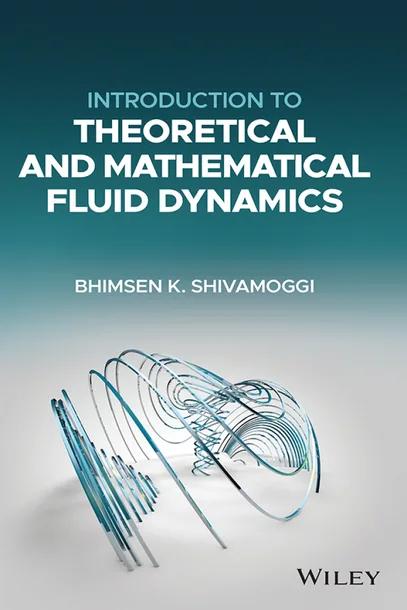
Introduction to Theoretical and Mathematical Fluid Dynamics
by Bhimsen K. Shivamoggi
Publisher: Wiley-Blackwell
Book Details
| Print ISBN | 9781119101505 |
| eText ISBN | 9781119101529 |
| Publisher | Wiley-Blackwell |
| Publishing Year | 2022 |
| Language | English |
| Pages | 576 |
Introduction to Theoretical and Mathematical Fluid Dynamics is a graduate-level textbook that presents fluid behavior through a rigorous mathematical perspective. The volume examines theoretical principles alongside disciplinary advances spanning the fifteen years prior to its 2022 publication.
The textbook addresses fundamental fluid models, governing flow equations, surface tension effects, and the dynamics of incompressible and compressible fluid flows. It also investigates viscous fluid dynamics, analyzing phenomena such as shear layers, jet flows, and wake flows.
Designed for graduate students in mathematics, engineering, or physics, the work also serves practicing applied mathematicians, engineers, and physicists. Real-world examples, practical applications, and exercises are integrated throughout the text to illustrate theoretical concepts.
Table of Contents
Part I: Basic Concepts and Equations of Fluid Dynamics
Chapter 1: Introduction to the Fluid Model
- • 1.1 The Fluid State
- • 1.2 Description of the Flow-Field
- • 1.3 Volume Forces and Surface Forces
- • 1.4 Relative Motion Near a Point
- • 1.5 Stress–Strain Relations
Chapter 2: Equations of Fluid Flows
- • 2.1 The Transport Theorem
- • 2.2 The Material Derivative
- • 2.3 The Law of Conservation of Mass
- • 2.4 Equation of Motion
- • 2.5 The Energy Equation
- • 2.6 The Equation of Vorticity
- • 2.7 The Incompressible Fluid
- • 2.8 Boundary Conditions
- • 2.9 A Program for Analysis of the Governing Equations
Chapter 3: Hamiltonian Formulation of Fluid-Flow Problems
- • 3.1 Hamiltonian Dynamics of Continuous Systems
- • 3.2 Three-Dimensional Incompressible Flows
- • 3.3 Two-Dimensional Incompressible Flows
Chapter 4: Surface Tension Effects
- • 4.1 Shape of the Interface between Two Fluids
- • 4.2 Capillary Rises in Liquids
Part II: Dynamics of Incompressible Fluid Flows
Chapter 5: Fluid Kinematics and Dynamics
- • 5.1 Stream Function
- • 5.2 Equations of Motion
- • 5.3 Integrals of Motion
- • 5.4 Capillary Waves on a Spherical Drop
- • 5.5 Cavitation
- • 5.6 Rates of Change of Material Integrals
- • 5.7 The Kelvin Circulation Theorem
- • 5.8 The Irrotational Flow
- • 5.9 Simple-Flow Patterns
- • (i) The Source Flow
- • (ii) The Doublet Flow
- • (iii) The Vortex Flow
- • (iv) Doublet in a Uniform Stream
- • (v) Uniform Flow Past a Circular Cylinder with Circulation
Chapter 6: The Complex-Variable Method
- • 6.1 The Complex Potential
- • 6.2 Conformal Mapping of Flows
- • 6.3 Hydrodynamic Images
- • 6.4 Principles of Free-Streamline Flow
- • (i) Schwarz-Christoffel Transformation
- • (ii) Hodograph Method
Chapter 7: Three-Dimensional Irrotational Flows
- • 7.1 Special Singular Solutions
- • (i) The Source Flow
- • (ii) The Doublet Flow
- • 7.2 d’Alembert’s Paradox
- • 7.3 Image of a Source in a Sphere
- • 7.4 Flow Past an Arbitrary Body
- • 7.5 Unsteady Flows
- • 7.6 Renormalized (or Added) Mass of Bodies Moving through a Fluid
Chapter 8: Vortex Flows
- • 8.1 Vortex Tubes
- • 8.2 Induced Velocity Field
- • 8.3 Biot-Savart’s Law
- • 8.4 von Kármán Vortex Street
- • 8.5 Vortex Ring
- • 8.6 Hill’s Spherical Vortex
- • 8.7 Vortex Sheet
- • 8.8 Vortex Breakdown: Brooke Benjamin’s Theory
Chapter 9: Rotating Flows
- • 9.1 Governing Equations and Elementary Results
- • 9.2 Taylor-Proudman Theorem
- • 9.3 Propagation of Inertial Waves in a Rotating Fluid
- • 9.4 Plane Inertial Waves
- • 9.5 Forced Wavemotion in a Rotating Fluid
- • (i) The Elliptic Case
- • (ii) The Hyperbolic Case
- • 9.6 Slow Motion along the Axis of Rotation
- • 9.7 Rossby Waves
Chapter 10: Water Waves
- • 10.1 Governing Equations
- • 10.2 A Variational Principle for Surface Waves
- • 10.3 Water Waves in a Semi-Infinite Fluid
- • 10.4 Water Waves in a Fluid Layer of Finite Depth
- • 10.5 Shallow-Water Waves
- • (i) Analogy with Gas Dynamics
- • (ii) Breaking of Waves
- • 10.6 Water Waves Generated by an Initial Displacement over a Localized Region
- • 10.7 Waves on a Steady Stream
- • (i) One-Dimensional Gravity Waves
- • (ii) One-Dimensional Capillary-Gravity Waves
- • (iii) Ship Waves
- • 10.8 Gravity Waves in a Rotating Fluid
- • 10.9 Theory of Tides
- • 10.10 Hydraulic Jump
- • (i) Tidal Bores
- • (ii) The Dam-Break Problem
- • 10.11 Nonlinear Shallow-Water Waves
- • (i) Solitary Waves
- • (ii) Periodic Cnoidal Waves
- • (iii) Interacting Solitary Waves
- • (iv) Stokes Waves
- • (v) Modulational Instability and Envelope Solutions
- • 10.12 Nonlinear Capillary-Gravity Waves
- • (i) Resonant Three-Wave Interactions
- • (ii) Second-Harmonic Resonance
Chapter 11: Applications to Aerodynamics
- • 11.1 Airfoil Theory: Method of Complex Variables
- • (i) Force and Moments on an Arbitrary Body
- • (ii) Flow Past an Arbitrary Cylinder
- • (iii) Flow Around a Flat Plate
- • (iv) Flow Past an Airfoil
- • (v) The Joukowski Transformation
- • 11.2 Thin Airfoil Theory
- • (i) Thickness Problem
- • (ii) Camber Problem
- • (iii) Flat Plate at an Angle of Attack
- • (iv) Combined Aerodynamic Characteristics
- • (v) The Leading-Edge Problem of a Thin Airfoil
- • 11.3 Slender-Body Theory
- • 11.4 Prandtl’s Lifting-Line Theory for Wings
- • 11.5 Oscillating Thin-Airfoil Problem: Theodorsen’s Theory
Part III: Dynamics of Compressible Fluid Flows
Chapter 12: Review of Thermodynamics
- • 12.1 Thermodynamic System and Variables of State
- • 12.2 The First Law of Thermodynamics and Reversible and Irreversible Processes
- • 12.3 The Second Law of Thermodynamics
- • 12.4 Entropy
- • 12.5 Liquid and Gaseous Phases
Chapter 13: Isentropic Fluid Flows
- • 13.1 Applications of Thermodynamics to Fluid Flows
- • 13.2 Linear Sound Wave Propagation
- • 13.3 The Energy Equation
- • 13.4 Stream-Tube Area and Flow Velocity Relations
Chapter 14: Potential Flows
- • 14.1 Governing Equations
- • 14.2 Streamline Coordinates
- • 14.3 Conical Flows: Prandtl-Meyer Flow
- • 14.4 Small Perturbation Theory
- • 14.5 Characteristics
- • (i) Compatibility Conditions in Streamline Coordinates
- • (ii) A Singular-Perturbation Problem for Hyperbolic Systems
Chapter 15: Nonlinear Theory of Plane Sound Waves
- • 15.1 Riemann Invariants
- • 15.2 Simple Wave Solutions
- • 15.3 Nonlinear Propagation of a Sound Wave
- • 15.4 Nonlinear Resonant Three-Wave Interactions of Sound Waves
- • 15.5 Burgers Equation
Chapter 16: Shock Waves
- • 16.1 The Normal Shock Wave
- • 16.2 The Oblique Shock Wave
- • 16.3 Blast Waves: Taylor’s Self-similarity and Sedov’s Exact Solution
Chapter 17: The Hodograph Method
- • 17.1 The Hodograph Transformation of Potential Flow Equations
- • 17.2 The Chaplygin Equation
- • 17.3 The Tangent-Gas Approximation
- • 17.4 The Lost Solution
- • 17.5 The Limit Line
Chapter 18: Applications to Aerodynamics
- • 18.1 Thin Airfoil Theory
- • (i) Thin Airfoil in Linearized Supersonic Flows
- • (ii) Far-Field Behavior of Supersonic Flow Past a Thin Airfoil
- • (iii) Thin Airfoil in Transonic Flows
- • 18.2 Slender Bodies of Revolution
- • 18.3 Oscillating Thin Airfoil in Subsonic Flows: Possio’s Theory
- • 18.4 Oscillating Thin Airfoils in Supersonic Flows: Stewartson’s Theory
Part IV: Dynamics of Viscous Fluid Flows
Chapter 19: Exact Solutions to Equations of Viscous Fluid Flows
- • 19.1 Channel Flows
- • 19.2 Decay of a Line Vortex: The Lamb-Oseen Vortex
- • 19.3 Line Vortex in a Uniform Stream
- • 19.4 Diffusion of a Localized Vorticity Distribution
- • 19.5 Burgers Vortex
- • 19.6 Flow Due to a Suddenly Accelerated Plane
- • 19.7 The Round Laminar Jet: Landau-Squire Solution
- • 19.8 Ekman Layer at a Free Surface in a Rotating Fluid
- • 19.9 Centrifugal Flow Due to a Rotating Disk: von Kármán Solution
- • 19.10 Shock Structure: Becker’s Solution
- • 19.11 Couette Flow of a Gas
Chapter 20: Flows at Low Reynolds Numbers
- • 20.1 Dimensional Analysis
- • 20.2 Stokes’ Flow Past a Rigid Sphere: Stokes’ Formula
- • 20.3 Stokes’ Flow Past a Spherical Drop
- • 20.4 Stokes’ Flow Past a Rigid Circular Cylinder: Stokes’ Paradox
- • 20.5 Oseen’s Flow Past a Rigid Sphere
- • 20.6 Oseen’s Approximation for Periodically Oscillating Wakes
Chapter 21: Flows at High Reynolds Numbers
- • 21.1 Prandtl’s Boundary-Layer Concept
- • 21.2 The Method of Matched Asymptotic Expansions
- • 21.3 Location and Nature of the Boundary Layers
- • 21.4 Incompressible Flow Past a Flat Plate
- • (i) The Outer Expansion
- • (ii) The Inner Expansion
- • (iii) Flow Due to Displacement Thickness
- • 21.5 Separation of Flow in a Boundary Layer: Landau’s Theory
- • 21.6 Boundary Layers in Compressible Flows
- • (i) Crocco’s Integral
- • (ii) Flow Past a Flat Plate: Howarth-Dorodnitsyn Transformation
- • 21.7 Flow in a Mixing Layer between Two Parallel Streams
- • (i) Geometrical Characteristics of the Mixing Flow
- • 21.8 Narrow Jet: Bickley’s Solution
- • 21.9 Wakes
- • 21.10 Periodic Boundary Layer Flows
Chapter 22: Jeffrey-Hamel Flow
- • 22.1 The Exact Solution
- • (i) Only 𝑒1 Is Real and Positive
- • (ii) 𝑒1, 𝑒2, and 𝑒3 Are Real and Distinct
- • 22.2 Flows at Low Reynolds Numbers
- • 22.3 Flows at High Reynolds Numbers
Customer Reviews
0.0
0 reviews
No reviews yet. Be the first to review this book!
Write a Review
Reviewed by GradeFocus Editorial Team
Related Books

Fundamentals of Thermal Fluid Sciences
Yunus A. Cengel

Manufacturing Processes for Engineering Materials
Serope Kalpakjian

Fundamentals of Engineering Thermodynamics
Michael J. Moran

Elementary Principles of Chemical Processes
Richard M. Felder

Precision Machining Technology
Peter J. Hoffman

Mechanical and Electrical Systems for Construction Managers
American Technical Publishers