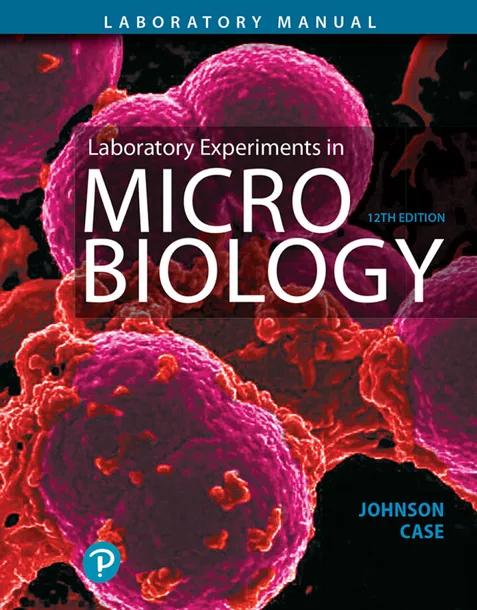
Laboratory Experiments in Microbiology
by Ted R. Johnson, Christine L. Case
12th Edition
Publisher: Pearson
Book Details
| Print ISBN | 9780134605203 |
| eText ISBN | 9780134644264 |
| Publisher | Pearson |
| Publishing Year | 2019 |
| Edition | 12th Edition |
| Language | English |
Laboratory Experiments in Microbiology, 12th Edition, is a laboratory manual designed for general microbiology laboratory courses. Authors Ted R. Johnson and Christine L. Case present instructional material supporting students across disciplines such as the biological sciences, allied health sciences, agriculture, environmental science, nutrition, pharmacy, and pre-professional programs.
The manual supplies 57 class-tested and customizable exercises in foundational microbiology techniques and applications. Work spans microscopy, aseptic transfer, staining methods, bacterial cultivation, microbial metabolism, and methods of controlling growth.
Designed as a companion to Tortora, Funke, and Case's Microbiology: An Introduction (13th Edition) or other introductory microbiology textbooks, the 2019 edition incorporates visual icons denoting investigative exercises, microbiome coverage, and alignment with American Society for Microbiology guidelines.
Table of Contents
PART ONE: MICROSCOPY
Chapter 1: Use and Care of the Microscope
Chapter 2: Examination of Living Microorganisms
PART TWO: HANDLING BACTERIA
Chapter 3: Microbes in the Environment
Chapter 4: Transfer of Bacteria: Aseptic Technique
PART THREE: STAINING METHODS
Chapter 5: Preparation of Smears and Simple Staining
Chapter 6: Negative Staining
Chapter 7: Gram Staining
Chapter 8: Acid-Fast Staining
Chapter 9: Structural Stains (Endospore, Capsule, and Flagella)
Chapter 10: Morphological Unknown
PART FOUR: CULTIVATION OF BACTERIA
Chapter 11: Isolation of Bacteria by Dilution Techniques
Chapter 12: Special Media for Isolating Bacteria
PART FIVE: MICROBIAL METABOLISM
Chapter 13: Carbohydrate Catabolism
Chapter 14: Fermentation
Chapter 15: Protein Catabolism, Part 1
Chapter 16: Protein Catabolism, Part 2
Chapter 17: Respiration
Chapter 18: Unknown Identification and Bergey's Manual
PART SIX: MICROBIAL GROWTH
Chapter 19: Oxygen and the Growth of Bacteria
Chapter 20: Determination of a Bacterial Growth Curve: The Role of Temperature
Chapter 21: Biofilms
PART SEVEN: CONTROL OF MICROBIAL GROWTH
Chapter 22: Physical Methods of Control: Heat
Chapter 23: Physical Methods of Control: Ultraviolet Radiation
Chapter 24: Chemical Methods of Control: Disinfectants and Antiseptics
Chapter 25: Chemical Methods of Control: Antimicrobial Drugs
Chapter 26: Effectiveness of Hand Scrubbing
PART EIGHT: MICROBIAL GENETICS
Chapter 27: Regulation of Gene Expression
Chapter 28: Isolation of Bacterial Mutants
Chapter 29: Transformation of Bacteria
Chapter 30: DNA Fingerprinting
Chapter 31: Genetic Engineering
Chapter 32: Ames Test for Detecting Possible Chemical Carcinogens
PART NINE: THE MICROBIAL WORLD
Chapter 33: Fungi: Yeasts and Molds
Chapter 34: Phototrophs: Algae and Cyanobacteria
Chapter 35: Protozoa
Chapter 36: Parasitic Helminths
PART TEN: VIRUSES
Chapter 37: Isolation and Titration of Bacteriophages
Chapter 38: Plant Viruses
PART ELEVEN: INTERACTION OF MICROBE AND HOST
Chapter 39: Epidemiology
Chapter 40: Koch's Postulate
PART TWELVE: IMMUNOLOGY
Chapter 41: Innate Immunity
Chapter 42: Agglutination Reactions: Slide Agglutination
Chapter 43: Agglutination Reactions: Microtiter Agglutination
Chapter 44: ELISA Technique
PART THIRTEEN: MICRORGANISMS AND DISEASE
Chapter 45: Bacteria of the Skin
Chapter 46: Bacteria of the Respiratory Tract
Chapter 47: Bacteria of the Mouth
Chapter 48: Bacteria of the Gastrointestinal Tract
Chapter 49: Bacteria of the Urogenital Trac
Chapter 50: Identification of an Unknown from a Clinical Sample
Chapter 51: Rapid Identification Methods
PART FOURTEEN: MICROBIOLOGY AND THE ENVIRONMENT
Chapter 52: Microbes in Water: Multiple-Tube Technique
Chapter 53: Microbes in Water: Membrane Filter Technique
Chapter 54: Microbes in Food: Contamination
Chapter 55: Microbes Used in the Production of Foods
Chapter 56: Microbes in Soil: The Nitrogen and Sulfur Cycles
Chapter 57: Microbes in Soil: Bioremediation
Chapter APPENDICES: APPENDICES
- • A. Pipetting
- • B. Dilution Techniques and Calculations
- • C. Use of the Spectrophotometer
- • D. Graphing
- • E. Use of the Dissecting Microscope
- • F. Use of the Membrane Filter
- • G. Electrophoresis
- • H. Keys to Bacteria
Customer Reviews
0.0
0 reviews
No reviews yet. Be the first to review this book!
Write a Review
Reviewed by GradeFocus Editorial Team