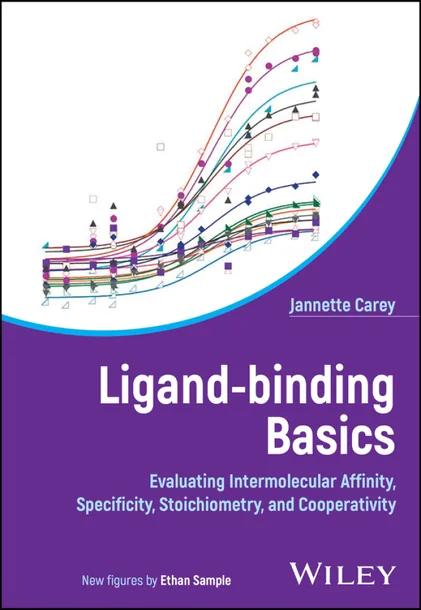
Ligand-Binding Basics
Evaluating Intermolecular Affinity, Specificity, Stoichiometry, and Cooperativity
by Jannette Carey
1st Edition
Publisher: Wiley-Blackwell
Book Details
| Print ISBN | 9781119878421 |
| eText ISBN | 9781119878476 |
| Publisher | Wiley-Blackwell |
| Publishing Year | 2025 |
| Edition | 1st Edition |
| Language | English |
| Pages | 256 |
In Ligand-Binding Basics: Evaluating Intermolecular Affinity, Specificity, Stoichiometry, and Cooperativity, 1st Edition, author Jannette Carey provides a comprehensive quantitative treatment of ligand-binding theory spanning chemistry, biology, and drug development. Written for students, educators, and practitioners in chemistry, biochemistry, molecular biology, and pharmaceutical science, this textbook establishes analytical methods for studying molecular interactions.
The volume derives basic equations that describe binding processes by applying core principles of equilibrium, mass action, and mass balance. It systematically presents recommended approaches for plotting and graphical analysis of binding data, allowing readers to extract fundamental physical parameters including intermolecular affinity, specificity, stoichiometry, and cooperativity.
Informed by Carey's experience serving on the Chemistry faculty at Princeton University for over thirty years teaching biophysical chemistry, this 256-page text connects mathematical foundations directly with empirical data. It offers a practical reference for upper-level coursework and professional research applications.
Table of Contents
Chapter 1: The Biology of Molecules
- • Why Study Intermolecular Interactions Quantitatively?
- • Equilibrium and Kinetics
- • Thermodynamic Definitions of Affinity and Specificity
- • The Affinity/Specificity Map
- • Biology Requires Optimization of Affinity and Specificity
- • The Special Case of Protein-DNA Interactions
Chapter 2: General Theory for Reversible Ligand Binding
- • Definition of Ligand and Titration
- • Affinity, Specificity, Stoichiometry, and Cooperativity
- • Ligand-binding Theory: Relationship to Experiment
- • General Theory for Reversible Ligand Binding: Rooted in Chemical Equilibrium
- • General Theory for Reversible Ligand Binding: Quantitative Treatment
- • The Case of 1:1 Binding
- • General Theory for Reversible Ligand Binding: Conservation of Mass
- • Definition of ν
- • The Basic Equation for 1:1 Binding
- • The Single Most Important Thing You Can Learn in This Book
- • The Example of Heme Binding to Apocytochrome c
- • The Rectangular Hyperbola
- • The Binding Isotherm
- • Plot of ν vs. [H f ]
- • General Theory for Reversible Ligand Binding: Role of Mass Action
- • Plot of [AH]vs.[H t ] with Fixed K
- • Determination of K d from Experiment
- • Plot of [AH]vs.[H t ] with Fixed [A t ]
- • Determining Molar Ratio from Experiment
- • About Activity
Chapter 3: Graphical Analysis
- • Limitations of Direct Plots
- • The Semi-log Plot
- • Breadth of the Semi-log Plot
- • Myoglobin and Hemoglobin
- • Advantages of the Direct and Semi-log Plots of Binding Data
- • Linear Transforms of the Basic Binding Equation
- • Common Linearizations
- • Requirements of the Linear Regression Model
- • A Linear Model May Misrepresent the Physical Process
- • Deviations from Linearity Are Hard to Detect or Interpret
- • Linear Transforms Distort Data Completeness
- • Linear Transforms Invite – Even Require – Extrapolation
- • Linear Transforms Falsely Promise Both K and Molar Ratio from a Single Dataset
- • Summary about Linear Treatments of Binding Data
- • Simulation Is Just as Good as Fitting, Given Realistic Experimental Errors
Chapter 4: Binding of Multiple Ligands
- • Conservation of Mass Outside the 1:1 Case
- • Redefine ν to Accommodate Any Molar Ratio
- • Accounting for the Definition of Molecule
- • Generalizing to Integer Multiples of 1:1
- • The Langmuir Equation for Any Molar Ratio with Sites of Identical Affinity and No Cooperativity
- • Adair Equation for Any Number of Binding Events
- • The Langmuir Equation vs. the Adair Equation
- • Thermodynamic Linkage
- • Two Classes of Sites with Different Affinities
- • Binding Isotherms for Multiple Sites with Different Affinities
- • Summary
Chapter 5: How to Determine K d and Molar Ratio Experimentally
- • Stoichiometric Titration First
- • Amounts of Materials
- • Assigning Partners
- • Choice of Experimental Observables
- • Choosing Solution Conditions
- • How Many Data Points?
- • Range-Finding Stoichiometric Titration
- • Visualizing Results
- • Range-Finding Asymptotic Titration to Estimate K d
- • Data Analysis
- • Practicalities about Experimental Error
- • Statistical Approaches to Estimate the Breakpoint
- • Refined Asymptotic Titration
- • Designing an Experiment to Refine K d
- • Calculating Free Ligand Concentration
- • Refining the Value of Molar Ratio
- • Example of ArgR/DNA Binding
- • Plotting the Data
- • Deriving K d from the Data
- • Summary
Chapter 6: Cooperativity
- • Facilitated and Antagonized Binding
- • Free Energy Definition of Cooperative Binding
- • Chemical Potential Diagram for Cooperative Binding
- • Cooperativity as Non-additivity
- • Reciprocity of Cooperative Effects
- • Limitations of Linear Transforms for Cooperative Interactions
- • Microscopic View of Species Distribution
- • Homotropic and Heterotropic Cooperativity
- • Cooperativity Affects Specificity as Well as Affinity
- • Cooperativity Is the Third Axis of the Affinity/Specificity Map
- • Quantifying Homotropic Cooperativity
- • Negative Homotropic Cooperativity
- • A Practical Advantage of Negative Cooperativity
- • Positive Cooperativity and the Ligand Concentration Interval
- • Importance of Individual-site Isotherms and Species Distribution
- • Species Distributions by Specialized Experimental Methods
- • The Many Forms of Cooperativity
- • Emergent Properties
- • Connectivity and Search Entropy
- • Breakdown of Additivity in Complex Systems
- • Statistical Effects
- • Relevance of Non-additivity for Analysis of Mutations
- • Universality and Promiscuity of Cooperativity
- • Proteins as Gestalt Objects
- • Summary
Chapter 7: Theoretical and Method-specific Troubleshooting
- • Equilibrium and Nonequilibrium Methods
- • Accessible Concentration Ranges Limit Accessible K d Values
- • Signal from Ligand or Target?
- • Separation-based Methods
- • Filter Binding
- • Gel Retardation or EMSA
- • Gel Filtration
- • Hummel and Dreyer Chromatography
- • Equilibrium Dialysis
- • UV Absorbance
- • CD Spectroscopy
- • Fluorescence
- • NMR
- • ITC
- • AUC
- • SPR
- • MS
Chapter 8: Allostery
- • An Historical Overview
- • Facilitated Binding
- • Elaboration of the MWC Model
- • Relaxed Monomers and Tense Multimers
- • Positive Homotropic Cooperativity Only
- • Artifactual Origins of Affinity Heterogeneity
- • Relaxation of Multimers by Ligand Binding
- • Koshland’s Sequential (Asymmetric) Model
- • G3Pase Was Heterogeneous, Not Negatively Cooperative
- • Many Models Fit the Hemoglobin Data
- • Advantages of Negative Cooperativity for Molecular Insight
- • Biology of Negative Cooperativity
- • Structural Analysis Cannot Solve Allostery
- • Allostery without Cooperativity
- • Summary
Chapter 9: Lessons on Affinity and Specificity from Host/Guest Chemistry
- • 2D Representations of 3D Objects
- • Early Hosts Were Linear and Flexible
- • Design of Molecular Properties
- • Very Weak Affinity and No Detectable Specificity
- • Later Hosts Pre-organized in Bound Conformation
- • Enormous Gains in Affinity and Specificity
- • Bonds between Host and Guest Are Identical
- • Lessons from the Host/Guest Chemistry
- • Rational Design of Affinity and Specificity
- • Affinity and Specificity Accrue in Parallel
- • Cryptic Contributions Can Dominate Binding
Chapter 10: Reconciling Structure and Thermodynamics in Molecular Interactions
- • Thermodynamics of Molecular Interactions
- • Structural Analysis of Bonding Does Not Predict Binding
- • The Goldilocks Region of Affinity/Specificity Space
- • Conformational Rearrangement upon Binding Decouples Affinity and Specificity
- • A Reservoir of Adaptability
- • No Simple Reconciliation of Structural and Energetic Views
- • Implications for Drug Design
Chapter 11: Applications in Modern Drug Development
- • Background
- • Technological Developments
- • Crystal Structures
- • Trapped High-energy States
- • Another Example
- • Computational Methods
- • High-throughput Assays
- • Druggability
- • Irrational Drug Design
- • A New Workflow
Chapter Appendix A: Ligand-binding Study Questions
Chapter Appendix B: Thought Experiments
Chapter Appendix C: Derivations
Chapter Appendix D: Simulation and Fitting
- • Simulation
- • Fitting
Chapter Appendix E: About the Hill Equation
- • Deriving the Hill Equation
- • The Hill Equation as a Limit of the Adair Equation
- • On Applying the Hill Equation to Quantify Cooperativity
Chapter Appendix F: Stereo Viewing
Customer Reviews
0.0
0 reviews
No reviews yet. Be the first to review this book!
Write a Review
Reviewed by GradeFocus Editorial Team
▶Research Sources (14)
- [PDF] Ligand-Binding Basics by Jannette Carey
- Ligand-Binding Basics, eBook by Jannette Carey
- Ligand-Binding Basics: Evaluating Intermolecular Affinity, ...
- Ligand-binding basics : evaluating intermolecular affinity, ...
- Please verify you are human - Captcha
- Search for Textbooks
- Thompson Learn.
- Untitled
- Ligand-Binding Basics: Evaluating Intermolecular Affinity ...
- Ligand-Binding Basics
- Mechanisms of ligand binding - PMC
- Ligand Binding: A Fundamental Mechanism in Biochemistry
- Ligand-Binding Basics | Ebook - Ellibs Ebookstore
- Ligand-Binding Basics by Jannette Carey - The Nile