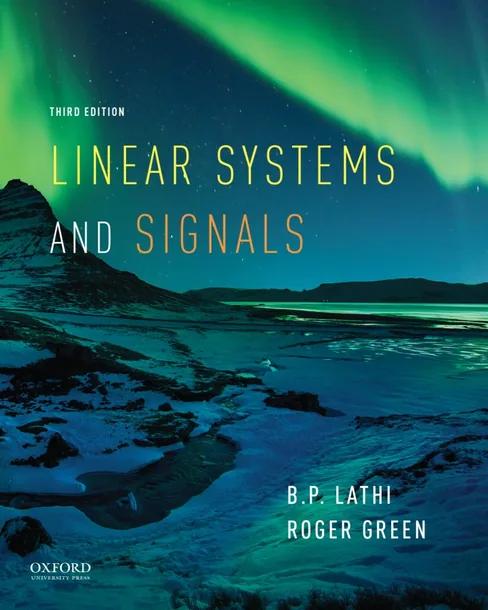
Linear Systems and Signals
by B.P. Lathi, Roger Green
3rd Edition
Publisher: Oxford University Press
Book Details
| Print ISBN | 9780190200176 |
| eText ISBN | 9780190699581 |
| Publisher | Oxford University Press |
| Publishing Year | 2017 |
| Edition | 3rd Edition |
| Language | English |
| Pages | 1008 |
Linear Systems and Signals, 3rd Edition, is an undergraduate textbook designed by B.P. Lathi and Roger Green to introduce foundational engineering principles for analyzing signals and systems.
The volume covers time-domain analysis for continuous-time and discrete-time systems alongside frequency-domain and transform methods. Topics include the Laplace transform, the z-transform, continuous-time Fourier series, sampling, discrete-time Fourier analysis, and state-space analysis.
The authors build physical intuition through heuristic reasoning, metaphors, analogies, and creative explanations alongside mathematical proofs. In addition, hundreds of fully worked examples offer students structured practice applying theory to technical problems.
Table of Contents
Chapter B: Background
- • B.1 Complex Numbers
- • B.2 Sinusoids
- • B.3 Sketching Signals
- • B.4 Cramer's Rule
- • B.5 Partial Fraction Expansion
- • B.6 Vectors and Matrices
- • B.7 MATLAB: Elementary Operations
- • B.8 Appendix: Useful Mathematical Formulas
Chapter 1: Signals and Systems
- • 1.1 Size of a Signal
- • 1.2 Some Useful Signal Operations
- • 1.3 Classification of Signals
- • 1.4 Some Useful Signal Models
- • 1.5 Even and Odd Functions
- • 1.6 Systems
- • 1.7 Classification of Systems
- • 1.8 System Model: Input-Output Description
- • 1.9 Internal and External Descriptions of a System
- • 1.10 Internal Description: The State-Space Description
- • 1.11 MATLAB: Working with Functions
- • 1.12 Summary
Chapter 2: Time-Domain Analysis of Continuous-Time Systems
- • 2.1 Introduction
- • 2.2 System Response to Internal Conditions: The Zero-Input Response
- • 2.3 The Unit Impulse Response
- • 2.4 System Response to External Input: Zero-State Response
- • 2.5 System Stability
- • 2.6 Intuitive Insights into System Behavior
- • 2.7 MATLAB: M-Files
- • 2.8 Appendix: Determining the Impulse Response
- • 2.9 Summary
Chapter 3: Time-Domain Analysis of Discrete-Time Systems
- • 3.1 Introduction
- • 3.2 Useful Signal Operations
- • 3.3 Some Useful Discrete-Time Signal Models
- • 3.4 Examples of Discrete-Time Systems
- • 3.5 Discrete-Time System Equations
- • 3.6 System Response to Internal Conditions: The Zero-Input Response
- • 3.7 The Unit Impulse Response h[n]
- • 3.8 System Response to External Input: The Zero-State Response
- • 3.9 System Stability
- • 3.10 Intuitive Insights into System Behavior
- • 3.11 MATLAB: Discrete-Time Signals and Systems
- • 3.12 Appendix: Impulse Response for a Special Case
- • 3.13 Summary
Chapter 4: Continuous-Time System Analysis Using the Laplace Transform
- • 4.1 The Laplace Transform
- • 4.2 Some Properties of the Laplace Transform
- • 4.3 Solution of Differential and Integro-Differential Equations
- • 4.4 Analysis of Electrical Networks: The Transformed Network
- • 4.5 Block Diagrams
- • 4.6 System Realization
- • 4.7 Application to Feedback and Controls
- • 4.8 Frequency Response of an LTIC System
- • 4.9 Bode Plots
- • 4.10 Filter Design by Placement of Poles and Zeros of H(s)
- • 4.11 The Bilateral Laplace Transform
- • 4.12 MATLAB: Continuous-Time Filters
- • 4.13 Summary
Chapter 5: Discrete-Time System Analysis Using the z-Transfor
- • 5.1 The z-Transform
- • 5.2 Some Properties of the z-Transform
- • 5.3 z-Transform Solution of Linear Difference Equations
- • 5.4 System Realization
- • 5.5 Frequency Response of Discrete-Time Systems
- • 5.6 Frequency Response from Pole-Zero Locations
- • 5.7 Digital Processing of Analog Signals
- • 5.8 The Bilateral z-Transform
- • 5.9 Connecting the Laplace and z-Transforms
- • 5.10 MATLAB: Discrete-Time IIR Filters
- • 5.11 Summary
Chapter 6: Continuous-Time Signal Analysis: The Fourier Series
- • 6.1 Periodic Signal Representation by Trigonometric Fourier Series
- • 6.2 Existence and Convergence of the Fourier Series
- • 6.3 Exponential Fourier Series
- • 6.4 LTIC System Response to Periodic Inputs
- • 6.5 Generalized Fourier Series: Signals as Vectors
- • 6.6 Numerical Computation of Dn
- • 6.7 MATLAB: Fourier Series Applications
- • 6.8 Summary
Chapter 7: Continuous-Time Signal Analysis: The Fourier Transform
- • 7.1 Aperiodic Signal Representation by the Fourier Integral
- • 7.2 Transforms of Some Useful Functions
- • 7.3 Some Properties of the Fourier Transform
- • 7.4 Signal Transmission Through LTIC Systems
- • 7.5 Ideal and Practical Filters
- • 7.6 Signal Energy
- • 7.7 Application to Communications: Amplitude Modulation
- • 7.8 Data Truncation: Window Functions
- • 7.9 MATLAB: Fourier Transform Topics
- • 7.10 Summary
Chapter 8: Sampling: The Bridge from Continuous to Discrete
- • 8.1 The Sampling Theorem
- • 8.2 Signal Reconstruction
- • 8.3 Analog-to-Digital (A/D) Conversion
- • 8.4 Dual of Time Sampling: Spectral Sampling
- • 8.5 Numerical Computation of the Fourier Transform: The Discrete Fourier Transform
- • 8.6 The Fast Fourier Transform (FFT)
- • 8.7 MATLAB: The Discrete Fourier Transform
- • 8.8 Summary
Chapter 9: Fourier Analysis of Discrete-Time Signals
- • 9.1 Discrete-Time Fourier Series (DTFS)
- • 9.2 Aperiodic Signal Representation by Fourier Integral
- • 9.3 Properties of the DTFT
- • 9.4 LTI Discrete-Time System Analysis by DTFT
- • 9.5 DTFT Connection with the CTFT
- • 9.6 Generalization of the DTFT to the z-transform
- • 9.7 MATLAB: Working with the DTFS and the DTFT
- • 9.8 Summary
Chapter 10: State-Space Analysis
- • 10.1 Mathematical Preliminaries
- • 10.2 Introduction to State Space
- • 10.3 A Systematic Procedure to Determine State Equations
- • 10.4 Solution of State Equations
- • 10.5 Linear Transformation of State Vector
- • 10.6 Controllability and Observability
- • 10.7 State-Space Analysis of Discrete-Time Systems
- • 10.8 MATLAB: Toolboxes and State-Space Analysis
- • 10.9 Summary
Customer Reviews
0.0
0 reviews
No reviews yet. Be the first to review this book!
Write a Review
Reviewed by GradeFocus Editorial Team
▶Research Sources (1)
Related Books
Electronics Use in Harsh Environments
Rajan Ambat
Digital Design using VerilogHDL
Shilpi Birla
Artificial Intelligence Empowered Smart Energy Systems
Qiang Yang
Stability Analysis of Converter-Rich Power Grids
Jun Liang
Multiphase Power Electronic Converters
Salman Ahmad
Robust Dynamic State Estimation of Power Systems
Junbo Zhao