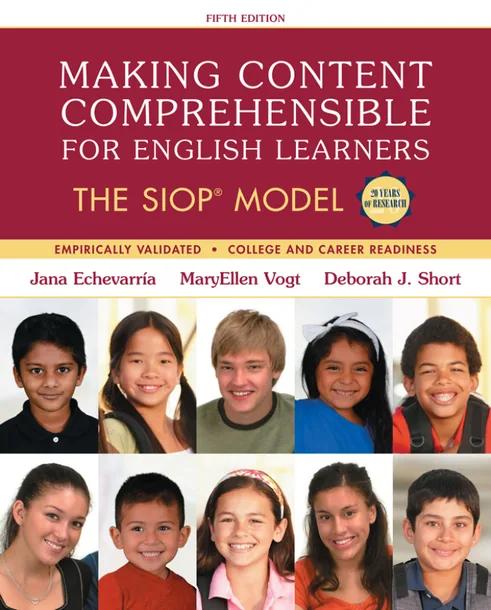
Making Content Comprehensible for English Learners
The SIOP Model
by Jana Echevarria, MaryEllen Vogt, Deborah J. Short
5th Edition
Publisher: Pearson
Book Details
| Print ISBN | 9780134045238 |
| eText ISBN | 9780134045412 |
| Publisher | Pearson |
| Publishing Year | 2017 |
| Edition | 5th Edition |
| Language | English |
Making Content Comprehensible for English Learners: The SIOP Model, 5th Edition, is a textbook focused on teaching English learners effectively across diverse classroom settings. The text examines the SIOP model, an instructional approach evaluated as a complete intervention that produced statistically significant gains in academic literacy measures.
Coverage introduces foundational context regarding the educational needs of English learners and outlines core instructional components. The text addresses lesson preparation, building background knowledge, comprehensible input, instructional strategies, classroom interaction, practice and application, lesson delivery, and review and assessment.
Additional topics include reading difficulties, response to intervention, special education for English learners, and effective use of the SIOP protocol. Reflect and Apply activities enable readers to rate sample lessons using the protocol.
Table of Contents
Chapter 1: Introducing the SIOP® Model
- • Background on English Learners
- • Demographic Trends
- • Diverse Characteristics
- • School Reform, Standards, and Accountability
- • Achievement Gaps
- • Academic Language and Literacy
- • Research on Academic Language and Literacy
- • Role in Schooling
- • Effective Instructional Practice for English Learners: The SIOP® Model
- • Content-based ESL and Sheltered Content Instruction
- • Research and Development of the Sheltered Instruction Observation Protocol (SIOP®) Model
- • Effective SIOP® Model Instruction
- • Implementing the SIOP® Model
- • Summary
- • Discussion Questions
Chapter 2: Lesson Preparation
- • Background
- • Selecting and Writing Content and Language Objectives
- • Teaching Ideas for Lesson Preparation
- • Differentiating Ideas for Multi-level Classes
- • Rating Lessons with the SIOP® Protocol
- • The Lesson
- • Teaching Scenarios
- • Discussion of Lessons
- • Teaching with Technology
- • Summary
- • Discussion Questions
Chapter 3: Building Background
- • Background
- • Something to Think About
- • Academic Vocabulary
- • Word Consciousness
- • Teaching Academic Vocabulary
- • Teaching Ideas for Building Background
- • Differentiating Ideas for Multi-level Classes
- • The Lesson
- • Teaching Scenarios
- • Discussion of Lessons
- • Teaching with Technology
- • Summary
- • Discussion Questions
Chapter 4: Comprehensible Input
- • Background
- • Teaching Ideas for Comprehensible Input
- • Differentiating Ideas for Multi-level Classes
- • The Lesson
- • Teaching Scenarios
- • Discussion of Lessons
- • Teaching with Technology
- • Summary
- • Discussion Questions
Chapter 5: Strategies
- • Background
- • Things to Consider When Teaching Learning Strategies
- • Three Types of Scaffolding
- • Teaching Ideas for Strategies
- • Differentiating Ideas for Multi-level Classes
- • The Lesson
- • Teaching Scenarios
- • Discussion of Lessons
- • Teaching with Technology
- • Summary
- • Discussion Questions
Chapter 6: Interaction
- • Background
- • Typical Lesson
- • SIOP® Lesson
- • Oral Language Development
- • Teaching Ideas for Interaction
- • Differentiating Ideas for Multi-level Classes
- • The Lesson
- • Teaching Scenarios
- • Discussion of Lessons
- • Teaching with Technology
- • Summary
- • Discussion Questions
Chapter 7: Practice & Application
- • Background
- • Teaching Ideas for Practice & Application
- • Differentiating Ideas for Multi-level Classes
- • The Lesson
- • Teaching Scenarios
- • Discussion of Lessons
- • Teaching with Technology
- • Summary
- • Discussion Questions
Chapter 8: Lesson Delivery
- • Background
- • Linking Lesson Preparation and Lesson Delivery
- • Teaching Ideas for Lesson Delivery
- • Differentiating Ideas for Multi-level Classes
- • The Lesson
- • Teaching Scenarios
- • Discussion of Lessons
- • Teaching with Technology
- • Summary
- • Discussion Questions
Chapter 9: Review & Assessment
- • Background
- • Classroom Context and the Review & Assessment Component
- • Formative and Summative Assessment
- • Informal Assessment
- • Formal Assessment
- • Teaching Ideas for Review & Assessment
- • Differentiating Ideas for Multi-level Classes
- • The Lesson
- • Teaching Scenarios
- • Discussion of Lessons
- • Teaching with Technology
- • Summary
- • Discussion Questions
Chapter 10: Issues of Reading, RTI, and Special Education for English Learners
- • Issues of Reading Development and Assessment
- • Estimating Students’ Reading Levels
- • English Learners and the Common Core State Standards for Reading, Writing, Listening, and Speaking
- • Assisting Struggling Learners: Response to Intervention
- • Issues Related to Special Education
- • Special Education Services: When Are They Appropriate?
- • Search for Intervention Rather than Disability
- • Teaching Ideas for Students with Special Needs
- • Summary
- • Discussion Questions
Chapter 11: Effective Use of the SIOP® Protocol
- • Best Practice in Using the SIOP® Protocol
- • Scoring and Interpreting the SIOP® Protocol
- • Assigning Scores
- • Not Applicable (NA) Category
- • Calculating Scores
- • Using Non-Numeric Rating
- • Sample Lesson
- • Using SIOP® Scores and Comments
- • Reliability and Validity of the SIOP®
- • Summary
- • Discussion Questions
Chapter 12: Frequently Asked Questions: Getting Started with the SIOP® Model
- • General SIOP® Questions
- • Questions About Getting Started with SIOP® in the Classroom
- • Questions About School-wide Implementation of the SIOP® Model
Customer Reviews
0.0
0 reviews
No reviews yet. Be the first to review this book!
Write a Review
Reviewed by GradeFocus Editorial Team