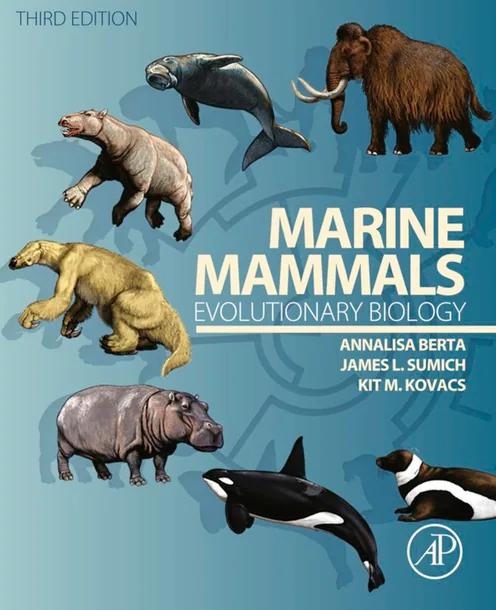
Marine Mammals
Evolutionary Biology
by Annalisa Berta, James L. Sumich, Kit M. Kovacs
3rd Edition
Publisher: Academic Press
Book Details
| Print ISBN | 9780123970022 |
| eText ISBN | 9780123970022 |
| Publisher | Academic Press |
| Publishing Year | 2015 |
| Edition | 3rd Edition |
| Language | English |
| Pages | 738 |
Marine Mammals: Evolutionary Biology, 3rd Edition, is a textbook that surveys the origin, diversity, and ecology of aquatic mammals. The work presents comprehensive biological coverage structured around evolutionary relationships.
Content is arranged within a phylogenetic framework that connects evolutionary lineages with behavior and ecological adaptations. Core subjects include the systematics of cetaceans, pinnipeds, and sirenians, alongside analyses of locomotion, diving physiology, and sensory adaptations.
The 2015 edition expanded nearly every chapter with distribution maps, full-color photographs, and updated citations. Prepared for mammalogists, marine biologists, vertebrate zoologists, researchers, faculty, and students, the volume features chapter summaries, a glossary, and instructor support resources.
Table of Contents
Chapter 1: Introduction
- • 1.1. Marine Mammals—“What Are They?”
- • 1.2. Adaptations for Aquatic Life
- • 1.3. Scope and Use of this Book
- • 1.4. Time Scale
- • 1.5. Early Observations of Marine Mammals
- • 1.6. Emergence of Marine Mammal Science
- • 1.7. Further Reading and Resources
Part 1: Evolutionary History
Chapter 2: Phylogeny, Taxonomy, and Classification
- • 2.1. Introduction: Investigating Evolutionary Histories
- • 2.2. Some Basic Terminology and Concepts
- • 2.3. How Do You Build a Phylogenetic Tree?
- • 2.4. Testing Phylogenetic Hypotheses
- • 2.5. Applying Phylogenies: Elucidating Evolutionary and Ecological Patterns
- • 2.6. Taxonomy and Classification
- • 2.7. Summary and Conclusions
- • 2.8. Further Reading and Resources
Chapter 3: Pinniped Evolution and Systematics
- • 3.1. Introduction
- • 3.2. Origin and Evolution
- • 3.3. Summary and Conclusions
- • 3.4. Further Reading and Resources
Chapter 4: Cetacean Evolution and Systematics
- • 4.1. Introduction
- • 4.2. Origin and Evolution
- • 4.3. Summary and Conclusions
- • 4.4. Further Reading and Resources
Chapter 5: Sirenians and Other Marine Mammals: Evolution and Systematics
- • 5.1. Introduction
- • 5.2. Origin and Evolution of Sirenians
- • 5.3. The Extinct Sirenian Relatives—Desmostylia
- • 5.4. The Extinct Marine Bear-Like Carnivoran, _Kolponomos_
- • 5.5. The Extinct Aquatic Sloth, _Thalassocnus natans_
- • 5.6. Marine Otters
- • 5.7. The Polar Bear, _Ursus maritimus_
- • 5.8. Summary and Conclusions
- • 5.9. Further Reading and Resources
Chapter 6: Evolution and Geography
- • 6.1. Introduction
- • 6.2. Species Identity
- • 6.3. Speciation
- • 6.4. Ecological Factors Affecting Distributions of Marine Mammals
- • 6.5. Present Patterns of Distribution
- • 6.6. Reconstructing Biogeographic Patterns
- • 6.7. Past Patterns of Distribution
- • 6.8. Summary and Conclusions
- • 6.9. Further Reading and Resources
Part 2: Evolutionary Biology, Ecology, and Behavior
Chapter 7: Integumentary and Sensory Systems
- • 7.1. Introduction
- • 7.2. Integumentary System
- • 7.3. Nerves and Sense Organs
- • 7.4. Summary and Conclusions
- • 7.5. Further Reading and Resources
Chapter 8: Musculoskeletal System and Locomotion
- • 8.1. Introduction
- • 8.2. Pinnipeds
- • 8.3. Cetaceans
- • 8.4. Sirenians
- • 8.5. Sea Otter
- • 8.6. Polar Bear
- • 8.7. Summary and Conclusions
- • 8.8. Further Reading and Resources
Chapter 9: Energetics
- • 9.1. Introduction
- • 9.2. Metabolic Rates
- • 9.3. Thermoregulation
- • 9.4. Energetics of Locomotion
- • 9.5. Osmoregulation
- • 9.6. Summary and Conclusions
- • 9.7. Further Reading and Resources
Chapter 10: Respiration and Diving Physiology
- • 10.1. Introduction
- • 10.2. Challenges of Deep and Prolonged Dives for Breath-Holders
- • 10.3. Pulmonary and Circulatory Adaptations to Diving
- • 10.4. Diving Response
- • 10.5. Diving Behavior and Phylogenetic Patterns
- • 10.6. Summary and Conclusions
- • 10.7. Further Reading and Resources
Chapter 11: Sound Production for Communication, Echolocation, and Prey Capture
- • 11.1. Introduction
- • 11.2. Sound Propagation in Air and Water
- • 11.3. Anatomy and Physiology of Sound Production and Reception
- • 11.4. Functions of Intentionally Produced Sounds
- • 11.5. Acoustic Thermometry of Ocean Climate and Low-Frequency Military Sonars
- • 11.6. Summary and Conclusions
- • 11.7. Further Reading and Resources
Chapter 12: Diet, Foraging Structures, and Strategies
- • 12.1. Introduction
- • 12.2. Seasonal and Geographical Patterns of Prey Abundance
- • 12.3. Adaptations for Foraging in Pinnipeds
- • 12.4. Feeding Specializations of Cetaceans
- • 12.5. Feeding Specializations of Sirenians
- • 12.6. Feeding Specializations of Other Marine Mammals
- • 12.7. Summary and Conclusions
- • 12.8. Further Reading and Resources
Chapter 13: Reproductive Structures, Strategies, and Patterns
- • 13.1. Introduction
- • 13.2. Anatomy and Physiology of the Reproductive System
- • 13.3. Mating Systems
- • 13.4. Lactation Strategies
- • 13.5. Reproductive Patterns
- • 13.6. Summary and Conclusions
- • 13.7. Further Reading and Resources
Chapter 14: Population Structure and Dynamics
- • 14.1. Introduction
- • 14.2. Abundance and Its Determination in Marine Mammals
- • 14.3. Techniques for Monitoring Populations
- • 14.4. Population Structure and Dynamics
- • 14.5. Summary and Conclusions
- • 14.6. Further Reading and Resources
Part 3: Exploitation, Conservation, and Management
Chapter 15: Exploitation and Conservation
- • 15.1. Introduction
- • 15.2. Exploitation of Marine Mammals
- • 15.3. Marine Mammal Conservation and Protection
- • 15.4. Progress and the Future
- • 15.5. Summary and Conclusions
- • 15.6. Further Reading and Resources
Customer Reviews
0.0
0 reviews
No reviews yet. Be the first to review this book!
Write a Review
Reviewed by GradeFocus Editorial Team