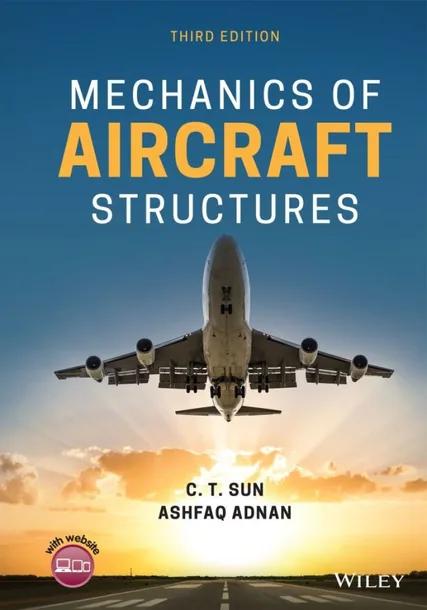
Mechanics of Aircraft Structures
by C. T. Sun, Ashfaq Adnan
3rd Edition
Publisher: Wiley-Blackwell
Book Details
| Print ISBN | 9781119583912 |
| eText ISBN | 9781119584148 |
| Publisher | Wiley-Blackwell |
| Publishing Year | 2021 |
| Edition | 3rd Edition |
| Language | English |
| Pages | 320 |
Mechanics of Aircraft Structures, 3rd Edition, provides an introductory textbook for one-semester courses in structural mechanics and aerospace engineering. It establishes fundamental analytical principles for evaluating aerospace vehicle structures.
The volume introduces structural configurations including fixed-wing aircraft, rotorcraft, lighter-than-air vehicles, and drones, alongside core structural elements such as wings and fuselages. Thematic coverage addresses structural loads, elasticity, flexural shear, elastic buckling, and composite laminates.
Created for students and practicing aerospace or mechanical engineers, the 2021 edition includes new problems and worked examples across each chapter. A companion website supplies Python code to assist readers in solving design optimization problems.
Table of Contents
Chapter 1: Characteristics of Aircraft Structures and Materials
- • 1.1 Introduction
- • 1.2 Types of Aircraft Structures
- • 1.2.1 Fixed-Wing Aircraft
- • 1.2.2 Rotorcraft
- • 1.2.3 Lighter-than-Air Vehicles
- • 1.2.4 Drones
- • 1.3 Basic Structural Elements in Aircraft Structure
- • 1.3.1 Fuselage
- • 1.3.2 Wing
- • 1.3.3 Landing Gear
- • 1.3.4 Control Surfaces
- • 1.4 Aircraft Materials
- • 1.4.1 Steel Alloys
- • 1.4.2 Aluminum Alloys
- • 1.4.3 Titanium Alloys
- • 1.4.4 Fiber-Reinforced Composites
- • Problems
Chapter 2: Loads on Aircraft Structures
- • 2.1 Introduction
- • 2.2 Basic Structural Elements
- • 2.2.1 Axial Member
- • 2.2.2 Shear Panel
- • 2.2.3 Bending Member (Beam)
- • 2.2.4 Torsion Member
- • 2.3 Wing and Fuselage
- • 2.3.1 Load Transfer
- • 2.3.2 Wing Structure
- • 2.3.3 Fuselage
- • Problems
Chapter 3: Introduction to Elasticity
- • 3.1 Introduction
- • 3.2 Concept of Displacement
- • 3.3 Strain
- • 3.3.1 Rigid Body Motion
- • 3.4 Stress
- • 3.5 Equations of Equilibrium in a Uniform Stress Field
- • 3.6 Equations of Equilibrium in a Nonuniform Stress Field
- • 3.7 Stress Vector and Stress Components Relations
- • 3.8 Principal Stress
- • 3.9 Shear Stress
- • 3.10 Stress Transformation
- • 3.11 Linear Stress–Strain Relations
- • 3.11.1 Strains Induced by Normal Stress
- • 3.11.2 Strains Induced by Shear Stress
- • 3.11.3 Three-Dimensional Stress–Strain Relations
- • 3.11.3.1 Orthotropic Materials
- • 3.11.3.2 Isotropic Materials
- • 3.12 Plane Elasticity
- • 3.12.1 Stress–Strain Relations for Plane Isotropic Solids
- • 3.12.1.1 Plane Strain
- • 3.12.1.2 Plane Stress
- • 3.12.2 Stress–Strain Relations for Orthotropic Solids in Plane Stress
- • 3.12.3 Governing Equations
- • 3.12.3.1 Equilibrium Equations
- • 3.12.3.2 Boundary Conditions
- • 3.12.3.3 Compatibility Equation
- • 3.12.4 Solution by Airy Stress Function for Plane Isotropic Solids
- • 3.12.5 Plane Elasticity Solutions in Polar Coordinate System
- • 3.12.5.1 Strain–Displacement Relations
- • 3.12.5.2 Stresses in Polar Coordinates and Equilibrium Equations
- • 3.12.5.3 Stress–Strain Relations
- • 3.12.5.4 Stress Function Formulations
- • 3.13 Formulations Beyond 2-D Plane Elasticity
- • Problems
- • References
Chapter 4: Torsion
- • 4.1 Introduction
- • 4.2 Torsion of Uniform Bars With Arbitrary Cross-Section
- • 4.2.1 Governing Equations
- • 4.2.2 Boundary Conditions
- • 4.2.3 Torque–Stress Relations
- • 4.2.4 Warping Displacement
- • 4.2.5 Torsion Constant
- • 4.3 Bars With Circular Cross-Sections
- • 4.3.1 Elasticity Approach Using Prandtl Stress Function
- • 4.3.2 Mechanics of Solid Approach
- • 4.4 Bars With Narrow Rectangular Cross-Sections
- • 4.5 Closed Single-Cell Thin-Walled Sections
- • 4.5.1 The s–n Coordinate System
- • 4.5.2 Prandtl Stress Function
- • 4.5.3 Shear Flow q
- • 4.5.4 Shear Flow–Torque Relation
- • 4.5.5 Twist Angle
- • 4.5.5.1 Method 1
- • 4.5.5.2 Method 2 for Constant Shear Flow
- • 4.5.6 Torsion Constant J
- • 4.6 Multicell Thin-Walled Sections
- • 4.7 Warping in Open Thin-Walled Sections
- • 4.8 Warping in Closed Thin-Walled Sections
- • 4.9 Effect of End Constraints
- • Problems
- • References
Chapter 5: Bending and Flexural Shear
- • 5.1 Introduction
- • 5.2 Bernoulli–Euler Beam Theory
- • 5.2.1 Unidirectional Bending on Beams with a Symmetric Section
- • 5.2.2 Bidirectional Bending on Beams with an Arbitrary Section
- • 5.3 Structural Idealization
- • 5.4 Transverse Shear Stress Due to Transverse Force in Symmetric Sections
- • 5.4.1 Narrow Rectangular Cross-Section
- • 5.4.2 General Symmetric Sections
- • 5.4.3 Thin-Walled Sections
- • 5.4.4 Shear Deformation in Thin-Walled Sections
- • 5.5 Timoshenko Beam Theory
- • 5.6 Saint-Venant’s principle
- • 5.7 Shear Lag
- • Problems
- • Reference
Chapter 6: Flexural Shear Flow in Thin-Walled Sections
- • 6.1 Introduction
- • 6.2 Flexural Shear Flow in Open Thin-Walled Sections
- • 6.2.1 Symmetric Thin-Walled Sections
- • 6.2.1.1 Stringer–Web Sections
- • 6.2.2 Unsymmetric Thin-Walled Sections
- • 6.2.3 Multiple Shear Flow Junctions
- • 6.2.4 Selection of Shear Flow Contour
- • 6.3 Shear Center in Open Sections
- • 6.4 Closed Thin-Walled Sections and Combined Flexural and Torsional Shear Flow
- • 6.4.1 Shear Center
- • 6.4.2 Statically Determinate Shear Flow
- • 6.5 Closed Multicell Sections
- • Problems
Chapter 7: Failure Criteria for Isotropic Materials
- • 7.1 Introduction
- • 7.2 Strength Criteria for Brittle Materials
- • 7.2.1 Maximum Principal Stress Criterion
- • 7.2.2 Coulomb–Mohr Criterion
- • 7.3 Yield Criteria for Ductile Materials
- • 7.3.1 Maximum Shear Stress Criterion (Tresca Yield Criterion) in Plane Stress
- • 7.3.2 Maximum Distortion Energy Criterion (von Mises Yield Criterion)
- • 7.4 Fracture Mechanics
- • 7.4.1 Stress Concentration
- • 7.4.2 Concept of Cracks and Strain Energy Release Rate
- • 7.4.3 Fracture Criterion
- • 7.4.3.1 Strain Energy in Structural Members
- • 7.4.3.2 Axial Element
- • 7.4.3.3 Beam Element
- • 7.4.3.4 Torsion Member
- • 7.5 Stress Intensity Factor
- • 7.5.1 Symmetric Loading (Mode I Fracture)
- • 7.5.2 Antisymmetric Loading (Mode II Fracture)
- • 7.5.3 Relation between K and G
- • 7.5.4 Mixed Mode Fracture
- • 7.6 Effect of Crack Tip Plasticity
- • 7.7 Fatigue Failure
- • 7.7.1 Constant Stress Amplitude
- • 7.7.2 S–N Curves
- • 7.7.3 Variable Amplitude Loading
- • 7.8 Fatigue Crack Growth
- • Problems
- • References
Chapter 8: Elastic Buckling
- • 8.1 Introduction
- • 8.2 Eccentrically Loaded Beam-Column
- • 8.3 Elastic Buckling of Straight Bars
- • 8.3.1 Pinned–Pinned Bar
- • 8.3.2 Clamped–Free Bar
- • 8.3.3 Clamped–Pinned Bar
- • 8.3.4 Clamped–Clamped Bar
- • 8.3.5 Effective Length of Buckling
- • 8.4 Initial Imperfection
- • 8.5 Postbuckling Behavior
- • 8.6 Bar of Unsymmetric Section
- • 8.7 Torsional–Flexural Buckling of Thin-Walled Bars
- • 8.7.1 Nonuniform Torsion
- • 8.7.2 Torsional Buckling of Doubly Symmetric Section
- • 8.7.3 Torsional–Flexural Buckling
- • 8.8 Elastic Buckling of Flat Plates
- • 8.8.1 Governing Equation for Flat Plates
- • 8.8.1.1 Boundary Conditions
- • 8.8.1.2 Clamped Edge
- • 8.8.1.3 Simply Supported Edge
- • 8.8.1.4 Free Edge
- • 8.8.2 Cylindrical Bending
- • 8.8.3 Buckling of Rectangular Plates
- • 8.8.3.1 Simply Supported Edges
- • 8.8.3.2 Other Boundary Conditions
- • 8.8.4 Buckling Under Shearing Stresses
- • 8.9 Local Buckling of Open Sections
- • Problems
Chapter 9: Analysis of Composite Laminates
- • 9.1 Plane Stress Equations for Composite Lamina
- • 9.2 Off-Axis Loading
- • 9.3 Notation for Stacking Sequence in Laminates
- • 9.3.1 Symmetry
- • 9.3.2 Repetition
- • 9.4 Symmetric Laminate Under In-Plane Loading
- • 9.5 Effective Moduli for Symmetric Laminates
- • 9.5.1 Quasi-Isotropic Laminate
- • 9.6 Laminar Stresses
- • 9.7 [±45 ] Laminate
- • 9.7.1 Determination of G 12 Using ±45 Laminates
- • Problems
Customer Reviews
0.0
0 reviews
No reviews yet. Be the first to review this book!
Write a Review
Reviewed by GradeFocus Editorial Team