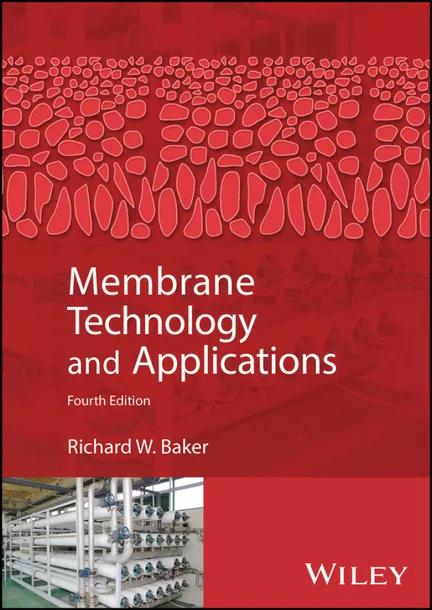
Membrane Technology and Applications
by Richard W. Baker
4th Edition
Publisher: John Wiley & Sons P&T
Book Details
| Print ISBN | 9781119685982 |
| eText ISBN | 9781119685999 |
| Publisher | John Wiley & Sons P&T |
| Publishing Year | 2023 |
| Edition | 4th Edition |
| Language | English |
| Pages | 560 |
Membrane Technology and Applications, 4th Edition presents systematic coverage of separation membrane theory, manufacture, and engineering applications. Authored by Richard W. Baker, this textbook introduces core operational concepts for synthetic membrane separation processes. The opening sections establish essential physical foundations required to analyze fluid transport, membrane structures, module configurations, and operational parameters.
General introductory chapters examine membrane preparation techniques, transport theory, and concentration polarization effects. The text then investigates individual process types, including electrodialysis, pervaporation, microfiltration, and coupled and facilitated transport mechanisms. Further sections address medical applications of membranes, detailing technical principles behind specialized healthcare separations and therapeutic devices.
A defining structural addition to this 4th Edition is a new chapter on transport mechanisms in finely microporous membranes, focusing directly on gas transport principles. The textbook provides structured educational support for graduate students, academic researchers, and industry professionals seeking rigorous separation engineering knowledge.
Table of Contents
Chapter 1: Overview of Membrane Science and Technology
- • 1.1 Introduction
- • 1.2 Historical Development of Membranes
- • 1.3 Membrane Transport Theory
- • 1.4 Types of Membranes
- • 1.4.1 Isotropic Membranes
- • 1.4.2 Anisotropic Membranes
- • 1.4.3 Membranes with Special Features
- • 1.5 Membrane Processes
- • 1.5.1 Reverse Osmosis, Ultrafiltration, Microfiltration
- • 1.5.2 Electrodialysis
- • 1.5.3 Gas Separation
- • 1.5.4 Pervaporation
- • 1.5.5 Hyperfiltration
- • 1.5.6 Membrane Contactors
- • 1.5.7 Carrier Transport
- • 1.5.8 Medical Applications
- • References
Chapter 2: Membrane Transport Theory – Solution-Diffusion
- • 2.1 Introduction
- • 2.2 The Solution-Diffusion Model
- • 2.2.1 Molecular Dynamics Simulations
- • 2.2.2 Concentration and Pressure Gradients in Membranes
- • 2.2.3 Application of the Solution-Diffusion Model to Specific Processes
- • 2.2.4 A Unified View
- • 2.3 Structure–Permeability Relationships in Solution-Diffusion Membranes
- • 2.3.1 Diffusion Coefficients
- • 2.3.2 Sorption Coefficients in Polymers
- • 2.4 Conclusions
- • References
Chapter 3: Microporous Membranes – Characteristics and Transport Mechanisms
- • 3.1 Introduction
- • 3.2 Gas Separation in Microporous Membranes
- • 3.2.1 Membrane Categories
- • 3.2.2 Crystalline Finely Microporous Membranes
- • 3.2.3 Amorphous Microporous Membranes
- • 3.3 Gas Separation: Transport Mechanisms
- • 3.3.1 Surface Adsorption and Diffusion
- • 3.3.2 Knudsen Diffusion
- • 3.3.3 Molecular Sieving
- • 3.3.4 Pore Blocking
- • 3.3.5 Summary
- • 3.4 Liquid Permeation in Microporous Membranes
- • 3.4.1 Screen Filters
- • 3.4.2 Depth Filters
- • 3.5 Conclusions and Future Directions
- • References
Chapter 4: Membranes and Modules
- • 4.1 Introduction
- • 4.2 Isotropic Membranes
- • 4.2.1 Isotropic Nonporous Membranes
- • 4.2.2 Isotropic Microporous Membranes
- • 4.3 Anisotropic Membranes
- • 4.3.1 Phase Separation Membranes
- • 4.3.2 Interfacial Polymerization Membranes
- • 4.3.3 Solution-Coated Composite Membranes
- • 4.3.4 Repairing Membrane Defects
- • 4.4 Ceramic and Glass Membranes
- • 4.4.1 Ceramic Membranes
- • 4.4.2 Microporous Glass Membranes
- • 4.5 Other Membranes
- • 4.6 Hollow Fiber Membranes
- • 4.7 Membrane Modules
- • 4.7.1 Plate-and-Frame Modules
- • 4.7.2 Tubular Modules
- • 4.7.3 Spiral-Wound Modules
- • 4.7.4 Hollow Fiber Modules
- • 4.7.5 Other Module Types
- • 4.8 Module Selection
- • 4.9 Conclusions and Future Directions
- • References
Chapter 5: Concentration Polarization
- • 5.1 Introduction
- • 5.2 Boundary Layer Film Model
- • 5.2.1 Determination of the Peclet Number
- • 5.3 Concentration Polarization in Liquid Separation Processes
- • 5.4 Concentration Polarization in Gas Separation Processes
- • 5.5 Concentration Polarization in Membrane Contactors and Related Processes
- • 5.6 Conclusions and Future Directions
- • References
Chapter 6: Reverse Osmosis (Hyperfiltration)
- • 6.1 Introduction and History
- • 6.2 Theoretical Background
- • 6.3 Membrane Materials
- • 6.3.1 Cellulosic Membranes
- • 6.3.2 Noncellulosic Loeb–Sourirajan Membranes
- • 6.3.3 Interfacial Composite Membranes
- • 6.4 Membrane Performance
- • 6.5 Reverse Osmosis Membrane Categories
- • 6.5.1 Seawater Desalination Membranes
- • 6.5.2 Brackish Water Desalination Membranes
- • 6.5.3 Nanofiltration Membranes
- • 6.5.4 Organic Solvent Separating Membranes
- • 6.6 Membrane Modules
- • 6.7 Membrane Fouling and Control
- • 6.7.1 Silt
- • 6.7.2 Scale
- • 6.7.3 Biofouling
- • 6.7.4 Organic Fouling
- • 6.7.5 Pretreatment
- • 6.7.6 Membrane Cleaning
- • 6.8 Applications
- • 6.8.1 Seawater Desalination
- • 6.8.2 Brackish Water Desalination
- • 6.8.3 Industrial Applications
- • 6.8.4 Organic Solvent Separations
- • 6.8.5 Conclusions and Future Directions
- • References
Chapter 7: Ultrafiltration
- • 7.1 Introduction and History
- • 7.2 Characterization of Ultrafiltration Membranes
- • 7.3 Membrane Fouling
- • 7.3.1 Constant Pressure and Constant Flux Operation
- • 7.3.2 Concentration Polarization
- • 7.3.3 Fouling Control
- • 7.4 Membranes
- • 7.5 Tangential-Flow Modules and Process Designs
- • 7.5.1 Modules
- • 7.5.2 Process Design
- • 7.6 Applications
- • 7.6.1 Industrial Applications
- • 7.6.2 Municipal Water Treatment/Membrane Bioreactors (MBRs)
- • 7.6.3 Biotechnology
- • 7.7 Conclusions and Future Directions
- • References
Chapter 8: Microfiltration
- • 8.1 Introduction and History
- • 8.2 Background
- • 8.2.1 Types of Membrane
- • 8.2.2 Membrane Characterization
- • 8.2.3 Microfiltration Membranes and Modules
- • 8.2.4 Process Design
- • 8.3 Applications
- • 8.3.1 Sterile Filtration of Pharmaceuticals
- • 8.3.2 Microfiltration in the Electronics Industry
- • 8.3.3 Sterilization of Wine and Beer
- • 8.4 Conclusions and Future Directions
- • References
Chapter 9: Gas Separation
- • 9.1 Introduction and History
- • 9.2 Dense Polymeric Membranes
- • 9.2.1 Theoretical Background
- • 9.2.2 Structural Features and Considerations
- • 9.3 Microporous Membranes
- • 9.4 Membrane Modules
- • 9.5 Process Design
- • 9.5.1 Pressure Ratio
- • 9.5.2 Stage-Cut
- • 9.5.3 Multistep and Multistage System Designs
- • 9.5.4 Recycle Designs
- • 9.6 Applications
- • 9.6.1 Hydrogen Separation
- • 9.6.2 Air Separation
- • 9.6.3 Natural Gas Separations
- • 9.6.4 Organic Vapor/Gas Separations
- • 9.6.5 To-Be-Developed Applications
- • 9.7 Conclusions and Future Directions
- • References
Chapter 10: Pervaporation/Vapor Permeation
- • 10.1 Introduction and History
- • 10.2 Theoretical Background
- • 10.3 Membrane Materials and Modules
- • 10.3.1 Membrane Characterization
- • 10.3.2 Membrane Materials
- • 10.3.3 Membrane Modules
- • 10.4 Process Design
- • 10.4.1 Basic Principles
- • 10.4.2 Hybrid Distillation/Membrane Processes
- • 10.5 Applications
- • 10.5.1 Bioethanol and Solvent Dehydration
- • 10.5.2 VOC/Water Separations
- • 10.5.3 Separation of Organic Mixtures
- • 10.6 Conclusions and Future Directions
- • References
Chapter 11: Ion Exchange Membrane Processes
- • 11.1 Introduction and History
- • 11.2 Theoretical Background
- • 11.2.1 Transport Through Ion Exchange Membranes
- • 11.3 Chemistry of Ion Exchange Membranes
- • 11.3.1 Homogeneous Membranes
- • 11.3.2 Heterogeneous Membranes
- • 11.4 Electrodialysis
- • 11.4.1 Concentration Polarization and Limiting Current Density
- • 11.4.2 Current Efficiency and Power Consumption
- • 11.4.3 System Design
- • 11.5 Electrodialysis Applications
- • 11.5.1 Water Desalination
- • 11.5.2 Continuous Electrodeionization and Ultrapure Water
- • 11.5.3 Salt Recovery from Seawater
- • 11.5.4 Other Electrodialysis Applications
- • 11.6 Fuel Cells
- • 11.7 Chlor-Alkali Processes
- • 11.8 Other Electrochemical Processes
- • 11.8.1 Water Splitting Using Bipolar Membranes
- • 11.8.2 Redox Flow Batteries
- • 11.8.3 Reverse Electrodialysis
- • 11.9 Conclusions and Future Directions
- • References
Chapter 12: Carrier Facilitated Transport
- • 12.1 Introduction
- • 12.2 Facilitated Transport
- • 12.2.1 Membrane and Process Development
- • 12.2.2 Theory
- • 12.2.3 Membranes
- • 12.2.4 Applications
- • 12.3 Coupled Transport
- • 12.3.1 Membrane and Process Development
- • 12.3.2 Theory
- • 12.3.3 Coupled Transport Membrane Characteristics
- • 12.3.4 Applications
- • 12.4 Conclusions and Future Directions
- • References
Chapter 13: Membrane Contactors
- • 13.1 Introduction
- • 13.2 Contactor Modules
- • 13.3 Applications of Membrane Contactors
- • 13.3.1 Liquid/Liquid Contactor Applications
- • 13.3.2 Liquid/Gas and Gas/Liquid Contactors
- • 13.3.3 Gas/Gas Membrane Contactors
- • 13.4 Conclusions and Future Directions
- • References
Chapter 14: Medical Applications of Membranes
- • 14.1 Introduction
- • 14.2 Hemodialysis
- • 14.3 Plasma Fractionation
- • 14.4 Blood Oxygenators
- • 14.5 Controlled Drug Delivery
- • 14.5.1 Membrane Diffusion-Controlled Systems
- • 14.5.2 Monolithic Systems
- • 14.5.3 Biodegradable Systems
- • 14.5.4 Osmotic Systems
- • References
Chapter 15: Other Membrane Processes
- • 15.1 Introduction
- • 15.2 Metal Membranes
- • 15.3 Ion-Conducting Membranes
- • 15.4 Charge Mosaic Membranes and Piezodialysis
- • References
Customer Reviews
0.0
0 reviews
No reviews yet. Be the first to review this book!
Write a Review
Reviewed by GradeFocus Editorial Team
▶Research Sources (13)
- Membrane technology and applications - Washington State University
- E-grāmata: Membrane Technology and Applications
- Membrane technology and applications
- Start reading Membrane Technology and Applications for free
- Please verify you are human - Captcha
- Search for Textbooks
- Explore insightful publications today - CSTnetwork.org
- Membrane Technology and Applications - eCampus @ UMass
- Membrane Technology and Applications - Perlego
- Membrane Technology and Applications - Richard W. Baker
- (PDF) Membrane Technology Application - Academia.edu
- Membrane technology and applications / Richard W. Baker.
- Membrane Technology and Applications
Related Books
Industrial Chemical Process Analysis and Design
Mariano Martín Martín
Industrial Water Conservation
Dominic Foo
Ionic Liquids in Biomass Processing
Harish K. Chopra
Artificial Intelligence in Chemical Engineering
Farooq Sher
Ozone Gas Sensing Technologies
Niravkumar J. Joshi
Machine Learning for Membrane Separation Applications
Mashallah Rezakazemi