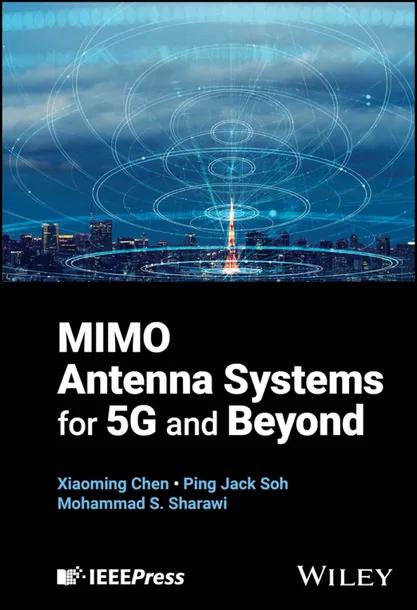
MIMO Antenna Systems for 5G and Beyond
by Xiaoming Chen, Ping Jack Soh, Mohammad S. Sharawi
1st Edition
Publisher: Wiley-IEEE Press
Book Details
| Print ISBN | 9781119932512 |
| eText ISBN | 9781119932536 |
| Publisher | Wiley-IEEE Press |
| Publishing Year | 2024 |
| Edition | 1st Edition |
| Language | English |
| Pages | 400 |
The 1st Edition of MIMO Antenna Systems for 5G and Beyond, authored by Xiaoming Chen, Ping Jack Soh, and Mohammad S. Sharawi, offers engineering design protocols and performance evaluation metrics for 5G and subsequent wireless standards. Published by Wiley-IEEE Press, this 400-page volume addresses the technical requirements of practicing engineers and researchers in wireless and radio engineering sectors. It outlines foundational principles alongside practical engineering approaches for multi-antenna architectures.
The text covers essential hardware topics including feed network design and analysis, passive MIMO antenna systems, and active reconfigurable MIMO antenna systems. It expands into massive-MIMO structures and modern beamforming networks. Additional coverage addresses specialized hardware implementations, focusing on on-chip and on-package MIMO antennas alongside millimeter-wave and sub-THz antenna systems.
To support system implementation, the authors present dedicated decoupling techniques designed to manage antenna interactions within compact platforms. Detailed measurement methods for MIMO antenna systems complete the technical guidance, offering readers structured strategies to evaluate multi-antenna performance. The text provides a practical reference for industry practitioners and academic researchers developing advanced wireless hardware.
Table of Contents
Chapter 1: Introduction
- • 1.1 Wireless Technology Evolution
- • 1.2 Benefits of MIMO Technology
- • 1.3 Future Technology Trends
- • 1.4 Book Organization
Chapter 2: MIMO Antenna Fundamentals and Characterization Methods
- • 2.1 Performance Metrics for Conventional Antennas
- • 2.2 Performance Metrics of MIMO Antenna Systems
- • 2.3 MIMO Antenna Characterization Methods
- • 2.4 Summary
Chapter 3: Feed Network Design and Analysis for MIMO Antenna Systems
- • 3.1 Impedance-Matching Networks
- • 3.2 Passive Feeding Networks
- • 3.3 Active Feed Networks
- • 3.4 Beamforming Networks
- • 3.5 Summary
Chapter 4: Passive MIMO Antenna Systems
- • 4.1 Single-Band Implementations
- • 4.2 Multi-Band MIMO Antennas
- • 4.3 Wideband and Ultra-Wide Band (UWB) MIMO Antennas
- • 4.4 Practical Implementations
- • 4.5 Design Examples
- • 4.6 Summary
Chapter 5: Active Reconfigurable MIMO Antenna Systems
- • 5.1 Frequency-Reconfigurable MIMO Antennas
- • 5.2 Pattern Reconfigurable MIMO Antennas
- • 5.3 Polarization Reconfigurable MIMO Antennas
- • 5.4 Challenges and Practical Considerations
- • 5.5 CAD Modeling Example
- • 5.6 Summary/Conclusion
Chapter 6: Massive-MIMO (m-MIMO) Antenna Systems
- • 6.1 Advantages of m-MIMO
- • 6.2 m-MIMO Antenna Implementations
- • 6.3 5G Massive-MIMO Array Example (Practical/Industry Related)
- • 6.4 Challenges in m-MIMO Antenna Designs
- • 6.5 Conclusion
Chapter 7: Recent Topics in MIMO Antenna Systems
- • 7.1 On-Chip and On-Package MIMO Antenna Systems
- • 7.2 Millimeter-Wave MIMO Antenna Systems
- • 7.3 Sub-THz Antennas
- • 7.4 MTS
- • 7.5 Reflective Intelligent Surfaces
- • 7.6 MIMO OAM
- • 7.7 MIMO Antennas for Space Applications
Chapter 8: Decoupling Techniques for MIMO Antenna Systems
- • 8.1 Mutual Coupling and Its Impact on MIMO
- • 8.2 Decoupling Techniques
- • 8.3 Challenges and Practical Considerations
- • 8.4 Conclusions
- • References
Chapter 9: Measurement Methods for MIMO Antenna Systems
- • 9.1 Over-the-Air Tests in Reverberation Chamber
- • 9.2 Multi-Probe Anechoic Chamber
- • 9.3 Radiated Two-Stage Method
- • 9.4 Other Testing Methods
- • References
Customer Reviews
0.0
0 reviews
No reviews yet. Be the first to review this book!
Write a Review
Reviewed by GradeFocus Editorial Team
▶Research Sources (13)
- MIMO Antenna Systems for 5G and Beyond
- MIMO Antenna Systems for 5G and Beyond (ebook), Xiaoming Chen ...
- MIMO Antenna Systems for 5G and Beyond
- Bookstore
- MIMO antenna systems for 5G and beyond
- Inklings Book Shoppe, LLC
- Self-Improvement & Inspiration Archives
- The Perfect Plan Book, Paperback - IF-470
- MIMO Antenna Systems for 5G and Beyond
- Massive MIMO for superior network performance
- Massive MIMO Systems for 5G and beyond Networks ...
- An Effective MIMO Antenna Design for 5G and Beyond to ...
- MIMO Antenna Systems for 5G and Beyond