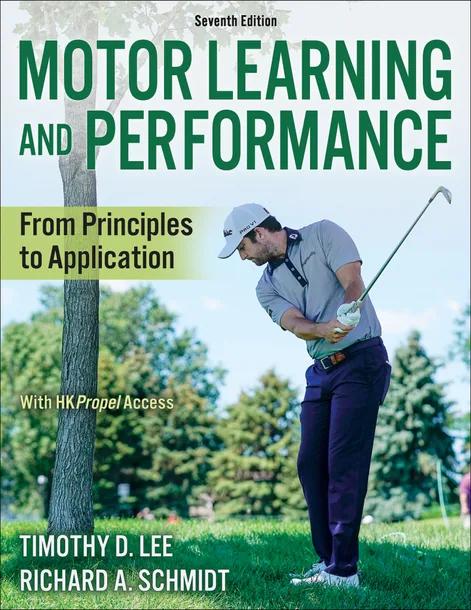
Motor Learning and Performance
From Principles to Application
by Timothy D. Lee, Richard A. Schmidt
7th Edition
Publisher: Human Kinetics, Inc.
Book Details
| Print ISBN | 9781718221093 |
| eText ISBN | 9781718221116 |
| Publisher | Human Kinetics, Inc. |
| Publishing Year | 2026 |
| Edition | 7th Edition |
| Language | English |
| Pages | 352 |
Motor Learning and Performance: From Principles to Application, 7th Edition, is an introductory textbook that establishes a conceptual model of human movement. The text explains the acquisition and retention of motor skills through practice, demonstrating their practical application across diverse real-world settings.
Core thematic areas include information processing, attentional constraints, sensory contributions to performance, and motor programs. The volume also examines movement coordination alongside principles governing speed, accuracy, and timing.
Written to remain accessible to learners with minimal background in physiology, psychology, or statistics, this work supports introductory courses in motor learning, performance, and behavior. It also serves as a practical reference for coaches, teachers, therapists, and athletic trainers.
Table of Contents
Chapter 1: Introduction to Motor Learning and Performance
- • How Skills Are Studied
- • Why Study Motor Skills?
- • The Science of Motor Learning and Performance
- • Focus on Research 1.1 Paul M. Fitts
- • Focus on Research 1.2 Franklin M. Henry
- • Defining Skills
- • Components of Skills
- • Classifying Skills
- • Measuring Skilled Performance
- • Understanding Performance and Learning
- • Summary
- • HK Propel Activities
Chapter 2: Processing Information and Making Decisions
- • The Mental Side of Human Performance
- • The Information-Processing Approach
- • Focus on Application 2.1 Intent to Blow Whistle Rule in the NHL
- • Reaction Time and Decision-Making
- • Focus on Research 2.1 Hick’s Law
- • Focus on Application 2.2 Population Stereotypes
- • Focus on Research 2.2 Studying the Expert Advantage
- • Focus on Application 2.3 Cost–Benefit of Anticipating in Sprint Starting
- • Errors in Decision-Making
- • Memory
- • Summary
- • HK Propel Activities
Chapter 3: Attention and Performance
- • Information-Processing Limitations
- • Focus on Application 3.1 William James on Attention
- • What Is Attention?
- • Attentional Limitations in Stimulus Identification
- • Focus on Research 3.1 A Stroop-Like Effect in Basketball
- • Attentional Limitations in Response Selection
- • Focus on Research 3.2 Distracted-Driving Research
- • Attentional Limitations in Movement Programming
- • Focus on Research 3.3 The Double-Stimulation Paradigm
- • Attentional Focus During Action
- • Decision-Making Under Stress
- • Focus on Application 3.2 Driver Panic and Unintended Acceleration
- • Summary
- • HK Propel Activities
Chapter 4: Sensory Contributions to Skilled Performance
- • Feedback Processing in Motor Control
- • Sources of Sensory Information
- • Focus on Application 4.1 When Vision Distorts Performance
- • Processing Sensory Information
- • Focus on Application 4.2 Force Escalation Between Siblings
- • Vision and Motor Control
- • Focus on Research 4.1 Blindsight Reveals Dorsal and Ventral Stream Processing
- • Focus on Research 4.2 Gaze Control and the Quiet Eye
- • Audition and Motor Control
- • Summary
- • HK Propel Activities
Chapter 5: Motor Programs
- • Motor Control of Brief Actions
- • Motor Program Theory
- • Evidence for Motor Programs
- • Focus on Research 5.1 The Henry–Rogers Experiment
- • Focus on Application 5.1 Checked Swings in Baseball
- • Focus on Research 5.2 Initiating a Motor Program
- • Motor Programs and the Conceptual Model
- • Problems in Motor Program Theory: Novelty and Storage
- • Generalized Motor Program Theory
- • Focus on Research 5.3 Invariances and Parameters
- • Focus on Application 5.2 Relative-Timing Biometrics
- • Focus on Application 5.3 The Stereo System Analogy
- • Summary
- • HK Propel Activities
Chapter 6: Principles of Speed, Accuracy, and Timing
- • Controlling Simple Movements
- • Fitts’ Law
- • Focus on Research 6.1 Fitts’ Tasks
- • Focus on Application 6.1 Trading Off Speed and Accuracy
- • Focus on Application 6.2 Fitts’ Law in Daily Activities
- • Schmidt’s Law
- • Exceptions to Fitts’ and Schmidt’s Laws
- • Applying the Principles: Baseball Batting
- • Summary
- • HK Propel Activities
Chapter 7: Performance of Complex Movements
- • Differing Approaches to Understanding Coordination
- • The Differential Approach
- • Focus on Application 7.1 The Relative-Age Effect
- • The Ecological Approach
- • Focus on Research 7.1 Head–Arm Coordination in Golf Putting
- • Focus on Application 7.2 Usain Bolt Versus Tyson Gay
- • Focus on Research 7.2 Relative Phase: An Index of Coordination
- • Summary
- • HK Propel Activities
Chapter 8: Introduction to Motor Learning
- • Concepts and Methods in Research and Application
- • Motor Learning Defined
- • How Is Motor Learning Measured?
- • Focus on Research 8.1 Learning Curves: Facts or Artifacts?
- • Distinguishing Learning From Performance
- • Focus on Application 8.1 Self-Assessments of Learning
- • Transfer of Learning
- • Summary
- • HK Propel Activities
Chapter 9: The Motor Learning Process
- • Practice, Retention, and Transfer
- • Two Principles of Practice
- • Focus on Research 9.1 The 10,000-Hour Rule Myth
- • Focus on Application 9.1 Learning Versus Performance During Practice
- • Benefits of Practice
- • Retention of Skill
- • Transfer of Skill
- • Focus on Application 9.2 From Esport to Real Sport
- • Summary
- • HK Propel Activities
Chapter 10: Organizing and Scheduling Practice
- • How the Structure of Practice Influences Learning
- • Distribution of Practice
- • Variability in Practice
- • Focus on Research 10.1 Especial Skills: An Exception to Variable Practice?
- • Focus on Research 10.2 Impact of Shea and Morgan
- • Motivation for Learning
- • Observational Learning and Mental Practice
- • Focus on Application 10.1 Mental Practice in Stroke Rehabilitation
- • Focus on Application 10.2 Practice Distribution Revisited
- • Summary
- • HK Propel Activities
Chapter 11: Augmented Feedback
- • How Supplemental Feedback Influences Learning
- • Feedback Classifications
- • Functions of Augmented Feedback
- • Focus on Research 11.1 Early Views on How Augmented Feedback Works
- • What Feedback to Give
- • How Much Feedback to Give
- • Feedback Timing
- • Focus on Application 11.1 Physical Guidance in Stroke Rehabilitation
- • Focus on Application 11.2 Physical Guidance in Learning to Swim
- • Summary
- • HK Propel Activities
Chapter 12: Theoretical Perspectives on Motor Learning
- • Understanding How Learning Occurs
- • Stage Theories
- • Adams’ Closed-Loop Theory
- • Schema Theory
- • Challenge Point Framework
- • Dynamic Pattern Theory
- • Constraints-Based Framework
- • OPTIMAL Theory
- • Summary
- • HK Propel Activities
Customer Reviews
0.0
0 reviews
No reviews yet. Be the first to review this book!
Write a Review
Reviewed by GradeFocus Editorial Team