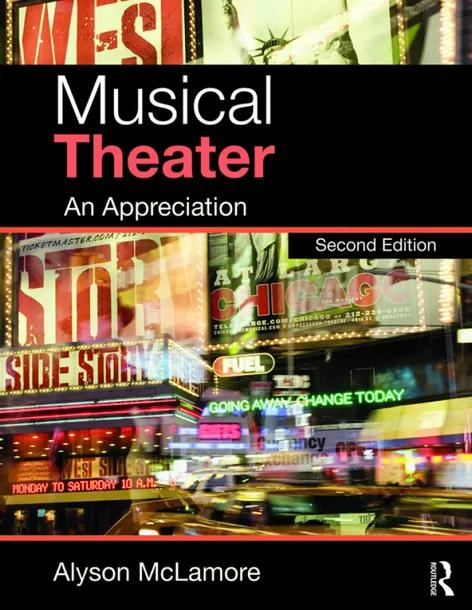
Musical Theater
An Appreciation
by Alyson McLamore
2nd Edition
Publisher: Routledge
Book Details
| Print ISBN | 9781138678682 |
| eText ISBN | 9781317191032 |
| Publisher | Routledge |
| Publishing Year | 2018 |
| Edition | 2nd Edition |
| Language | English |
| Pages | 584 |
Musical Theater: An Appreciation, 2nd Edition, explores the historical evolution of musical theater alongside the musical styles that accompanied theatrical change. The text instructs readers on analyzing both words and scores to understand how staging and music interact in performance.
The volume traces musical stage traditions from early European and American colonial antecedents through modern Broadway productions. Its historical repertoire extends from Wolfgang Amadeus Mozart's Don Giovanni to Lin-Manuel Miranda's Hamilton.
Discussions of musical selections incorporate detailed listening guides to assist study. Companion resources supply plot summaries, audio links, and materials intended for instructor lectures, student self-testing, and revision.
Table of Contents
Part I: The Antecedents to the Genre of "Musical Theater"
Chapter 1: The Birth of "Staged" Music
Chapter 2: Developing Genres in the Eighteenth Century: Ballad Opera and Singspiel
Chapter 3: Developing Genres in the Eighteenth Century: Opera Buffa and Dramma Giocoso
Chapter 4: The Musical Stage in the American Colonies
Part II: The Musical Stage in the Nineteenth Century
Chapter 5: France and Spain in the Nineteenth Century
Chapter 6: The Serious and the Not-so-Serious: Germany, Italy, and Austria in the Nineteenth Century
Chapter 7: England in the Nineteenth Century: Gilbert and Sullivan
Chapter 8: The United States in the Early Nineteenth Century
Chapter 9: New American Genres of the Later Nineteenth Century
Chapter 10: Operetta in America, 1880–1903
Part III: Diverging Paths in the Twentieth Century
Chapter 11: The Continuing Dominance of Operetta
Chapter 12: Challenges to Operetta
Chapter 13: The Princess Shows
Chapter 14: Increasing Drama on the Stage
Chapter 15: Musical Theater of the Lighter Kind
Part IV: Beginnings of a Golden Age: Synthesis of Style and Substance
Chapter 16: Great Partnerships of the Early Book Musical: Kern and Hammerstein
Chapter 17: Great Partnerships of the Early Book Musical: Rodgers and Hart
Chapter 18: Great Partnerships of the Early Book Musical: The Gershwins (1)
Chapter 19: Great Partnerships of the Early Book Musical: The Gershwins (2)
Chapter 20: Great Solo Acts: Irving Berlin
Chapter 21: Great Solo Acts: Cole Porter and Other Efforts in the 1930s
Part V: A Greater Maturity
Chapter 22: New Achievements from Familiar Names: Rodgers and Hart, Irving Berlin
Chapter 23: A Cole Porter Renaissance and the Rise of Recognition
Chapter 24: Politics and Social Commentary
Part VI: New Partnerships
Chapter 25: Rodgers and Hammerstein: Oklahoma!
Chapter 26: Rodgers and Hammerstein: Carousel and South Pacific
Chapter 27: Rodgers and Hammerstein: The King and I and The Sound of Music
Chapter 28: Lerner and Loewe
Part VII: New Faces of the 1940s and 1950s
Chapter 29: Leonard Bernstein
Chapter 30: Jule Styne and Frank Loesser
Chapter 31: Meredith Willson and Other Faces of the 1950s
Part VIII: New Faces of the 1960s and 1970s
Chapter 32: New Names in Lights in the 1960s
Chapter 33: Sondheim in the 1960s: Flash in the Pan?
Chapter 34: New Partnerships: Bock and Harnick
Chapter 35: New Partnerships: Kander and Ebb
Chapter 36: New Partnerships: Andrew Lloyd Webber and Tim Rice
Chapter 37: Wunderkinder of the 1970s
Chapter 38: Sondheim in the 1970s: The Endless Experiments
Part IX: The Late Twentieth Century—and Beyond
Chapter 39: Andrew Lloyd Webber Without Tim Rice: Cats and Starlight Express
Chapter 40: The Luxuriant Lloyd Webber
Chapter 41: The New Team in Town: Schönberg and Boublil
Chapter 42: New Names, New Teams in the 1980s
Chapter 43: Stephen Sondheim: Never a Formula
Chapter 44: A Surge of "Soloists"
Chapter 45: Team Efforts—The 1990s and Beyond
Chapter 46: Whither Musical Theater?
Customer Reviews
0.0
0 reviews
No reviews yet. Be the first to review this book!
Write a Review
Reviewed by GradeFocus Editorial Team