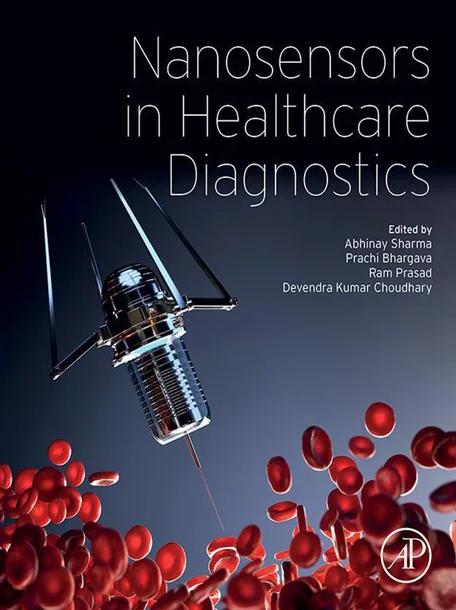
Nanosensors in Healthcare Diagnostics
by Abhinay Sharma, Prachi Bhargava, Ram Prasad
1st Edition
Publisher: Academic Press
Book Details
| Print ISBN | 9780443191299 |
| eText ISBN | 9780443153099 |
| Publisher | Academic Press |
| Publishing Year | 2024 |
| Edition | 1st Edition |
| Language | English |
| Pages | 414 |
Nanosensors in Healthcare Diagnostics, 1st Edition, by Abhinay Sharma, Prachi Bhargava, Ram Prasad, and Devendra Kumar Choudhary, details the principles, preparation techniques, and mechanisms governing nanosensor-based diagnostic platforms. Published by Academic Press, this reference volume addresses how nanostructured devices operate within clinical microbiology, diagnostic sensing, point-of-care testing, and therapeutic monitoring. The text supports the research and analytical needs of graduate students, academics, research scientists, and industry professionals across biological and medical sciences.
The thematic coverage examines point-of-care diagnostic systems designed to detect protein, metabolite, nucleic acid, and pathogenic biomarkers. Specialized sections evaluate gold-conjugated polymeric nanoparticles, exploring their utility as biosensors that operate through fluorescence quenching and surface plasmon resonance.
The volume further explores advancements in early cancer detection, emphasizing circulating tumor cell probing, diagnostic bioimaging, and specific biomarker identification. By connecting sensor preparation methods with biomedical applications, this reference provides structured material for managing, treating, and detecting human diseases.
Table of Contents
Chapter 1: Nanobiosensors for point-of-care diagnostic applications
- • 1.1 Introduction
- • 1.2 Diagnostic biological markers
- • 1.2.1 Protein biological markers
- • 1.2.2 Metabolites biological markers
- • 1.2.3 Nucleic acid biological markers
- • 1.2.4 Pathogenic biological markers
- • 1.3 Diagnostic role of nanobiosensors in biomedical field
- • 1.3.1 Noncommunicable diseases
- • 1.3.2 Communicable diseases
- • 1.4 Summary and future perspective
- • References
Chapter 2: Gold-conjugated polymeric nanoparticles as biosensors
- • 2.1 Introduction
- • 2.1.1 Gold nanoparticle-based piezoelectric biosensors
- • 2.2 Biosensor’s state of the art
- • 2.2.1 Gold nanoparticles sensing by fluorescence quenching
- • 2.2.2 Gold nanoparticles surface plasmon resonance-based sensors
- • 2.2.3 Detection of metal ions
- • 2.3 Detection of small organic molecules and protein
- • 2.4 Conclusions
- • References
Chapter 3: Biosensors for detection of Alzheimer’s disease: a review
- • 3.1 Introduction
- • 3.1.1 Neurodegenerative diseases
- • 3.1.2 Alzheimer’s disease and its diagnosis
- • 3.2 Biomarkers of Alzheimer’s disease
- • 3.2.1 Amyloid beta proteins
- • 3.2.2 Tau protein
- • 3.2.3 Apolipoprotein E4
- • 3.3 Biosensors
- • 3.3.1 Bioreceptors
- • 3.3.2 Transducers
- • 3.3.3 Signal amplification
- • 3.4 Conclusion
- • Acknowledgments
- • Conflict of interest
- • References
Chapter 4: Nanodrug delivery—a noble approach in neurodegenerative disorder and glioblastoma
- • 4.1 Introduction
- • 4.2 Neurological diseases and treatment strategies
- • 4.2.1 Neurodegenerative disease
- • 4.3 The bloodbrain barrier and nanotechnology
- • 4.4 Bloodbrain barrier crossing mechanism by nanomaterial
- • 4.5 Nanocarriers in drug delivery
- • 4.5.1 Inorganic nanocarriers for drug delivery
- • 4.5.2 Organic nanocarriers
- • 4.6 Recent advancements in nano-based treatment of brain disorders
- • 4.6.1 Scaffold
- • 4.6.2 Three- and four-dimensional printing
- • 4.6.3 Induced pluripotent stem cells
- • 4.6.4 Nanocarrier-based gene therapy
- • 4.7 Clinical trials and current status of nanomedicines in the treatment of neurodegenerative diseases
- • 4.8 Challenges and approaches to overcome barriers in the nano-based treatment of neurodegenerative diseases and glioblastoma multiforme
- • 4.9 Conclusion and future perspective
- • References
Chapter 5: Advancements in nanosensors for an early detection of cancer
- • 5.1 Introduction
- • 5.2 Classification of nanosensors
- • 5.2.1 Based on the materials used
- • 5.2.2 Based on the mode of transduction
- • 5.3 Role of nanosensors in an early detection of cancer
- • 5.3.1 Detection of biomarkers
- • 5.3.2 Detection of circulating tumor cells and exosomes
- • 5.3.3 Probing of living cancer cells
- • 5.3.4 Bioimaging of tumors
- • 5.3.5 Artificial intelligence with nanosensors for bioimaging
- • 5.3.6 Micro- and nanorobotics for an early detection of cancer
- • 5.3.7 Conclusion
- • Acknowledgments
- • References
Chapter 6: Biomedical applications of nanobiosensors in cancer—recent advances and future prospects
- • 6.1 Introduction
- • 6.1.1 Cancer onset and types
- • 6.2 Cancer diagnostic tools
- • 6.3 Nanotechnology
- • 6.3.1 Classification of nanoparticles
- • 6.3.2 Nanoparticles in biomedical applications
- • 6.4 Nanomaterials as biosensors—a novel approach to cancer diagnostics
- • 6.5 Cancer biomarkers
- • 6.5.1 Detection method
- • 6.6 Nanobiosensors
- • 6.7 Clinical trial of biosensors
- • 6.8 Advantages of nanobiosensors
- • 6.9 Conclusion
- • References
Chapter 7: Nanomaterial-based nanosensors for food safety applications
- • 7.1 Introduction
- • 7.2 Food safety and nanosensors
- • 7.3 Types of nanosensors
- • 7.3.1 Optical sensors
- • 7.3.2 Piezoelectric sensors
- • 7.4 Application in healthcare trends
- • 7.4.1 Food processing
- • 7.4.2 Nutraceuticals delivery and food packaging
- • 7.4.3 Food safety
- • 7.5 Conclusion
- • References
Chapter 8: Nanosensors in medical microbiology
- • 8.1 Introduction
- • 8.1.1 Foodborne and clinical pathogens
- • 8.2 Sensing of pathogens from food and clinical samples by using nanosensors
- • 8.3 Types of nanobiosensors
- • 8.3.1 Optical nanobiosensors
- • 8.3.2 Colorimetric nanobiosensors
- • 8.3.3 Electrochemical nanobiosensors
- • 8.3.4 Thermometric nanobiosensors
- • 8.3.5 Piezoelectric nanobiosensors
- • 8.3.6 Microfluidic nanobiosensors
- • References
Chapter 9: Nanosensors technology for diagnosis of viral infections
- • 9.1 Introduction
- • 9.2 Nanosensors: a brief overview
- • 9.2.1 Definition and functionality
- • 9.2.2 Types of nanosensors
- • 9.2.3 Nanosensors for viral detection
- • 9.2.4 Nanosensors for specific viral infections
- • 9.2.5 Challenges and limitations
- • 9.2.6 Future perspectives
- • 9.3 Conclusion
- • References
Chapter 10: Nanosensor-based therapeutic interventions to diagnose and cure bacterial infections
- • 10.1 Introduction
- • 10.2 Conventional diagnostic and therapeutic methods of bacterial infections
- • 10.3 Application of nanotechnology for bacterial infection management
- • 10.4 Nanodiagnostics for bacterial infection
- • 10.4.1 Magnetic nanoparticles
- • 10.4.2 Metal nanoparticles
- • 10.4.3 Nanowire-based biosensors
- • 10.4.4 Quantum dots
- • 10.4.5 Surface-enhanced photoluminescence
- • 10.4.6 Surface-enhanced Raman scattering
- • 10.4.7 Field-effect transistors
- • 10.4.8 Fluorescent nanosensors
- • 10.4.9 DNA microarray
- • 10.5 Nanotherapeutics
- • 10.5.1 Inorganic nanoparticles
- • 10.5.2 Organic nanoparticles
- • 10.5.3 Quantum dots
- • 10.5.4 Nanowires
- • 10.5.5 Nanocarriers
- • 10.5.6 Others
- • 10.6 Conclusion
- • References
Chapter 11: Use of nanotechnology in diagnosis and cure of mycotic infections
- • 11.1 Introduction
- • 11.2 Nanotechnology for diagnosis and cure of mycotic infections
- • 11.3 Nanodiagnostic techniques
- • 11.3.1 Gold nanoparticles
- • 11.3.2 Magnetic nanoparticles
- • 11.3.3 Quantum dots
- • 11.3.4 Nanorods and nanotubes
- • 11.3.5 Nanowires
- • 11.3.6 Nanoprobes or nanosensors
- • 11.3.7 Nanobarcodes
- • 11.3.8 Surface-enhanced Raman scattering nanotags
- • 11.3.9 Surface plasmon resonancebased detection
- • 11.3.10 DNA microarray
- • 11.3.11 Other techniques
- • 11.4 Therapeutics of mycotic infections
- • 11.4.1 Conventional therapeutic methods for fungal infections
- • 11.4.2 Intervention of nanotechnology mycotic therapeutics
- • 11.5 Conclusion
- • References
Chapter 12: Potential applications of nanotechnology in management of parasitic diseases
- • 12.1 Introduction
- • 12.2 Traditional diagnosis and treatment methods of parasitic diseases
- • 12.3 Nanotechnology aided diagnosis and treatment of parasitic diseases
- • 12.3.1 Liposomes
- • 12.3.2 Solid lipid nanoparticles
- • 12.3.3 Quantum dots
- • 12.3.4 Polymeric nanoparticles
- • 12.3.5 Metal nanoparticles
- • 12.3.6 Nanosensors
- • 12.3.7 Carbon nanotubes
- • 12.3.8 Dendrimers
- • 12.3.9 Nanoemulsions
- • 12.3.10 Nanotechnology-based vaccines
- • 12.4 Conclusion
- • References
Chapter 13: Green-synthesized nanoparticles for biomedical sensor technology
- • 13.1 Introduction
- • 13.2 Obtaining of nanoparticles
- • 13.2.1 Nanoparticle synthesis with plants or green synthesis
- • 13.3 Biosensors
- • 13.3.1 Classification of sensors
- • 13.3.2 Introduction to nanobiosensors (nanomaterial-based biosensors)
- • 13.3.3 Applications of nanobiosensors
- • 13.4 Conclusion
- • References
Customer Reviews
0.0
0 reviews
No reviews yet. Be the first to review this book!
Write a Review
Reviewed by GradeFocus Editorial Team
▶Research Sources (19)
- [PDF] Nanosensors in Healthcare Diagnostics by Abhinay Sharma
- Nanosensors in Healthcare Diagnostics
- Nanosensors in Healthcare Diagnostics - Royal Melbourne ...
- Sourcebooks, LLC.
- Shreya Mahato
- Nanosensors in Healthcare Diagnostics - 1st Edition
- Searching the Catalog
- Nanosensors in Healthcare Diagnostics eBook por - EPUB
- Please verify you are human - Captcha
- Farrell Covington And The Limits of Style
- Nanosensors in Healthcare Diagnostics
- Nano-Engineered Sensor Systems for Disease Diagnostics
- Nanosensors in Healthcare Diagnostics by Abhinay ...
- Nanosensors in Healthcare Diagnostics
- Nanosensors in Healthcare Diagnostics by Sharma
- Nanosensors in Healthcare Diagnostics
- Nanosensors in Healthcare Diagnostics
- Details for: Nanosensors in healthcare diagnostics / › Koha ...
- Nano-Sensors in Healthcare: Market Trends and Insights