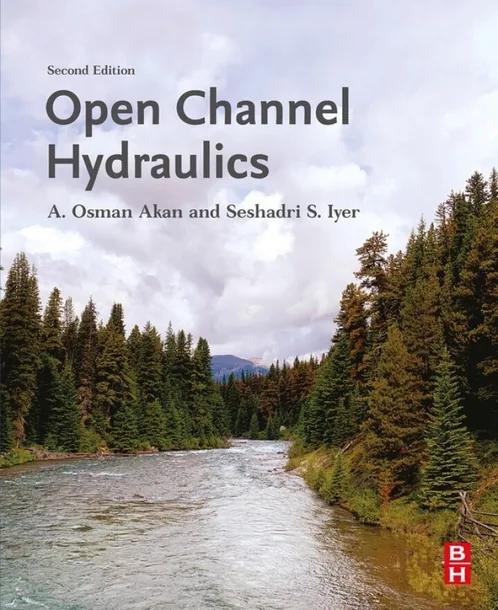
Open Channel Hydraulics
by A. Osman Akan, Seshadri S. Iyer
2nd Edition
Publisher: Elsevier Butterworth Heinemann
Book Details
| Print ISBN | 9780128217702 |
| eText ISBN | 9780128220559 |
| Publisher | Elsevier Butterworth Heinemann |
| Publishing Year | 2021 |
| Edition | 2nd Edition |
| Language | English |
| Pages | 846 |
Open Channel Hydraulics, 2nd Edition, is a reference work that connects open channel design with fundamental governing equations and their practical hydraulic applications. The volume combines analytical foundations with computation methods used to evaluate open channel conditions.
The text addresses core principles of open channel flow, examining normal depth, water surface profiles, and the ways mutual interaction among interconnected channels affects system design. It supplies practical formulas to compute discharge rates, depths, and other hydraulic quantities across steady and varied flow regimes.
Worked examples throughout the book illustrate major flow concepts and calculation procedures. The volume serves practicing civil and water resources engineers, designers, and modelers, as well as students in civil, environmental, mechanical, and naval engineering.
Table of Contents
Chapter 1: FUNDAMENTALS OF OPEN CHANNEL FLOW
- • 1.1 Geometric Elements of Open Channels
- • 1.2 Velocity and Discharge
- • 1.3 Hydrostatic Pressure
- • 1.4 Mass, Momentum and Energy Transfer in Open Channel Flow
- • 1.4.1 Mass Transfer
- • 1.4.2 Momentum Transfer
- • 1.4.3 Energy Transfer
- • 1.5 Open-Channel Flow Classification
- • 1.6 Conservation Laws
- • 1.6.1 Conservation of Mass
- • 1.6.2 Conservation of Momentum
- • 1.6.3 Conservation of Energy
- • 1.6.4Steady Flow Equations
- • 1.6.5Steady Spatially-Varied Flow Equations
- • 1.6.6 Comparison and Use of Momentum and Energy Equations
- • Problems
- • References
Chapter 2: ENERGY AND MOMENTUM PRINCIPLES
- • 2.1. Critical Flow
- • 2.1.1 Froude Number
- • 2.1.2 Calculation of Critical Depth
- • 2.2. Applications of Energy Principle for Steady Flow
- • 2.2.1 Energy Equation
- • 2.2.2 Specific Energy Diagram for Constant Discharge
- • 2.2.3 Discharge Diagram for Constant Specific Energy
- • 2.2.4 Specific Energy in Rectangular Channels
- • 2.2.5 Choking of Flow
- • 2.3. Applications of Momentum Principle for Steady Flow
- • 2.3.1 Momentum Equation
- • 2.3.2 Specific Momentum Diagram for Constant Discharge
- • 2.3.3 Discharge Diagram for Constant Specific Momentum
- • 2.3.4 Hydraulic Jump
- • 2.3.5 Specific Momentum in Rectangular Channels
- • 2.3.6 Hydraulic Jump in Rectangular Channels
- • 2.3.7 Choking and Momentum Principle
- • Problems
- • References
Chapter 3: NORMAL FLOW
- • 3.1. Flow Resistance
- • 3.1.1 Boundary Layer and Flow Resistance
- • 3.1.2 Darcy-Weisbach Equation
- • 3.1.3 The Chezy Equation
- • 3.1.4 The Manning Formula
- • 3.2 Normal Flow Equation
- • 3.3 Normal Depth Calculations in Uniform Channels
- • 3.4 Normal Depth Calculations in Grass-Lined Channels
- • 3.5 Normal Depth Calculations in Rip-Rap Channels
- • 3.6 Normal Flow in Composite Channels
- • 3.7 Normal Flow in Compound Channels
- • Problems
- • References
Chapter 4: GRADUALLY VARIED FLOW
- • 4.1. Classification of Channels for Gradually-Varied Flow
- • 4.2 Classification of Gradually-Varied Flow Profiles
- • 4.3 Significance of Froude Number in Gradually-Varied Flow Calculations
- • 4.4 Qualitative Determination of Expected Gradually Varied Flow Profiles
- • 4.5 Gradually-Varied Flow Computations
- • 4.5.1 Direct Step Method
- • 4.5.2 Standard Step Method
- • 4.6 Applications of Gradually-Varied Flow
- • 4.6.1 Locating Hydraulic Jumps
- • 4.6.2 Lake and Channel Problem
- • 4.6.2.1 Lake and Mild Channel
- • 4.6.2.2 Lake and Steep Channel
- • 4.6.3 The Two-Lake Problem
- • 4.6.3.1 Two Lakes and a Mild Channel
- • 4.6.3.2 Two Lakes and Steep Channel
- • 4.6.4 Effect of Choking on Water Surface Profile
- • 4.6.4.1 Choking in Long Mild Channels
- • 4.6.4.2 Choking in Steep Channels
- • 4.7 Gradually Varied Flow in Channel Systems
- • 4.8 Gradually Varied Flow in Natural Channels
- • Problems
- • References
Chapter 5: DESIGN OF OPEN CHANNELS
- • 5.1 General Design Considerations
- • 5.2 Design of Unlined Channels
- • 5.2.1 Maximum Permissible Velocity Method
- • 5.2.2 Tractive Force Method
- • 5.2.3 Channel Bends
- • 5.3 Design of Channels with Flexible Linings
- • 5.3.1 Design of Channels Lined with Vegetal Cover
- • 5.3.1.1 Phase 1 - Design for Stability
- • 5.3.1.2 Phase 2 - Modification for Required Conveyance
- • 5.3.2 Design of Riprap Channels
- • 5.3.3 Temporary Flexible Linings
- • 5.4 Design of Rigid Boundary Channels
- • 5.4.1 Experience Curve Approach
- • 5.4.2 Best Hydraulic Section Approach
- • 5.4.3 Minimum Lining Cost Approach
- • 5.5 Channel Design for Nonuniform Flow
- • Problems
- • References
Chapter 6: HYDRAULIC STRUCTURES
- • 6.1 Flow Measurement Structures
- • 6.1.1 Sharp-Crested Weirs
- • 6.1.1.1 Rectangular Sharp-Crested Weirs
- • 6.1.1.2 Sharp-Crested V-Notch
- • 6.1.1.3 Cipoletti Weir
- • 6.1.2 Broad-Crested Weirs
- • 6.1.3 Flumes
- • 6.2 Culverts
- • 6.2.1 Inlet Control Flow
- • 6.2.2 Outlet Control Flow
- • 6.2.2.1 Full Flow Conditions
- • 6.2.2.2 Partly Full Flow Condition
- • 6.2.3 Sizing of Culverts
- • 6.3 Overflow Spillways
- • 6.3.1 Shape for Uncontrolled Ogee Crest
- • 6.3.2 Discharge over an Uncontrolled Ogee Crest
- • 6.3.3 Discharge over Gate-Controlled Ogee Crests
- • 6.4 Stilling Basins
- • 6.4.1 Position of Hydraulic Jump
- • 6.4.2 Hydraulic Jump Characteristics
- • 6.4.3 Standard Stilling Basin Designs
- • 6.5 Channel Transitions
- • 6.5.1 Channel Transitions for Subcritical Flow
- • 6.5.1.1 Energy Loss at Transitions
- • 6.5.1.2 Water Surface Profile at Transitions
- • 6.5.1.3 Design of Channel Transitions for Subcritical Flow
- • 6.5.2 Channel Transitions for Supercritical Flow
- • 6.5.2.1 Standing Wave Fronts in Supercritical Flow
- • 6.5.2.2 Rectangular Contractions for Supercritical Flow
- • 6.5.2.3 Rectangular Expansions for Supercritical Flow
- • 6.6 Internal Energy Dissipators
- • 6.6.1 Increased Resistance – Tumbling Flow
- • 6.6.2 Drop Inlet Structures
- • 6.7 Streambed Level Dissipators - Contra Costa Basin Design
- • 6.8 Riprap Aprons
- • Problems
- • References
Chapter 7: BRIDGE HYDRAULICS
- • 7.1 Modeling Bridge Sections
- • 7.1.1 Cross-Section Locations
- • 7.1.2 Low Flow Types at Bridge Sites
- • 7.1.3 Low Flow Calculations at Bridge Sites
- • 7.1.3.1 Flow Choking at Bridge Sections
- • 7.1.3.2 Energy Method for Low Flow Calculations
- • 7.1.3.3 Momentum Method for Low Flow Calculations
- • 7.1.3.4 Yarnell Equation for Low Flow Calculations
- • 7.1.4 High Flow Calculations at Bridge Sites
- • 7.1.4.1 Sluice Gate Type Flow
- • 7.1.4.2 Orifice Type Flow
- • 7.1.4.3 Weir Type Flow
- • 7.1.4.4 Direct Step Method for High Flow Calculation
- • 7.2 Evaluating Scour at Bridges
- • 7.2.1 Contraction Scour
- • 7.2.1.1 Critical Velocity
- • 7.2.1.2. Live Bed Contraction Scour
- • 7.2.1.3 Clear-Water Contraction Scour
- • 7.2.2 Local Scour at Piers
- • 7.2.2.1 The CSU Equation for Pier Scour
- • 7.2.2.2 Froehlich Equation for Pier Scour
- • 7.2.2.3 Pressure Flow Scour
- • 7.2.3 Local Scour at Abutments
- • 7.2.3.1. The HIRE Equation
- • 7.2.3.2. Froehlich Equation
- • Problems
- • References
Chapter 8: INTRODUCTION TO UNSTEADY OPEN-CHANNEL FLOW
- • 8.1 Governing Equations
- • 8.2 Numerical Solution Methods
- • 8.2.1 Explicit Finite Difference Schemes
- • 8.2.2 Implicit Finite Difference Schemes
- • 8.2.2.1 Reach Equations
- • 8.2.2.2 Boundary Equations
- • 8.2.2.3 Solution Procedure
- • 8.2.2.4 Elements of the Coefficient Matrix
- • 8.2.2.5 An Efficient Algorithm to Determine Corrections
- • 8.2.3 Special Considerations
- • 8.2.4 Channel Systems
- • 8.3 Approximate Unsteady Flow Models
- • 8.3.1 Diffusion-Wave Model for Unsteady Flow
- • 8.3.2 Finite Difference Equations
- • 8.3.3 Solution of Finite Difference Equations
- • 8.4 Simple Channel Routing Methods
- • 8.4.1 Muskingum Method
- • 8.4.1.1 Routing Equation
- • 8.4.1.2 Calibration of Muskingum Parameters
- • 8.4.2 Muskingum-Cunge Method
- • Problems
- • References
Customer Reviews
0.0
0 reviews
No reviews yet. Be the first to review this book!
Write a Review
Reviewed by GradeFocus Editorial Team