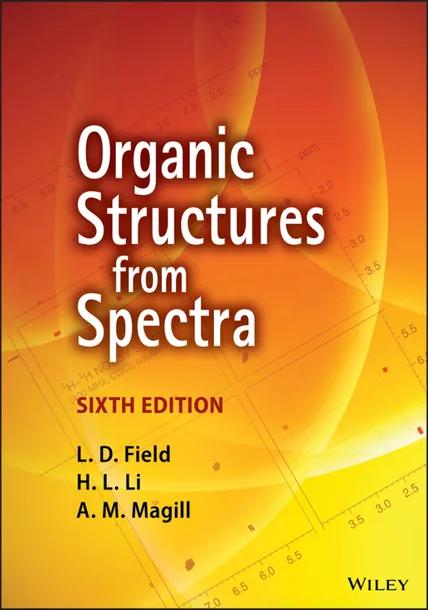
Organic Structures from Spectra
by L. D. Field, H. L. Li, A. M. Magill
6th Edition
Publisher: Wiley-Blackwell
Book Details
| Print ISBN | 9781119524809 |
| eText ISBN | 9781119524847 |
| Publisher | Wiley-Blackwell |
| Publishing Year | 2020 |
| Edition | 6th Edition |
| Language | English |
| Pages | 560 |
Organic Structures from Spectra, 6th Edition, is a textbook designed to teach students how to determine organic chemical structures from spectroscopic data. The text emphasizes practical problem solving, using carefully graded exercises to develop confidence and interpretative ability.
Coverage spans major analytical techniques, including infrared spectroscopy, mass spectrometry, ultraviolet spectroscopy, and one- and two-dimensional NMR spectroscopy. Concise theoretical summaries accompany condensed reference tables that highlight characteristic spectral properties across common functional groups.
The volume serves students of chemistry, biochemistry, and pharmacy taking introductory courses in organic chemistry. It features roughly 250 structural problems, including many based on compounds synthesized specifically for the textbook.
Table of Contents
Chapter 1: Introduction
- • 1.1 General Principles of Absorption Spectroscopy
- • 1.2 Chromophores
- • 1.3 Degree of Unsaturation
- • 1.4 Connectivity
- • 1.5 Sensitivity
- • 1.6 Practical Considerations
Chapter 2: Ultraviolet (UV) Spectroscopy
- • 2.1 The Nature of Ultraviolet Spectroscopy
- • 2.2 Basic Instrumentation
- • 2.3 Quantitative Aspects of Ultraviolet Spectroscopy
- • 2.4 Classification of UV Absorption Bands
- • 2.5 Special Terms in Ultraviolet Spectroscopy
- • 2.6 Important UV Chromophores
- • 2.7 The Effect of Solvents
Chapter 3: Infrared (IR) Spectroscopy
- • 3.1 Absorption Range and the Nature of IR Absorption
- • 3.2 Experimental Aspects of Infrared Spectroscopy
- • 3.3 General Features of Infrared Spectra
- • 3.4 Important IR Chromophores
Chapter 4: Mass Spectrometry
- • 4.1 Ionisation Processes
- • 4.2 Instrumentation
- • 4.3 Mass Spectral Data
- • 4.4 Representation of Fragmentation Processes
- • 4.5 Factors Governing Fragmentation Processes
- • 4.6 Examples of Common Types of Fragmentation
Chapter 5: 1H Nuclear Magnetic Resonance (NMR) Spectroscopy
- • 5.1 The Physics of Nuclear Spins and NMR Instruments
- • 5.2 Basic NMR Instrumentation
- • 5.3 Chemical Shift in 1H NMR Spectroscopy
- • 5.4 Spin–Spin Coupling in 1H NMR Spectroscopy
- • 5.5 Analysis of 1H NMR Spectra
- • 5.6 Correlation of 1H–1H Coupling With Structure
- • 5.7 The Nuclear Overhauser Effect (NOE)
- • 5.8 Labile and Exchangeable Protons
Chapter 6: 13c NMR Spectroscopy
- • 6.1 Coupling and Decoupling in 13c NMR Spectra
- • 6.2 The Nuclear Overhauser Effect (NOE) in 13c NMR Spectroscopy
- • 6.3 Determining 13c Signal Multiplicity Using Dept
- • 6.4 Shielding and Characteristic Chemical Shifts in 13c NMR Spectra
Chapter 7: 2-Dimensional NMR Spectroscopy
- • 7.1 Proton–Proton Interactions By 2D NMR
- • 7.2 Proton–Carbon Interactions By 2D NMR
Chapter 8: Miscellaneous Topics
- • 8.1 Solvents for NMR Spectroscopy
- • 8.2 Solvent-Induced Shifts
- • 8.3 Dynamic Processes in NMR – The NMR Time-Scale
- • 8.4 The Effect of Chirality
- • 8.5 The NMR Spectra of “Other Nuclei”
Chapter 9: Determining the Structure of Organic Compounds From Spectra
- • 9.1 Solving Problems
- • 9.2 Worked Examples
Chapter 10: Problems
Customer Reviews
0.0
0 reviews
No reviews yet. Be the first to review this book!
Write a Review
Reviewed by GradeFocus Editorial Team