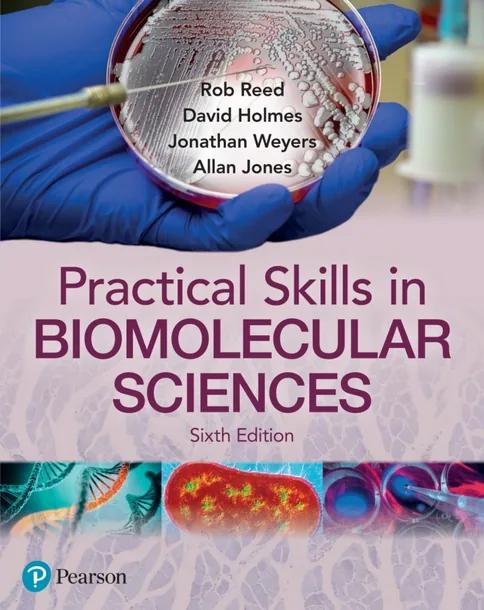
Practical Skills in Biomolecular Sciences
by Rob Reed, Jonathan Weyers, David A Holmes
6th Edition
Publisher: Pearson
Book Details
| Print ISBN | 9781292397085 |
| eText ISBN | 9781292397092 |
| Publisher | Pearson |
| Publishing Year | 2021 |
| Edition | 6th Edition |
| Language | English |
| Pages | 656 |
The textbook Practical Skills in Biomolecular Sciences, 6th Edition, authored by Rob Reed, Jonathan Weyers, David A Holmes, and Allan Jones, provides comprehensive instruction in practical laboratory techniques and academic study skills. Published by Pearson in December 2021, this volume supports undergraduate students across biochemistry, microbiology, biomedical sciences, and cellular and molecular bioscience degree programmes.
The text addresses core analytical operations, experimental planning, survey design, and scientific data presentation. Learners explore specific methods for assaying biomolecules, implementing molecular genetics procedures, completing literature reviews, and measuring key parameters such as temperature, dissolved oxygen, pH probes, and microelectrodes.
This sixth edition features dedicated content on self-management and teamwork alongside three new microbiological chapters focused on working with bacteria, eukaryotic microbes, and viruses. End-of-chapter study exercises offer direct practice for students preparing for laboratory coursework, practical assessments, and written examinations.
Table of Contents
Chapter 1: Developing your skills
Chapter 2: Self-management
Chapter 3: Learning effectively
Chapter 4: Making the most of learning resources
Chapter 5: Locating and citing published information
Chapter 6: Evaluating information
Chapter 7: Working with others
Chapter 8: Mapping your personal development
Chapter 9: Succeeding in assessments
Chapter 10: Scientific writing
Chapter 11: Writing essays
Chapter 12: Reporting practical and project work
Chapter 13: Tackling literature surveys and reviews
Chapter 14: Presenting written assignments
Chapter 15: Preparing a poster
Chapter 16: Giving a spoken presentation
Chapter 17: Revision strategies
Chapter 18: Improving your performance in exams
Chapter 19: Preparing for practical work
Chapter 20: Working safely in the lab
Chapter 21: Basic laboratory skills
Chapter 22: Measuring and dispensing liquids
Chapter 23: Preparing solutions principles and practice
Chapter 24: Measuring and maintaining pH
Chapter 25: Understanding microscopy
Chapter 26: Setting up and using a light microscope
Chapter 27: Making measurements
Chapter 28: Understanding SI units and their use
Chapter 29: Designing experiments
Chapter 30: Understanding bioethics
Chapter 31: Recording data and images
Chapter 32: Tackling project work and placements
Chapter 33: Learning sterile technique
Chapter 34: Culturing cells and measuring growth
Chapter 35: Collecting and isolating microbes
Chapter 36: Identifying microbes
Chapter 37: Naming microbes and other organisms
Chapter 38: Working with bacteria
Chapter 39: Working with eukaryotic microbes: fungi and protists
Chapter 40: Working with viruses
Chapter 41: Working with animal and plant cells and tissues
Chapter 42: Homogenising and fractionating cells and tissues
Chapter 43: Understanding calibration and quantitative analysis
Chapter 44: Centrifugation techniques
Chapter 45: Measuring light
Chapter 46: Using advanced spectroscopy and spectrometry
Chapter 47: Carrying out basic spectroscopy and spectrometry
Chapter 48: Separating compounds using chromatography
Chapter 49: Detecting and analysing compounds after chromatography
Chapter 50: Methods of electrophoresis
Chapter 51: Advanced electrophoretic techniques
Chapter 52: Electroanalytical techniques
Chapter 53: Using immunological methods
Chapter 54: Using radioisotopes
Chapter 55: Analysing stable isotopes
Chapter 56: Analysing biomolecules
Chapter 57: Assaying amino acids, peptides and proteins
Chapter 58: Assaying lipids
Chapter 59: Assaying carbohydrates
Chapter 60: Assaying nucleic acids and nucleotides
Chapter 61: Protein purification
Chapter 62: Studying enzymes
Chapter 63: Measuring membrane transport
Chapter 64: Quantifying photosynthesis and respiration
Chapter 65: Studying Mendelian and population genetics
Chapter 66: Studying bacterial and phage genetics
Chapter 67: Understanding molecular genetics fundamental principles
Chapter 68: Using the polymerase chain reaction in molecular genetics
Chapter 69: Genetic manipulation techniques
Chapter 70: Applying bioinformatics
Chapter 71: Manipulating and transforming raw data
Chapter 72: Analysing data with spreadsheets
Chapter 73: Summarising data in tables
Chapter 74: Illustrating data in graphs
Chapter 75: Solving numerical problems
Chapter 76: Using descriptive statistics
Chapter 77: Selecting and interpreting statistical tests
Customer Reviews
0.0
0 reviews
No reviews yet. Be the first to review this book!
Write a Review
Reviewed by GradeFocus Editorial Team
▶Research Sources (13)
- 9781292397092: Practical Skills in Biomolecular Sciences
- Practical Skills in Biomolecular Sciences
- eBook Details
- Practical skills in biomolecular sciences - University of Exeter
- eBook Details
- Practical Skills in Biomolecular Science
- eBook Details | Alabama Aviation College Bookstore
- eBook Details - GCTC Campus Store | BibliU
- Practical Skills in Biomolecular Science by Rob Reed
- Practical Skills in Biomolecular Sciences by Allan Jones
- Practical Skills in Biomolecular Sciences 6e (PDF)
- Practical Skills in Biomolecular Sciences : Robert H. Reed
- Practical Skills in Biomolecular Sciences / 6th edition