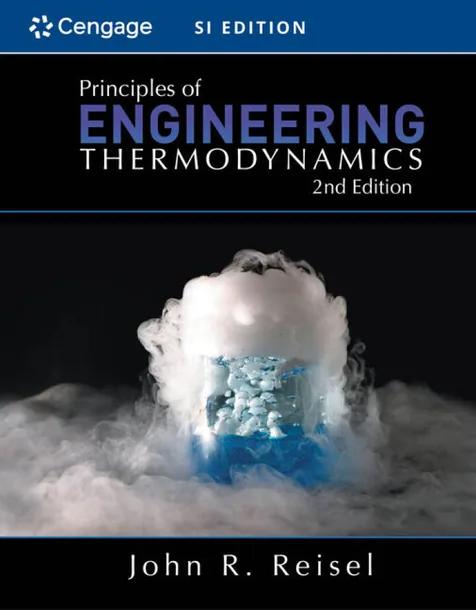
Principles of Engineering Thermodynamics, SI Edition
by John R. Reisel
2nd Edition
Publisher: Cengage Learning
Book Details
| Print ISBN | 9780357111796 |
| eText ISBN | 9798214352701 |
| Publisher | Cengage Learning |
| Publishing Year | 2022 |
| Edition | 2nd Edition |
| Language | English |
| Pages | 576 |
Principles of Engineering Thermodynamics, SI Edition, 2nd Edition, is a textbook that introduces fundamental thermodynamic concepts and engineering applications.
Core coverage addresses the nature of energy, equations of state, and the first and second laws of thermodynamics. The volume also examines applied systems, including power and refrigeration cycles, ideal gas mixtures, psychrometrics, and combustion analysis.
Written in an informal, first-person style, the textbook guides students in evaluating how changing system parameters, such as turbine outlet pressure or compressor inlet temperature, affects overall performance. It also helps learners build computer-based models of thermodynamic devices, processes, and cycles.
Table of Contents
Chapter 1: INTRODUCTION TO THERMODYNAMICS AND ENERGY.
- • Basic Concepts: Systems, Processes, and Properties.
- • An Introduction to Some Common Properties.
- • Zeroth Law of Thermodynamics.
- • Phases of Matter.
- • Summary.
Chapter 2: THE NATURE OF ENERGY.
- • What is Energy?
- • Types of Energy.
- • Transport of Energy.
- • Heat Transfer.
- • Work Transfer.
- • Energy Transfer via Mass Transfer.
- • Analyzing Thermodynamics Systems and Processes.
- • Platform for Performing Thermodynamics Analysis.
- • Summary.
Chapter 3: THERMODYNAMIC PROPERTIES AND EQUATIONS OF STATE.
- • Phase Diagrams.
- • The State Postulate.
- • Internal Energy, Enthalpy and Specific Heats.
- • Equations of State for Ideal Gases.
- • Incompressible Substances.
- • Property Determination for Water and Refrigerants.
- • Summary.
Chapter 4: THE FIRST LAW OF THERMODYNAMICS.
- • Conservation of Mass.
- • First Law of Thermodynamics in Open Systems.
- • First Law of Thermodynamics in Closed Systems.
- • Thermal Efficiency of Heat Engines, Refrigerators, and Heat Pumps.
- • Summary.
Chapter 5: INTRODUCTION TO THE SECOND LAW OF THERMODYNAMICS.
- • The Nature of the Second Law of Thermodynamics.
- • Summary of Some Uses of the Second Law.
- • Classical Statements of the Second Law.
- • Reversible and Irreversible Processes.
- • A Thermodynamic Temperature Scale.
- • Carnot Efficiencies.
- • Perpetual Motion Machines.
Chapter 6: ENTROPY.
- • Entropy and the Clausius Inequality.
- • Entropy Generation.
- • Evaluating Changes in the Entropy of a System.
- • The Entropy Balance.
- • Isentropic Efficiencies.
- • Consistency of Entropy Analyses.
- • Entropy Generation and Irreversibility.
- • Summary.
Chapter 7: POWER CYCLES.
- • Introduction.
- • The Ideal Carnot Power Cycle.
- • The Rankine Cycle.
- • Gas (Air) Power Cycles and Air Standard Cycle analysis.
- • Brayton Cycle.
- • Otto Cycle.
- • Diesel Cycle.
- • Dual Cycle.
- • Atkinson/Miller Cycle.
- • Summary.
Chapter 8: REFRIGERATION CYCLES.
- • Introduction.
- • The Vapor-Compression Refrigeration Cycle.
- • Absorption Refrigeration.
- • Reversed Brayton Refrigeration Cycle.
- • Summary.
Chapter 9: IDEAL GAS MIXTURES.
- • Introduction.
- • Defining the Composition of a Gas Mixture.
- • Ideal Gas Mixtures.
- • Solutions of Thermodynamics Problems Incorporating Ideal Gas Mixtures.
- • Introduction to Real Gas Mixture Behavior.
- • Summary.
Chapter 10: PSYCHROMETRICS: THE STUDY OF "ATMOSPHERIC AIR."
- • Introduction.
- • Basic Concepts and Terminology of Psychrometrics.
- • Methods of Determining Humidity.
- • Comfort Conditions.
- • Cooling and Dehumidifying of Moist Air.
- • Combining the Cooling and Dehumidifying Process with Refrigeration Cycles.
- • Heating and Humidifying Air.
- • Mixing of Moist Air Streams.
- • Cooling Tower Applications.
- • Summary.
Chapter 11: COMBUSTION ANALYSIS.
- • Introduction.
- • The Components of the Combustion Process.
- • A Brief Description of the Combustion Process.
- • Balancing Combustion Reactions.
- • Methods of Characterizing the Reactant Mixture.
- • Determination of Reactants from Known Products.
- • Enthalpy of a Compound and the Enthalpy of Formation.
- • Further Description of the Combustion Process.
- • Heat of Reaction.
- • Adiabatic Flame Temperature.
- • Entropy Balance for Combustion Processes.
- • The Gibbs Function.
- • Fuel Cells.
- • Introduction to Chemical Equilibrium.
- • The Water-Gas Shift Reaction and Rich Combustion.
- • Summary and the Limitations of Combustion Analysis.
Customer Reviews
0.0
0 reviews
No reviews yet. Be the first to review this book!
Write a Review
Reviewed by GradeFocus Editorial Team
▶Research Sources (1)
Related Books
Fundamentals of Thermal Fluid Sciences
Yunus A. Cengel
Manufacturing Processes for Engineering Materials
Serope Kalpakjian
Fundamentals of Engineering Thermodynamics
Michael J. Moran
Elementary Principles of Chemical Processes
Richard M. Felder

Precision Machining Technology
Peter J. Hoffman
Mechanical and Electrical Systems for Construction Managers
American Technical Publishers