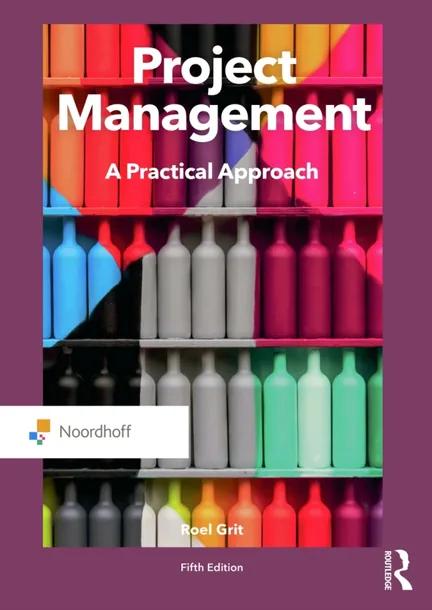
Project Management
A Practical Approach
by Roel Grit
5th Edition
Publisher: Routledge
Book Details
| Print ISBN | 9789001575625 |
| eText ISBN | 9781000416794 |
| Publisher | Routledge |
| Publishing Year | 2022 |
| Edition | 5th Edition |
| Language | English |
| Pages | 226 |
Project Management: A Practical Approach, 5th Edition introduces business and management students to project-based working through a practice-oriented framework.
The textbook covers foundational concepts such as project lifecycles, SMART criteria, and team collaboration roles based on Belbin. It also addresses practical frameworks including the six-step P6-Method and the flexible project approach Scrum.
Through course assignments, small student groups draft an operational project plan and an executive summary. Learners may apply these principles to textbook exercises, real-world company initiatives, or case studies provided on the companion website.
Table of Contents
Chapter 1: The project
- • 1.1 Types of activities, types of work
- • 1.2 Examples of projects
- • 1.3 What is a project?
- • 1.4 Moving from improvised to project based to routine activities
- • 1.5 Types of projects
- • 1.6 Things to remember
- • 1.7 Doing things in phases
- • 1.8 Why do things in phases?
- • 1.9 The phases of a project: an illustration
- • 1.10 When to do it as a project
- • 1.11 Lifecycle of a project
- • 1.12 Projects should be SMART
- • 1.13 Carrying out the projects in this book
- • Assignments
Chapter 2: People working on projects
- • 2.1 Line organisation
- • 2.2 The project organisation
- • 2.3 The project sponsor
- • 2.4 Future users
- • 2.5 The project manager
- • 2.6 The project members
- • 2.7 Relationship sponsor and project manager
- • 2.8 Task-oriented and people-oriented leadership
- • 2.9 Working on a project
- • 2.10 Team roles according to Belbin
- • 2.11 Digital tools for collaboration
- • 2.12 Team agreements
- • 2.13 Creativity and brainstorming
- • 2.14 Negotiating
- • 2.15 Making decisions in a project
- • 2.16 Related projects
- • 2.17 Outsourcing a project
- • 2.18 Projects and cultural differences
- • Assignments
Chapter 3: The project from start to finish
- • 3.1 Organising and carrying out the project
- • 3.2 Reasons for starting the project
- • 3.3 From reasons to do a project to actually doing the project itself
- • 3.4 Project proposal
- • 3.5 Initial meeting with the sponsor
- • 3.6 Setting up the project
- • 3.7 Project start-up meeting
- • 3.8 Design and preparation
- • 3.9 Realisation of the project result
- • 3.10 Completion of the project
- • 3.11 Project in time
- • 3.12 Monitoring aspects of a project
- • 3.13 Monitoring projects in practice
- • 3.14 Why projects fail
- • 3.15 Project risks
- • 3.16 Terminating a project prematurely
- • 3.17 Project management: methods
- • Assignments
Chapter 4: Planning
- • 4.1 Why plan?
- • 4.2 Concepts and terms
- • 4.3 Gantt charts
- • 4.4 Network diagrams
- • 4.5 Deriving a Gantt chart from a network diagram
- • 4.6 Adjustments to a planning
- • 4.7 Which activities are required?
- • 4.8 Planning software
- • 4.9 Using planning software
- • 4.10 Planning a large project in phases
- • 4.11 Time management
- • 4.12 Mini-course on MS Project on the website
- • Assignments
Chapter 5: How to do a project – the P6-Method
- • 5.1 The P6-Method
- • 5.2 Overview of the six steps
- • 5.3 Step 1: Initiating the project
- • 5.4 Step 2: Organising the project
- • 5.5 Step 3: Writing a project plan
- • 5.6 Step 4: Executing the project
- • 5.7 Step 5: Delivering the project’s results
- • 5.8 Step 6: Finalizing the project
- • Assignments
Chapter 6: Writing a project plan
- • 6.1 The project plan
- • 6.2 Dividing the project plan into sections
- • 6.3 Background information
- • 6.4 The project’s results
- • 6.5 Project activities
- • 6.6 Project scope and conditions
- • 6.7 Intermediate results
- • 6.8 Quality control
- • 6.9 The project organisation
- • 6.10 Planning
- • 6.11 Costs and benefits
- • 6.12 Risk analysis
- • 6.13 Writing the project plan
- • 6.14 The project’s files
- • Assignments
Chapter 7: Using Scrum
- • 7.1 Scrum
- • 7.2 Scrum applications
- • 7.3 The benefits and drawbacks of Scrum
- • 7.4 Scrum components
- • 7.5 Roles within Scrum
- • 7.6 Information during the Scrum process
- • 7.7 Meetings during the Scrum process
- • Assignments
Chapter 8: Organising meetings
- • 8.1 Project meeting
- • 8.2 Preparing for the meeting
- • 8.3 The meeting’s agenda
- • 8.4 The meeting itself
- • 8.5 After the meeting
- • Assignments
Chapter 9: Conducting interviews
- • 9.1 Types of interviews
- • 9.2 The three stages of an interview
- • Assignments
Chapter 10: Writing a report
- • 10.1 Preparing to write the report
- • 10.2 Putting the report together
- • 10.3 The structure of the report
- • 10.4 The main contents and finishing touches to the report
- • Assignments
Chapter 11: Holding a presentation
- • 11.1 Organisation and contents of a presentation
- • 11.2 Using an overhead projector or screen
- • 11.3 The structure of a presentation
- • 11.4 The presentation itself
- • Assignments
Chapter 12: Making an executive summary
- • 12.1 The purpose of an executive summary
- • 12.2 The components of an executive summary
- • Assignments
Chapter Appendix 1: Risk Analysis
Chapter Appendix 2: Website www.projectmanagement-english.noordhoff.nl
Customer Reviews
0.0
0 reviews
No reviews yet. Be the first to review this book!
Write a Review
Reviewed by GradeFocus Editorial Team