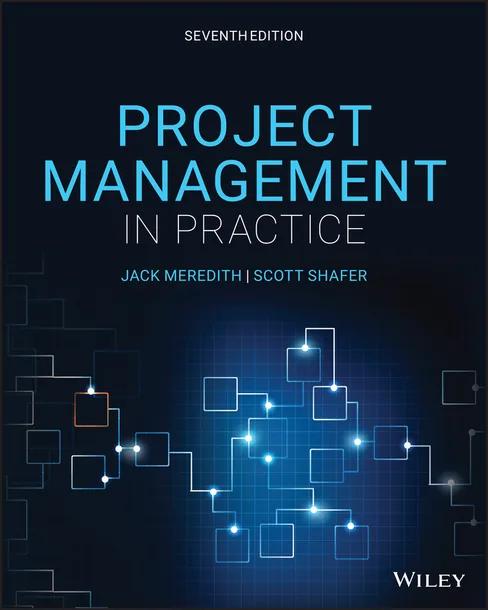
Project Management in Practice
by Jack R. Meredith, Scott M. Shafer, Samuel J. Mantel Jr.
7th Edition
Publisher: Wiley
Book Details
| Print ISBN | 9781119702962 |
| eText ISBN | 9781119703044 |
| Publisher | Wiley |
| Publishing Year | 2021 |
| Edition | 7th Edition |
| Language | English |
| Pages | 336 |
*Project Management in Practice*, 7th Edition, is a textbook structured for one-semester courses and modules. It emphasizes the technical aspects of the project management life cycle, guiding students through the fundamental strategies required to execute projects and meet organizational goals.
The volume covers key operational stages, including activity and risk planning, budgeting, scheduling, resource allocation, monitoring, and project evaluation and closure. It addresses both traditional methods and Agile environments, examining project selection alongside team and portfolio dynamics.
To reinforce concepts across chapters, the text features progressive cases that build upon earlier material, complemented by review questions, discussion topics, and illustrative examples for structured classroom practice.
Table of Contents
Chapter 1: The World of Project Management
- • 1.1 What is a Project?
- • 1.1.1 Trends in Project Management
- • 1.2 Project Management Versus General Management
- • 1.2.1 Major Differences
- • 1.2.2 Negotiation
- • 1.3 Agile Project Management
- • 1.4 What is Managed? The Three Goals of a Project
- • 1.5 The Life Cycles of Projects
- • 1.6 Selecting Projects to Meet Organizational Objectives
- • 1.6.1 Nonnumeric Selection Methods
- • 1.6.2 Numeric Selection Methods
- • 1.7 The Project Portfolio Process
- • 1.8 The Materials in this Text
- • Review Questions
- • Discussion Questions
- • Exercises
- • Incident for Discussion
- • Case: Friendly Assisted Living Facility—1
- • Case: Handstar Inc.
- • Bibliography
Chapter 2: The Manager the Organization and the Team
- • 2.1 The PM’s Roles
- • 2.1.1 Facilitator
- • 2.1.2 Communicator
- • 2.1.3 Virtual Project Manager
- • 2.1.4 Meetings, Convener, and Chair
- • 2.2 The PM’s Responsibilities to the Project
- • 2.2.1 Acquiring Resources
- • 2.2.2 Fighting Fires and Obstacles
- • 2.2.3 Leadership
- • 2.2.4 Negotiation, Conflict Resolution, and Persuasion
- • 2.3 Selection of a Project Manager
- • 2.3.1 Credibility
- • 2.3.2 Sensitivity
- • 2.3.3 Leadership Style Ethics
- • 2.3.4 Ability to Handle Stress
- • 2.4 Project Management as a Profession
- • 2.5 Fitting Projects into the Parent Organization
- • 2.5.1 Pure Project Organization
- • 2.5.2 Functional Project Organization
- • 2.5.3 Matrix Project Organization
- • 2.5.4 Mixed Organizational Systems
- • 2.5.5 The Project Management Office and Project Maturity
- • 2.6 The Project Team
- • 2.6.1 Matrix Team Problems
- • 2.6.2 Intrateam Conflict
- • 2.6.3 Integration Management
- • 2.7 Agile Team Roles
- • Review Questions
- • Discussion Questions
- • Incidents for Discussion
- • Case: Friendly Assisted Living Facility—2
- • Case: The Quantum Bank
- • Case: Southern Care Hospital
- • Bibliography
Chapter 3: Project Activity and Risk Planning
- • 3.1 From the Project Charter to the Project Plan
- • 3.2 The Planning Process—Overview
- • 3.3 The Planning Process—Nuts and Bolts
- • 3.3.1 The Launch Meeting—and Subsequent Meetings
- • 3.3.2 Sorting Out the Project—The Work Breakdown Structure (WBS)
- • 3.3.3 Extensions of the Everyday WBS
- • 3.4 More on the Work Breakdown Structure and Other Aids
- • 3.4.1 The RACI Matrix
- • 3.4.2 A Whole-Brain Approach to Project Planning
- • 3.4.3 The Design Structure Matrix
- • 3.5 Project Planning with Scrum
- • 3.5.1 Scrum Artifacts Supporting Project Planning
- • 3.5.2 Scrum Events for Project Planning
- • 3.5.3 Risk Management with Scrum
- • 3.6 Risk Management
- • Review Questions
- • Discussion Questions
- • Exercises
- • Incidents for Discussion
- • Case: Friendly Assisted Living Facility—3
- • Case: John Wiley & Sons
- • Case: Samson University
- • Bibliography
Chapter 4: Budgeting the Project
- • 4.1 Methods of Budgeting
- • 4.1.1 Top-Down Budgeting
- • 4.1.2 Bottom-Up Budgeting
- • 4.1.3 Budgeting With Agile
- • 4.2 Cost Estimating
- • 4.2.1 Work Element Costing
- • 4.2.2 The Impact of Budget Cuts
- • 4.2.3 An Aside
- • 4.2.4 Activity Versus Program Budgeting
- • 4.3 Improving Cost Estimates
- • 4.3.1 Forms
- • 4.3.2 Learning Curves
- • 4.3.3 Other Factors
- • 4.4 Budget Uncertainty and Project Risk Management
- • 4.4.1 Budget Uncertainty
- • 4.4.2 Project Budgeting in Practice
- • 4.5 Project Risk Simulation with Crystal Ball®
- • 4.5.1 Considering Disaster
- • Review Questions
- • Discussion Questions
- • Exercises
- • Incidents for Discussion
- • Case: Friendly Assisted Living Facility Project Budget Development—4
- • Case: Photstat Inc.
- • Case: Building the Geddy’s dream house
- • Bibliography
Chapter 5: Scheduling the Project
- • 5.1 PERT and CPM Networks
- • 5.1.1 The Language of PERT/CPM
- • 5.1.2 Building the Network
- • 5.1.3 Finding the Critical Path and Critical Time
- • 5.1.4 Calculating Activity Slack
- • 5.1.5 Doing It the Easy Way—Microsoft Project (MSP)
- • 5.2 Project Uncertainty and Risk Management
- • 5.2.1 Calculating Probabilistic Activity Times
- • 5.2.2 The Probabilistic Network, An Example
- • 5.2.3 Once More the Easy Way
- • 5.2.4 The Probability of Completing the Project on Time
- • 5.2.5 Selecting Risk and Finding D
- • 5.2.6 The Case of the Unreasonable Boss
- • 5.2.7 A Potential Problem: Path Mergers
- • 5.3 Simulation
- • 5.3.1 Incorporating Costs into the Simulation Analysis
- • 5.3.2 Traditional Statistics Versus Simulation
- • 5.3.3 Some Common Issues
- • 5.3.4 Simulation
- • 5.4 The Gantt Chart
- • 5.4.1 The Chart
- • 5.5 Extensions to PERT/CPM
- • 5.5.1 Precedence Diagramming
- • 5.5.2 Final Thoughts on the Use of These Tools
- • 5.6 Scheduling with Scrum
- • Review Questions
- • Discussion Questions
- • Exercises
- • Discussion Exercise
- • Incidents for Discussion
- • Case: Friendly Assisted Living Facility Program Plan—5
- • Case: NutriStar
- • Case: Launching E-Collar
- • Bibliography
Chapter 6: Allocating Resources to the Project
- • 6.1 Expediting a Project
- • 6.1.1 The Critical Path Method
- • 6.1.2 Crashing a Project With Excel
- • 6.1.3 Fast-Tracking a Project
- • 6.1.4 Project Expediting in Practice
- • 6.2 Resource Loading
- • 6.2.1 The Charismatic VP
- • 6.3 Resource Leveling
- • 6.3.1 Resource Loading/Leveling and Uncertainty
- • 6.4 Allocating Scarce Resources to Projects
- • 6.4.1 Some Comments About Constrained Resources
- • 6.4.2 Some Priority Rules
- • 6.5 Allocating Scarce Resources to Several Projects
- • 6.5.1 Criteria of Priority Rules
- • 6.5.2 The Basic Approach
- • 6.5.3 Resource Allocation and the Project Life Cycle
- • 6.6 Goldratt’s Critical Chain
- • 6.6.1 Estimating Task Times
- • 6.6.2 The Effect of Not Reporting Early Activity Completion
- • 6.6.3 Multitasking
- • 6.6.4 Common Chain of Events
- • 6.6.5 The Critical Chain
- • Review Questions
- • Discussion Questions
- • Exercises
- • Incidents for Discussion
- • Case: Friendly Assisted Living Facility Resource Usage—6
- • Case: Charter Financial Bank
- • Case: Rand Contractors
- • Bibliography
Chapter 7: Monitoring and Controlling the Project
- • 7.1 The Plan–Monitor–Control Cycle
- • 7.1.1 Designing the Monitoring System
- • 7.2 Data Collection and Reporting
- • 7.2.1 Data Analysis
- • 7.2.2 Reporting and Report Types
- • 7.2.3 Meetings
- • 7.2.4 Virtual Meetings, Reports, and Project Management
- • 7.3 Earned Value
- • 7.4 Project Control
- • 7.4.1 Purposes of Control
- • 7.5 Designing the Control System
- • 7.5.1 Types of Control Systems
- • 7.5.2 Tools for Control
- • 7.6 Scope Creep and Change Control
- • 7.7 Agile Approaches for Project Monitoring and Control
- • 7.7.1 Agile Tools for Tracking Project Progress
- • 7.7.2 Scrum Events for Project Control
- • Review Questions
- • Discussion Questions
- • Exercises
- • Incidents for Discussion
- • Case: Friendly Assisted Living Facility Updates—7
- • Case: Palmstar Enterprises, Inc.
- • Case: Peak Lighting, Inc.
- • Bibliography
Chapter 8: Evaluating and Closing the Project
- • 8.1 Evaluation
- • 8.1.1 Evaluation Criteria
- • 8.1.2 Measurement
- • 8.2 Project Auditing
- • 8.2.1 The Audit Process
- • 8.2.2 The Audit Report
- • 8.3 Project Closure
- • 8.3.1 When to Close a Project
- • 8.3.2 Types of Project Closure
- • 8.3.3 The Closure Process
- • 8.3.4 The Project Plan Closeout Report
- • 8.4 Benefits Realization
- • Review Questions
- • Discussion Questions
- • Incidents for Discussion
- • Case: Friendly Assisted Living Facility Audit—8
- • Case: Datatech
- • Case: Ivory Tower Systems
- • Bibliography
Chapter Appendix: Appendix
Customer Reviews
0.0
0 reviews
No reviews yet. Be the first to review this book!
Write a Review
Reviewed by GradeFocus Editorial Team