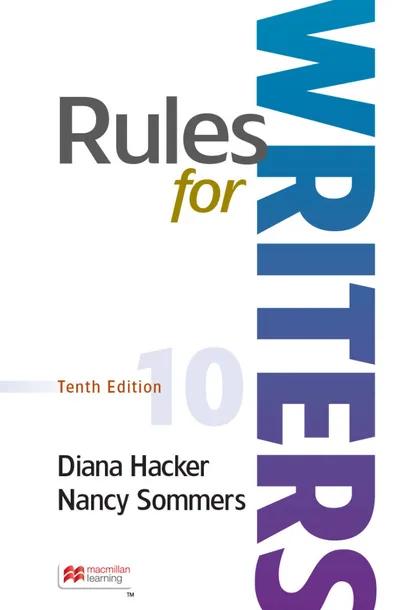
Rules for Writers
by Diana Hacker, Nancy Sommers
10th Edition
Publisher: Bedford/St. Martin's
Book Details
| Print ISBN | 9781319244255 |
| eText ISBN | 9781319392895 |
| Publisher | Bedford/St. Martin's |
| Publishing Year | 2021 |
| Edition | 10th Edition |
| Language | English |
| Pages | 624 |
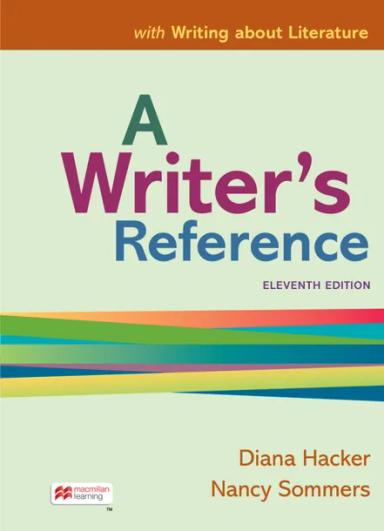
In Rules for Writers (10th Edition), authors Diana Hacker and Nancy Sommers provide a comprehensive reference handbook published by Bedford/St. Martin's. Designed for college students, university students, and writing instructors, this volume establishes clear methods for building foundational writing skills and navigating academic assignments.
The handbook guides students through early project exploration, drafting, paragraph development, and systematic methods for revising, editing, and reflecting on text. Readers learn strategies for reading critically, writing arguments, and evaluating multimodal texts. In addition, the text covers standard English mechanics, punctuation, sentence structures, and paper formatting in both MLA style and APA style.
Through accessible explanations and class-tested examples, the book offers step-by-step advice to help students refine their grammar and research capabilities. Specialized topics supply targeted assistance for multilingual writers and ESL students learning academic conventions. The handbook functions as a reliable instructional resource for postsecondary writing courses across various disciplines.
Table of Contents
Chapter 1: Exploring, planning, and drafting
- • a Assess the writing situation.
- • b Explore your subject.
- • c Draft and revise a working thesis statement.
- • d Draft a plan.
- • e Draft an introduction.
- • f Draft the body.
- • g Draft a conclusion.
Chapter 2: Writing paragraphs
- • a Focus on a main point.
- • b Develop the main point.
- • c Make paragraphs coherent.
- • d If necessary, adjust paragraph length.
- • e Choose a suitable strategy for developing paragraphs.
Chapter 3: Revising, editing, and reflecting
- • a Use peer review: Give constructive comments.
- • b Learn from peer review: Revise with comments.
- • c One student’s peer review process
- • d Approach global revision in cycles.
- • e Revise globally by making a reverse outline.
- • f Revise and edit sentences.
- • g Proofread and format the final manuscript.
- • h Sample student revision: Literacy narrative
- • i Reflect on your writing; prepare a portfolio.
Chapter 4: Reading and writing critically
- • a Read actively.
- • b Outline a text to identify main ideas.
- • c Summarize to deepen your understanding.
- • d Analyze to demonstrate your critical reading.
- • e Sample student writing: Analysis of an article
Chapter 5: Reading and writing about multimodal texts
- • a Read a multimodal text actively.
- • b Summarize a multimodal text to deepen your understanding.
- • c Analyze a multimodal text to demonstrate your critical reading.
- • d Sample student writing: Analysis of an advertisement
Chapter 6: Reading arguments
- • a Read with an open mind and a critical eye.
- • b Evaluate ethical, logical, and emotional appeals as a reader.
- • c Evaluate the evidence behind an argument.
- • d Identify underlying assumptions.
- • e Evaluate how fairly a writer handles opposing views.
Chapter 7: Writing arguments
- • a Identify your purpose and context.
- • b View your audience as a panel of jurors.
- • c Build common ground with your audience.
- • d In your introduction, establish credibility and state your position.
- • e Back up your thesis with persuasive lines of argument.
- • f Support your thesis with specific evidence.
- • g Anticipate objections; counter opposing arguments.
- • h Sample student writing: Argument
Chapter 8: Prefer active verbs.
- • a Active versus passive verbs
- • b Active versus be verbs
- • c Subject that names the actor
Chapter 9: Balance parallel ideas.
- • a Parallel ideas in a series
- • b Parallel ideas presented as pairs
- • c Repetition of function words
Chapter 10: Add needed words.
- • a In compound structures
- • b that
- • c In comparisons
- • d a, an, and the
Chapter 11: Untangle mixed constructions.
- • a Mixed grammar
- • b Illogical connections
- • c is when, is where, and reason . . . is because
Chapter 12: Repair misplaced and dangling modifiers.
- • a Limiting modifiers
- • b Misplaced phrases and clauses
- • c Awkwardly placed modifiers
- • d Split infinitives
- • e Dangling modifiers
Chapter 13: Eliminate distracting shifts.
- • a Point of view (person, number)
- • b Verb tense
- • c Verb mood, voice
- • d Indirect to direct questions or quotations
Chapter 14: Emphasize key ideas.
- • a Coordination and subordination
- • b Choppy sentences
- • c Ineffective or excessive coordination
- • d Ineffective subordination
- • e Excessive subordination
- • f Other techniques
Chapter 15: Provide some variety.
- • a Sentence openings
- • b Sentence structures
- • c Inverted order
Chapter 16: Tighten wordy sentences.
- • a Redundancies
- • b Unnecessary repetition
- • c Empty or inflated phrases
- • d Simplifying the structure
- • e Reducing clauses to phrases, phrases to single words
Chapter 17: Choose appropriate language.
- • a Levels of formality
- • b Jargon
- • c Euphemisms and “doublespeak”
- • d Slang
- • e Sexist and noninclusive language
- • f Biased language
Chapter 18: Find the exact words.
- • a Connotations
- • b Specific, concrete nouns
- • c Standard idioms
- • d Clichés
- • e Figures of speech
- • f Glossary of usage
Chapter 19: Repair sentence fragments.
- • a Subordinate clauses
- • b Phrases
- • c Other fragmented word groups
- • d Acceptable fragments
Chapter 20: Revise run-on sentences.
- • a Revision with coordinating conjunction
- • b Revision with semicolon, colon, or dash
- • c Revision by separating sentences
- • d Revision by restructuring
Chapter 21: Make subjects and verbs agree.
- • a Standard subject-verb combinations
- • b Words between subject and verb
- • c Subjects joined with and
- • d Subjects joined with or, nor, either . . . or, or neither . . . nor
- • e Indefinite pronouns
- • f Collective nouns
- • g Subject following verb
- • h Subject, not subject complement
- • i who, which, and that
- • j Words with plural form, singular meaning
- • k Titles of works, company names, words mentioned as words, gerund phrases
Chapter 22: Make pronouns and antecedents agree.
- • a Indefinite pronouns, generic nouns
- • b Collective nouns
- • c Compound antecedents
Chapter 23: Make pronoun references clear.
- • a Ambiguous or remote reference
- • b Broad reference with this, that, which, and it
- • c Implied antecedents
- • d Indefinite use of they, it, and you
- • e who for persons, which or that for things
Chapter 24: Distinguish between pronouns such as I and me.
- • a Subjective case for subjects and subject complements
- • b Objective case for objects
- • c Appositives
- • d Pronoun following than or as
- • e Subjects and objects of infinitives
- • f Pronoun modifying a gerund
Chapter 25: Distinguish between who and whom.
- • a In subordinate clauses
- • b In questions
- • c As subjects or objects of infinitives
Chapter 26: Choose adjectives and adverbs with care.
- • a Adjectives to modify nouns
- • b Adverbs to modify verbs, adjectives, and other adverbs
- • c good and well, bad and badly
- • d Comparatives and superlatives
- • e Double negatives
Chapter 27: Choose appropriate verb forms, tenses, and moods.
- • a Irregular verbs
- • b lie and lay
- • c -s (or -es) endings
- • d -ed endings
- • e Omitted verbs
- • f Verb tense
- • g Subjunctive mood
Chapter 28: Verbs
- • a Appropriate form and tense
- • b Passive voice
- • c Base form after a modal
- • d Negative verb forms
- • e Verbs in conditional sentences
- • f Verbs followed by gerunds or infinitives
Chapter 29: Articles (a, an, the)
- • a Articles and other noun markers
- • b When to use the
- • c When to use a or an
- • d When not to use a or an
- • e No articles with general nouns
- • f Articles with proper nouns
Chapter 30: Sentence structure
- • a Linking verb between a subject and its complement
- • b A subject in every sentence
- • c Repeated nouns or pronouns with the same grammatical function
- • d Repeated subjects, objects, and adverbs in adjective clauses
- • e Placement of adverbs
- • f Present participles and past participles as adjectives
- • g Order of cumulative adjectives
Chapter 31: Prepositions and idiomatic expressions
- • a Prepositions showing time and place
- • b Noun (including -ing form) after a preposition
- • c Common adjective + preposition combinations
- • d Common verb + preposition combinations
Chapter 32: Paraphrasing sources effectively
- • a Avoiding synonyms
- • b Determining a source’s meaning
- • c Presenting meaning in your own words
Chapter 33: The comma
- • a Independent clauses joined with and, but, etc.
- • b Introductory elements
- • c Items in a series
- • d Coordinate adjectives
- • e Nonrestrictive and restrictive elements
- • f Transitional expressions and other word groups
- • g Direct address, yes and no, interrogative tags, interjections
- • h he said etc.
- • i Dates, addresses, titles, numbers
Chapter 34: Unnecessary commas
- • a Between two words, phrases, or subordinate clauses
- • b Between a verb and its subject or object
- • c Before the first or after the last item in a series
- • d Between cumulative adjectives, an adjective and a noun, or an adverb and an adjective
- • e Before and after restrictive or parenthetical elements
- • f Before essential concluding adverbial elements
- • g After a phrase beginning an inverted sentence
- • h Other misuses
Chapter 35: The semicolon
- • a Between independent clauses not joined with a coordinating conjunction
- • b Between independent clauses linked with a transitional expression
- • c In a series containing internal punctuation
- • d Misuses
Chapter 36: The colon
- • a Before a list, an appositive, or a quotation
- • b Conventional uses
- • c Misuses
Chapter 37: The apostrophe
- • a Possessive nouns
- • b Possessive indefinite pronouns
- • c Contractions
- • d Not for plural numbers, letters, abbreviations, words as words
- • e Misuses
Chapter 38: Quotation marks
- • a Direct quotations
- • b Quotation within a quotation
- • c Titles of short works
- • d Words as words
- • e With other punctuation marks
- • f Misuses
Chapter 39: End punctuation
- • a The period
- • b The question mark
- • c The exclamation point
Chapter 40: Other punctuation marks
- • a The dash
- • b Parentheses
- • c Brackets
- • d The ellipsis mark
- • e The slash
Chapter 41: Abbreviations
- • a Titles with proper names
- • b Familiar abbreviations
- • c Conventional abbreviations
- • d Units of measurement
- • e Latin abbreviations
- • f Plural of abbreviations
Chapter 42: Numbers
- • a Spelling out
- • b Using numerals
Chapter 43: Italics
- • a Titles of works
- • b Non-English words
- • c Words as words, letters as letters, numbers as numbers
Chapter 44: Spelling
- • a Spelling rules
- • b Words that sound alike
Chapter 45: Hyphenation
- • a Compound words
- • b Hyphenated adjectives
- • c Fractions and compound numbers
- • d With certain prefixes and suffixes
- • e To avoid ambiguity or to separate awkward double or triple letters
- • f Word division
Chapter 46: Capitalization
- • a Proper vs. common nouns
- • b Titles with proper names
- • c Titles and subtitles of works
- • d First word of a sentence
- • e First word of a quoted sentence
- • f First word after a colon
Chapter 47: Parts of speech
- • a Nouns
- • b Pronouns
- • c Verbs
- • d Adjectives
- • e Adverbs
- • f Prepositions
- • g Conjunctions
- • h Interjections
Chapter 48: Sentence patterns
- • a Subjects
- • b Verbs, objects, and complements
Chapter 49: Subordinate word groups
- • a Prepositional phrases
- • b Verbal phrases
- • c Appositive phrases
- • d Absolute phrases
- • e Subordinate clauses
Chapter 50: Sentence types
- • a Sentence structures
- • b Sentence purposes
Chapter 51: Thinking like a researcher; gathering sources
- • a Manage the project.
- • b Pose questions worth exploring.
- • c Map out a search strategy.
- • d Search efficiently; master a few shortcuts to finding good sources.
- • e Write a research proposal.
- • f Conduct field research, if appropriate.
Chapter 52: Managing information; taking notes responsibly
Customer Reviews
0.0
0 reviews
No reviews yet. Be the first to review this book!
Write a Review
Reviewed by GradeFocus Editorial Team
▶Research Sources (14)
- Rules for Writers by: Diana Hacker - 9781319392895
- Rules for Writers | Rent | 9781319392895
- Rules for Writers - Northern New York Library Network
- Rules for Writers - Diana Hacker , Nancy Sommers
- Rules for Writers, 11th Edition
- Rules for Writers by Diana Hacker: 9781319392895
- Achieve with Rules for Writers (1-Term Online; Multi-Course)
- Rules for Writers (Paperbound) | Buy | 9781319392949
- Rules for Writers: Edition:10th ISBN:9781319244255
- Rules for Writers | Rent | 9781319244255
- Rules for Writers - ISBN 9781319244255
- Rules for Writers
- Rules for Writers (10th edition)
- Rules for Writers 10th Edition PDF by Diana Hacker