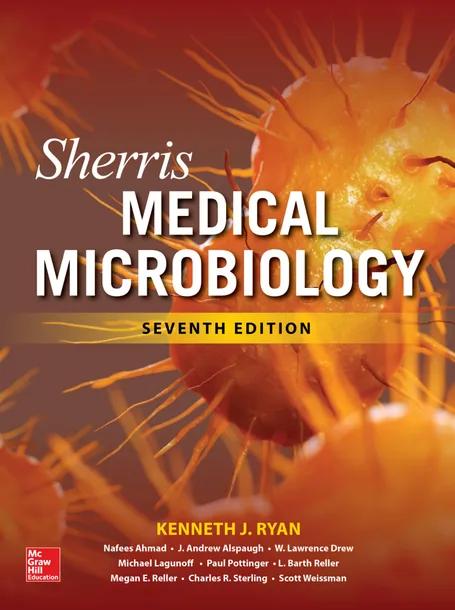
Sherris Medical Microbiology
by Kenneth J. Ryan, Scott Weissman, Nafees Ahmad
7th Edition
Publisher: McGraw-Hill Education / Medical
Book Details
| Print ISBN | 9781259859809 |
| eText ISBN | 9781259859816 |
| Publisher | McGraw-Hill Education / Medical |
| Publishing Year | 2018 |
| Edition | 7th Edition |
| Language | English |
| Pages | 1056 |
Sherris Medical Microbiology, 7th Edition, explains the links between infectious microorganisms and human disease states. Across 57 chapters, the textbook examines pathogenic processes, host immune responses, epidemiology, and the biological foundations of antimicrobial therapy.
Coverage addresses viral, bacterial, fungal, and parasitic organisms that cause infectious diseases. The volume explores basic biology, mechanisms of pathogenesis, and antimicrobial agents across each major category of pathogens.
To aid learning and review, chapters covering major diseases conclude with clinical cases and USMLE-style questions, supplemented by full-color illustrations and a collection of 100 practice questions.
Table of Contents
Chapter 1: Infection—Basic Concepts
Chapter 2: Immune Response to Infection
Chapter 3: Sterilization, Disinfection, and Infection Control
Chapter 4: Principles of Laboratory Diagnosis of Infectious Diseases
Chapter 5: Emerging and Reemerging Infectious Diseases: Emergence and Global Spread of Infection
Chapter 6: Viruses—Basic Concepts
Chapter 7: Pathogenesis of Viral Infection
Chapter 8: Antiviral Agents and Resistance
Chapter 9: Respiratory Viruses
Chapter 10: Viruses of Mumps, Measles, Rubella, and Other Childhood Exanthems
Chapter 11: Poxviruses
Chapter 12: Enteroviruses
Chapter 13: Hepatitis Viruses
Chapter 14: Herpesviruses
Chapter 15: Viruses of Diarrhea
Chapter 16: Arthropod-Borne and Other Zoonotic Viruses
Chapter 17: Rabies
Chapter 18: Retroviruses: Human T-Lymphotropic Virus, Human Immunodeficiency Virus, and Acquired Immunodeficiency Syndrome
Chapter 19: Papilloma and Polyoma Viruses
Chapter 20: Persistent Viral Infections of the Central Nervous System
Chapter 21: Bacteria—Basic Concepts
Chapter 22: Pathogenesis of Bacterial Infections
Chapter 23: Antibacterial Agents and Resistance
Chapter 24: Staphylococci
Chapter 25: Streptococci and Enterococci
Chapter 26: Corynebacterium, Listeria, and Bacillus
Chapter 27: Mycobacteria
Chapter 28: Actinomyces and Nocardia
Chapter 29: Clostridium, Bacteroides, and Other Anaerobes
Chapter 30: Neisseria
Chapter 31: Haemophilus and Bordetella
Chapter 32: Vibrio, Campylobacter, and Helicobacter
Chapter 33: Enterobacteriaceae
Chapter 34: Legionella and Coxiella
Chapter 35: Pseudomonas and Other Opportunistic Gram-negative Bacilli
Chapter 36: Plague and Other Bacterial Zoonotic Diseases
Chapter 37: Spirochetes
Chapter 38: Mycoplasma
Chapter 39: Chlamydia
Chapter 40: Rickettsia, Ehrlichia, Anaplasma, and Bartonella
Chapter 41: Dental and Periodontal Infections
Chapter 42: Fungi—Basic Concepts
Chapter 43: Pathogenesis and Diagnosis of Fungal Infections
Chapter 44: Antifungal Agents and Resistance
Chapter 45: The Superficial and Subcutaneous Fungi: Dermatophytes, Malassezia, Sporothrix, and Pigmented Molds
Chapter 46: The Opportunistic Fungi: Candida, Aspergillus, the Zygomycetes, and Pneumocystis
Chapter 47: The Systemic Fungal Pathogens: Cryptococcus, Histoplasma, Blastomyces, Coccidioides, Paracoccidioides
Chapter 48: Parasites—Basic Concepts
Chapter 49: Pathogenesis and Diagnosis of Parasitic Infection
Chapter 50: Antiparasitic Agents and Resistance
Chapter 51: Apicomplexa and Microsporidia
Chapter 52: Sarcomastigophora—The Amebas
Chapter 53: Sarcomastigophora—The Flagellates
Chapter 54: Intestinal Nematodes
Chapter 55: Tissue Nematodes
Chapter 56: Cestodes
Chapter 57: Trematodes
Customer Reviews
0.0
0 reviews
No reviews yet. Be the first to review this book!
Write a Review
Reviewed by GradeFocus Editorial Team