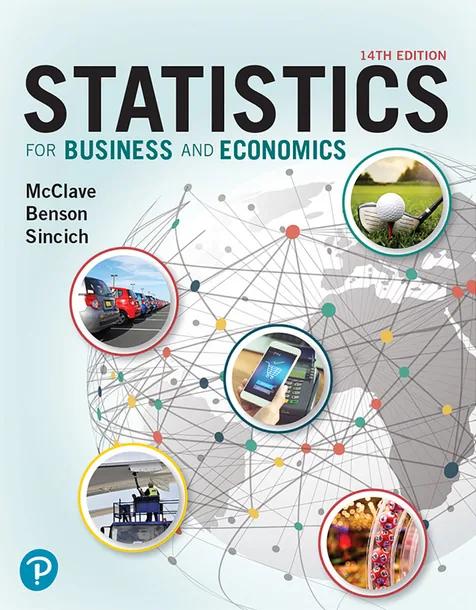
Statistics for Business and Economics
by James T. McClave, P. George Benson, Terry Sincich
14th Edition
Publisher: Pearson
Book Details
| Print ISBN | 9780136855354 |
| eText ISBN | 9780137376575 |
| Publisher | Pearson |
| Publishing Year | 2022 |
| Edition | 14th Edition |
| Language | English |
In an era dominated by big data, the capacity to convert raw information into strategic corporate action is a defining skill for modern professionals. Statistics for Business and Economics 14th Edition addresses this critical need by delivering a comprehensive introduction to statistical methodologies within a highly practical framework. By focusing on real-world scenarios, this edition helps students bridge the gap between abstract mathematical theory and everyday corporate decision-making. As organizations increasingly rely on quantitative metrics to guide their operations, mastering these analytical techniques has become essential for anyone entering the global marketplace. This textbook serves as a vital guide for developing the quantitative literacy required to navigate today's complex, information-rich commercial landscape.
The authors employ a structured approach that prioritizes conceptual understanding over rote memorization. Key themes explored throughout Statistics for Business and Economics 14th Edition include descriptive statistics, probability theory, random variables, and both parametric and nonparametric hypothesis testing. By integrating realistic datasets from diverse industries, the text demonstrates how statistical analysis directly impacts marketing, finance, human resources, and operations management. The authors emphasize the critical role of statistical inference, teaching readers not only how to perform calculations but also how to evaluate the credibility of reported research findings. This balanced perspective ensures that students learn to think critically about data collection methods, potential biases, and the ethical implications of statistical reporting in corporate environments.
Designed primarily for introductory undergraduate and graduate courses, this textbook is widely adopted by business schools seeking a rigorous yet accessible curriculum. Distinctive pedagogical features include interactive applet activities that illustrate complex probability demonstrations, helping students visualize concepts like confidence intervals and regression lines. This edition introduces updated case studies and enhanced technology integration, allowing learners to leverage modern software tools to build statistical thinking. By utilizing the Statistics for Business and Economics 14th Edition PDF, students gain flexible, digital access to these invaluable resources, including study aids and self-assessment exercises. Ultimately, this textbook equips future leaders with the analytical tools necessary to make sound, ethical, and data-driven decisions throughout their professional careers.
Table of Contents
Chapter 1: Statistics, Data, and Statistical Thinking
- • The Science of Statistics
- • Types of Statistical Applications in Business
- • Fundamental Elements of Statistics
- • Processes
- • Types of Data
- • Collecting Data: Sampling and Related Issues
- • Business Analytics: Critical Thinking with Statistics
Chapter 2: Methods for Describing Sets of Data
- • Describing Qualitative Data
- • Graphical Methods for Describing Quantitative Data
- • Numerical Measures of Central Tendency
- • Numerical Measures of Variability
- • Using the Mean and Standard Deviation
- • Numerical Measures of Relative Standing
- • Methods for Detecting Outliers
Chapter 3: Probability
- • Events, Sample Spaces, and Probability
- • Unions and Intersections
- • Complementary Events
- • The Additive Rule and Mutually Exclusive Events
- • Conditional Probability
- • The Multiplicative Rule and Independent Events
- • Bayes's Rule
Chapter 4: Random Variables and Probability Distributions
- • Two Types of Random Variables
- • Probability Distributions for Discrete Random Variables
- • The Binomial Distribution
- • The Poisson Distribution
- • Probability Distributions for Continuous Random Variables
- • The Normal Distribution
- • Descriptive Methods for Assessing Normality
Chapter 5: Sampling Distributions
- • The Concept of a Sampling Distribution
- • Properties of Sampling Distributions
- • The Sampling Distribution of the Sample Mean and the Central Limit Theorem
- • The Sampling Distribution of the Sample Proportion
Chapter 6: Inferences Based on a Single Sample: Estimation with Confidence Intervals
- • Identifying the Target Parameter
- • Large-Sample Confidence Interval for a Population Mean
- • Small-Sample Confidence Interval for a Population Mean
- • Large-Sample Confidence Interval for a Population Proportion
- • Determining the Sample Size
Chapter 7: Inferences Based on a Single Sample: Tests of Hypothesis
- • The Elements of a Test of Hypothesis
- • Formulating Hypotheses
- • Large-Sample Test of Hypothesis for a Population Mean
- • Observed Significance Levels: p-Values
- • Small-Sample Test of Hypothesis for a Population Mean
- • Large-Sample Test of Hypothesis for a Population Proportion
Chapter 8: Inferences Based on Two Samples: Confidence Intervals and Tests of Hypotheses
- • Comparing Two Population Means: Independent Sampling
- • Comparing Two Population Means: Paired Difference Experiments
- • Comparing Two Population Proportions: Independent Sampling
- • Determining the Sample Size
Chapter 9: Design of Experiments and Analysis of Variance
- • Elements of a Designed Experiment
- • The Completely Randomized Design: Single-Factor Analysis of Variance
- • Multiple Comparisons of Means
- • The Randomized Block Design
- • Two-Factor Factorial Experiments
Chapter 10: Categorical Data Analysis
- • Categorical Data and Multinomial Probabilities
- • Testing Categorical Probabilities: One-Way Table
- • Testing Independence: Two-Way Contingency Table
- • Comparing Proportions: Two-Way Contingency Table
Chapter 11: Simple Linear Regression
- • Probabilistic Models
- • Fitting the Model: The Least Squares Approach
- • Model Assumptions
- • An Estimator of Variance
- • Assessing the Utility of the Model: Making Inferences About the Slope
- • The Coefficient of Correlation
- • The Coefficient of Determination
- • Using the Model for Estimation and Prediction
Chapter 12: Multiple Regression and Model Building
- • Multiple Regression Models
- • The First-Order Model
- • Model Assumptions
- • Fitting the Model and Interpreting the Beta Coefficients
- • Utility of the Model: Overall F-Test
- • Using the Model for Estimation and Prediction
- • Model Building: Interaction and Quadratic Models
- • Qualitative Independent Variables
Customer Reviews
0.0
0 reviews
No reviews yet. Be the first to review this book!
Write a Review
Reviewed by GradeFocus
▶Research Sources (12)
- Statistics for Business and Economics by: James T. McClave
- eBook - Statistics for Business and Economics, 14e-9780137376575
- Requesting Statistics for Business and Economics : r/Textbooksfinder
- Statistics for Business and Economics 14th Edition – Original PDF ...
- [PDF] Statistics for Business and Economics, Global Edition, 14e
- Statistics for Business and Economics | CampusBooks
- Statistics for Business and Economics [Rental Edition] - eCampus.com
- [PDF] FOR BUSINESS AND ECONOMICS - studentebookhub.com
- Statistics for Business and Economics 14th Edition Direct Textbook
- Statistics for Business and Economics 14th edition - WebAssign
- Solutions for Statistics for Business & Economics 14th Ed. - McClave
- Statistics For Business & Economics (14th Edition) PDF - Scribd