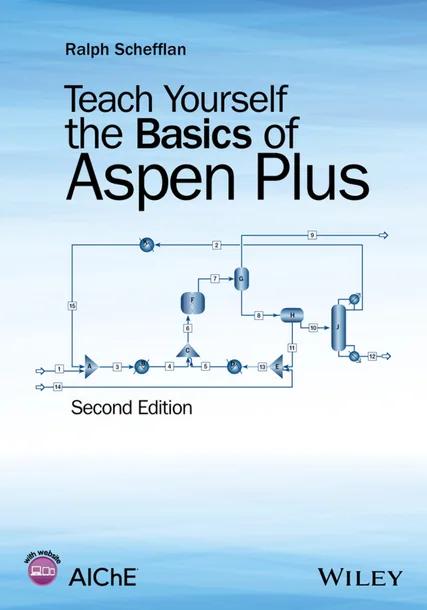
Teach Yourself the Basics of Aspen Plus
by Ralph Schefflan
2nd Edition
Publisher: Wiley-AIChE
Book Details
| Print ISBN | 9781118980590 |
| eText ISBN | 9781119276180 |
| Publisher | Wiley-AIChE |
| Publishing Year | 2016 |
| Edition | 2nd Edition |
| Language | English |
| Pages | 280 |
Teach Yourself the Basics of Aspen Plus, 2nd Edition is a textbook that introduces chemical process simulation using Aspen Plus software. Designed for students and professionals, the volume explains how to use the program for conceptual design, optimization, and performance monitoring.
Coverage outlines core simulation workflows, thermodynamic properties, recycle processes, and unit operation modeling. The volume also examines reactor and separation systems, flowsheet development, and equation-oriented solutions.
Structured in lecture-style chapters intended to emulate a workshop environment, the text integrates embedded examples to focus attention on key concepts and includes end-of-chapter workshops for testing comprehension.
Table of Contents
Chapter 1: INTRODUCTION TO ASPEN PLUS
- • 1.1 Basic Ideas
- • 1.2 Starting Aspen Plus
- • 1.3 The Next Function
- • 1.4 The Navigation Pane
- • 1.5 The Property Environment
- • 1.6 Properties for Simulation
- • 1.7 The Simulation Environment
- • 1.8 Simulation Options
- • 1.9 Units
- • 1.10 Streams
- • 1.11 Blocks
- • 1.12 The Object Manager
- • 1.13 Model Execution
- • 1.14 Viewing Results
- • 1.15 Plotting Results
- • References
Chapter 2: PROPERTIES
- • 2.1 Introduction
- • 2.2 The Pure Component Databanks
- • 2.3 Property Analysis
- • 2.4 Property Estimation
- • 2.5 Workshops
- • 2.6 Workshop Notes
- • References
Chapter 3: THE SIMPLE BLOCKS
- • 3.1 Introduction
- • 3.2 Mixer/Splitter Blocks
- • 3.3 The Simple Separator Blocks
- • 3.4 Some Manipulator Blocks
- • 3.5 Workshops
- • 3.6 Workshop Notes
Chapter 4: PROCESSES WITH RECYCLE
- • 4.1 Introduction
- • 4.2 Blocks with Recycle
- • 4.3 Heuristics
- • 4.4 Workshops
- • 4.5 Workshop Notes
- • References
Chapter 5: FLOWSHEETING AND MODEL ANALYSIS TOOLS
- • 5.1 Introduction
- • 5.2 Introduction to Fortran in Aspen Plus
- • 5.3 Basic Interpreted Fortran Capabilities
- • 5.4 The Sensitivity Function
- • 5.5 The Design Specification
- • 5.6 The Calculator Function
- • 5.7 The Transfer Function
- • 5.8 Workshops
- • 5.9 Workshop Notes
- • References
Chapter 6: THE DATA REGRESSION SYSTEM (DRS)
- • 6.1 Introduction
- • 6.2 Parameters of Equations of State
- • 6.3 Parameters of Activity Coefficient Equations
- • 6.4 Basic Ideas of Regression
- • 6.5 The Mathematics of Regression
- • 6.6 Practical Aspects of Regression of VLE or LLE Data
- • 6.7 VLE and LLE Data Sources
- • 6.8 Workshops
- • 6.9 Workshop Notes
- • References
Chapter 7: FLASHES AND DECANTER
- • 7.1 Introduction
- • 7.2 The Flash2 Block
- • 7.3 The Flash3 Block
- • 7.4 The Decanter Block
- • 7.5 Workshops
- • 7.6 Workshop Notes
- • References
Chapter 8: PRESSURE CHANGERS
- • 8.1 Introduction
- • 8.2 The Pump Block
- • 8.3 The Compr Block
- • 8.4 The MCompr Block
- • 8.5 Pipelines and Fittings
- • 8.6 Workshops
- • 8.7 Workshop Notes
- • References
Chapter 9: HEAT EXCHANGERS
- • 9.1 Introduction
- • 9.2 The Heater Block
- • 9.3 The Heatx Block
- • 9.4 The Mheatx Block
- • 9.5 Workshops
- • 9.6 Workshop Notes
- • References
Chapter 10: REACTORS
- • 10.1 Introduction
- • 10.2 The RStoic Block
- • 10.3 The RYield Block
- • 10.4 The REquil Block
- • 10.5 The RGibbs Block
- • 10.6 Reactions for the Rigorous Models
- • 10.7 The RCSTR Block
- • 10.8 The RPlug Block
- • 10.9 The RBatch Block
- • 10.10 Workshops
- • 10.11 Workshop Notes
- • References
Chapter 11: MULTISTAGE EQUILIBRIUM SEPARATORS
- • 11.1 Introduction
- • 11.2 The Basic Equations
- • 11.3 The Design Problem
- • 11.4 A Three-Product Distillation Example
- • 11.5 Preliminary Design and Rating Models
- • 11.6 Rigorous Models
- • 11.7 BatchSep
- • 11.8 Workshops
- • 11.9 Workshop Notes
- • References
Chapter 12: PROCESS FLOWSHEET DEVELOPMENT
- • 12.1 Introduction
- • 12.2 Heuristics
- • 12.3 An Example –The Production of Styrene
- • 12.4 A Model with Basic Blocks
- • 12.5 Properties
- • 12.6 Rigorous Flash and Decanter
- • 12.7 Analyzing the Rigorous Distillation
- • 12.8 Integrating the Rigorous Distillation into the Flowsheet
- • 12.9 The Reactor Feed
- • 12.10 Miscellaneous Considerations
- • 12.11 Workshops
- • 12.12 Workshop Notes
- • Reference
Chapter 13: OPTIMIZATION
- • 13.1 Introduction
- • 13.2 An Optimization Example
- • 13.3 Workshops
- • 13.4 Workshop Notes
- • References
Chapter 14: COMPLEX EQUILIBRIUM STAGE SEPARATIONS
- • 14.1 Introduction
- • 14.2 Energy Integration Applications
- • 14.3 Homogeneous Azeotropic Distillation
- • 14.4 Extractive Distillation
- • 14.5 Heterogeneous Operations
- • 14.6 Workshops
- • 14.7 Workshop Notes
- • References
Chapter 15: EQUATION-ORIENTED SIMULATION
- • 15.1 Introduction
- • 15.2 Identification of Variables
- • 15.3 Equations for EO Simulation
- • 15.4 Solving the EO Equations
- • 15.5 Comparing Calculated Variables in SM and EO Simulation
- • 15.6 Synchronization of the Equations
- • 15.7 The Equation Oriented Menu
- • 15.8 Solution of an EO Problem
- • 15.9 Reinitialization
- • 15.10 A Design Specification
- • 15.11 An SM Problem That is Difficult to Converge
- • 15.12 Sensitivity Analysis
- • 15.13 Equation-Oriented Optimization
- • 15.14 Workshops
- • 15.15 Workshop Notes
- • References
Chapter 16: ELECTROLYTES
- • 16.1 Introduction
- • 16.2 Electrolyte Solution Equilibria
- • 16.3 Electrolyte Solution Equilibria and the Electrolyte Wizard
- • 16.4 Electrolyte Equilibrium/Phase Equilibrium Examples
- • References
Chapter 17: BEYOND THE BASICS OF ASPEN PLUS
Customer Reviews
0.0
0 reviews
No reviews yet. Be the first to review this book!
Write a Review
Reviewed by GradeFocus Editorial Team
Related Books
Industrial Chemical Process Analysis and Design
Mariano Martín Martín
Industrial Water Conservation
Dominic Foo
Ionic Liquids in Biomass Processing
Harish K. Chopra
Artificial Intelligence in Chemical Engineering
Farooq Sher
Ozone Gas Sensing Technologies
Niravkumar J. Joshi
Machine Learning for Membrane Separation Applications
Mashallah Rezakazemi