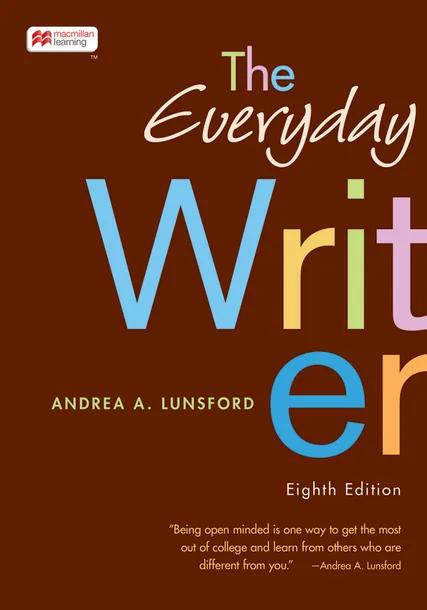
The Everyday Writer
by Andrea A. Lunsford
8th Edition
Publisher: Bedford/St. Martin's
Book Details
| Print ISBN | 9781319332037 |
| eText ISBN | 9781319412036 |
| Publisher | Bedford/St. Martin's |
| Publishing Year | 2023 |
| Edition | 8th Edition |
| Language | English |
The Everyday Writer, 8th Edition, is a writing handbook authored by Andrea A. Lunsford and published by Bedford/St. Martin's. Designed for postsecondary educational settings, this reference resource assists student writers with rhetorical strategies, critical thinking, and structured argument construction across various academic disciplines.
The handbook establishes an organized progression from preliminary composition strategies to rigorous research practices. Readers explore systematic methods for evaluating external source materials, integrating citations accurately, and avoiding plagiarism. The text further demonstrates how writing requirements adapt across distinct fields, providing explicit guidance for composition in the humanities, social sciences, and natural and applied sciences.
In addition to written text analysis, the volume incorporates contemporary media communication principles. It offers practical guidance for making thoughtful visual design decisions, preparing public presentations, and authoring content for alternative media formats. These features support college students and instructors seeking a versatile reference guide for academic coursework and practical projects.
Table of Contents
Chapter 1: A Writer’s Opportunities
Chapter 2: A Writer’s Choices
Chapter 3: Exploring, Planning, and Drafting
Chapter 4: Developing Paragraphs
Chapter 5: Reviewing, Revising, and Editing
Chapter 6: Reflecting
Chapter 7: Critical Reading
Chapter 8: Analyzing Arguments
Chapter 9: Constructing arguments
Chapter 10: Doing research
Chapter 11: Evaluating Sources
Chapter 12: Integrating Sources and Avoiding Plagiarism
Chapter 13: Writing Well and Ethically in Any Discipline or Profession
Chapter 14: Writing in the Humanities
Chapter 15: Writing in the Social Sciences
Chapter 16: Writing in the Natural and Applied Sciences
Chapter 17: Writing in Professional Settings
Chapter 18: Making Design Decisions
Chapter 19: Creating Presentations
Chapter 20: Communicating in Other Media
Chapter 21: Writing to Make Something Happen in the World
Chapter 22: Language and Identity
Chapter 23: Language Varieties
Chapter 24: Writing to the World
Chapter 25: Language That Builds Common Ground
Chapter 26: Style Matters!
Chapter 27: Coordination, Subordination, and Emphasis
Chapter 28: Consistency and Completeness
Chapter 29: Parallelism
Chapter 30: Shifts
Chapter 31: Conciseness
Chapter 32: The Top Twenty
Chapter 33: Parts of Speech
Chapter 34: Parts of Sentences
Chapter 35: Verbs and Verb Phrases
Chapter 36: Nouns and Noun Phrases
Chapter 37: Subject-Verb Agreement
Chapter 38: Pronouns
Chapter 39: Adjectives and Adverbs
Chapter 40: Modifier Placement
Chapter 41: Prepositions and Prepositional Phrases
Chapter 42: Comma Splices and Fused Sentences
Chapter 43: Sentence Fragments
Chapter 44: Commas
Chapter 45: Semicolons
Chapter 46: End Punctuation
Chapter 47: Apostrophes
Chapter 48: Quotation Marks
Chapter 49: Other Punctuation Marks
Chapter 50: Capital Letters
Chapter 51: Abbreviations and Numbers
Chapter 52: Italics and Hyphens
Chapter 53: The Basics of MLA Style
Chapter 54: MLA Style for In-Text Citations
Chapter 55: MLA Style for a List of Works Cited
Chapter 56: A Student Research Essay, MLA Style
Chapter 57: The Basics of APA Style
Chapter 58: APA Style for In-Text Citations
Chapter 59: APA Style for a List of References
Chapter 60: A Student Research Essay, APA Style
Chapter 61: The Basics of Chicago Style
Chapter 62: Chicago Style for Notes and Bibliographic Entries
Chapter 63: An Excerpt from a Student Research Essay, Chicago Style
Customer Reviews
0.0
0 reviews
No reviews yet. Be the first to review this book!
Write a Review
Reviewed by GradeFocus Editorial Team