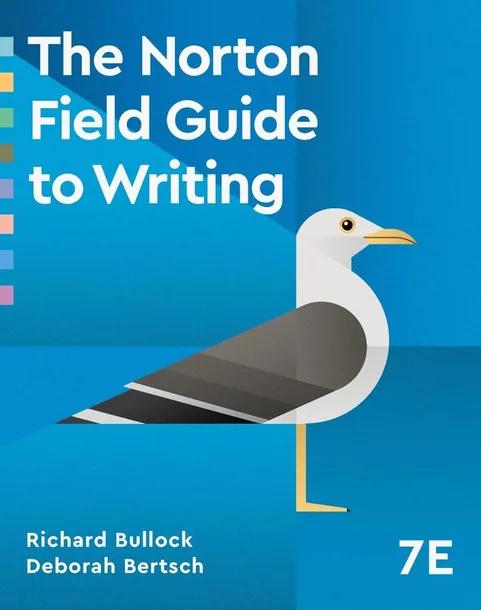
The Norton Field Guide to Writing
by Richard Bullock, Deborah Bertsch
7th Edition
Publisher: W. W. Norton & Company
Book Details
| Print ISBN | 9781324087335 |
| eText ISBN | 9781324087359 |
| Publisher | W. W. Norton & Company |
| Publishing Year | 2025 |
| Edition | 7th Edition |
| Language | English |
| Pages | 760 |
The Norton Field Guide to Writing, 7th Edition, written by Richard Bullock and Deborah Bertsch, is a postsecondary composition textbook published by W. W. Norton & Company. This volume provides structured instructional guidance for college students as they develop academic literacies across higher education settings.
The content explores primary composition forms, including literacy narratives, personal essays, profiles, proposals, remixes, and literary analyses. Instruction moves sequentially across key phases of the writing process, leading writers from initial inquiry and idea generation to drafting, peer feedback, self-assessment, revision, reflection, and portfolio compilation. Additional chapters examine rhetorical strategies such as analyzing causes and effects, classifying information, comparing topics, using dialogue, and establishing an appropriate stance for diverse academic audiences.
To offer authentic writing models, the Seventh Edition incorporates twelve new sample readings written by student and professional authors. This resource supports college students and composition instructors engaged in postsecondary writing coursework.
Table of Contents
Chapter 1: Writing in Academic Contexts
Chapter 2: Reading in Academic Contexts
Chapter 3: Summarizing and Responding: Where Reading Meets Writing
- • BEATRIZ CARDOSO E SOUZA, Let’s Stop Pretending That Expensive College Degrees and Student Loans Aren’t Barriers
Chapter 4: Developing Academic Habits of Mind
Chapter 5: Writing and Learning Online
Chapter 6: Writing with Generative AI
Chapter 7: Purpose
Chapter 8: Audience
Chapter 9: Genre
Chapter 10: Stance
Chapter 11: Media / Design
Chapter 12: Writing a Literacy Narrative
- • REA KARIM, Becoming an American Girl
- • KARLA MARIANA HERRERA GUTIERREZ, Reading, Writing, and Riding
- • ANA-JAMILEH KASSFY, Automotive Literacy
Chapter 13: Analyzing Texts
- • PAT FINN, The Architecture of Inequality: On Bong Joon-ho’s Parasite
- • DANIELLE ALLEN, Our Declaration
- • AIMEE BENDER, What Writers Can Learn from Goodnight Moon
Chapter 14: Reporting Information
- • RENAE TINGLING, Sleepless Nights of a University Student
- • FRANKIE SCHEMBRI, Edible Magic
- • MICHAELEEN DOUCLEFF, You Don’t Need Words to Calm a Grumpy Kid
Chapter 15: Arguing a Position
- • BEN WILDAVSKY, Let’s Stop Pretending College Degrees Don’t Matter
- • BRIANNA SCHUNK, Come Look at the Freaks: Examining and Advocating for Disability Theatre
- • ROHAN MEHTA, Banning ChatGPT Will Do More Harm Than Good
Chapter 16: Annotated Bibliographies and Reviews of Scholarly Literature
- • SEAN KELLIHER, Tunesmith Terror Techniques: Identifying Patterns in the Music of Horror Video Games
- • KELLY GREEN, Researching Hunger and Poverty
- • CAMERON CARROLL, Zombie Film Scholarship: A Review of the Literature
Chapter 17: Evaluations
- • JOEL ROBINSON, Killers of the Flower Moon Is Not the Story an Osage Would Have Told. You Should Still See It.
Chapter 18: Literary Analyses
- • RICHARD BLANCO, Complaint of El Río Grande
- • LANGSTON HUGHES, The Negro Speaks of Rivers
- • KRITHIKA SHRINIVAS, Blanco and Hughes: Rivers and Identity
Chapter 19: Personal Narrative
- • RYAN MCLENDON, The Definition of Love
Chapter 20: Profiles
- • KATIA FAROUN, A Crowd, a Question, and a Typewriter
Chapter 21: Proposals
- • DAVE CHOKSHI, Forget about Living to 100. Let’s Live Healthier Instead.
- • CATHERINE THOMS, Social Media and Data Privacy
Chapter 22: Explorations
- • BRIAN DIEHL, Talking with Granddad
Chapter 23: Remixes
- • TODD JONES, Rare Earth
Chapter 24: Fields of Study
Chapter 25: Reading across Fields of Study
Chapter 26: Writing in Academic Fields of Study
Chapter 27: Processes of Writing
Chapter 28: Writing as Inquiry
Chapter 29: Generating Ideas and Text
Chapter 30: Organizing Your Writing, Guiding Your Readers
Chapter 31: Drafting
Chapter 32: Assessing Your Own Writing
Chapter 33: Getting Response and Revising
Chapter 34: Editing and Proofreading
Chapter 35: Compiling a Portfolio
Chapter 36: Reflecting on Your Writing
Chapter 37: Analyzing Causes and Effects
Chapter 38: Arguing
Chapter 39: Classifying and Dividing
Chapter 40: Comparing and Contrasting
Chapter 41: Defining
Chapter 42: Describing
Chapter 43: Using Dialogue
Chapter 44: Explaining Processes
Chapter 45: Narrating
Chapter 46: Taking Essay Exams
Chapter 47: Getting a Start on Research
Chapter 48: Finding Sources
Chapter 49: Evaluating Sources
Chapter 50: Synthesizing Ideas
Chapter 51: Quoting, Paraphrasing, and Summarizing
Chapter 52: Acknowledging Sources, Avoiding Plagiarism
Chapter 53: Documentation
Chapter 54: MLA Style
- • JACKSON PARELL, Free at Last, Free at Last: Civil War Memory and Civil Rights Rhetoric
Chapter 55: APA Style
- • ANALISA JOHNSON, The Benefits of Prison Nursery Programs
Chapter 56: Choosing Media
Chapter 57: Designing Text
Chapter 58: Using Visuals, Incorporating Sound
Chapter 59: Giving Presentations
- • ABRAHAM LINCOLN, Gettysburg Address
- • GRETA THUNBERG, Our House Is Still on Fire
Customer Reviews
0.0
0 reviews
No reviews yet. Be the first to review this book!
Write a Review
Reviewed by GradeFocus Editorial Team
▶Research Sources (14)
- The Norton Field Guide to Writing
- 9780393883794: The Norton Field Guide to Writing (Sixth Edition)
- Search Results : Bullock
- The Norton Field Guide to Writing
- The Norton Field Guide to Writing (Paperback) by Richard Bullock et al.
- The Norton Field Guide to Writing | Richard Bullock, Deborah Bertsch
- The Norton Field Guide to Writing | Rent | 9781324087335
- The Norton Field Guide to Writing with Readings (with Ebook, ...
- Welcome to The Norton Field Guide to Writing
- 9781324087335: The Norton Field Guide to Writing
- Norton Field Guide to Writing: With Readings and Handbook - With Code
- The Norton Field Guide to Writing with Readings 7e : r/Dalhousie
- The Norton Field Guide to writing : with readings and handbook
- Hello, Im looking for the norton field guide to writing with reading 7th ...