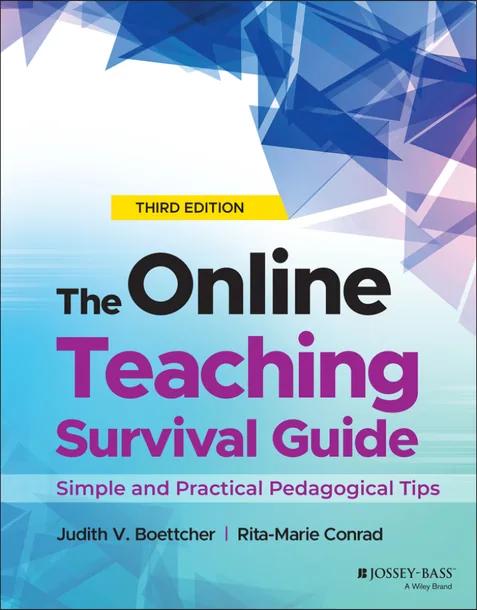
The Online Teaching Survival Guide
Simple and Practical Pedagogical Tips
by Judith V. Boettcher, Rita-Marie Conrad
3rd Edition
Publisher: Jossey-Bass
Book Details
| Print ISBN | 9781119765004 |
| eText ISBN | 9781119763178 |
| Publisher | Jossey-Bass |
| Publishing Year | 2021 |
| Edition | 3rd Edition |
| Language | English |
| Pages | 400 |
The Online Teaching Survival Guide: Simple and Practical Pedagogical Tips, 3rd Edition, presents research-grounded instructional strategies for educators leading online and blended courses. The textbook offers practical recommendations for structuring distance coursework across every stage of a term.
The volume focuses on core course management methods, including establishing social presence, fostering a supportive community, and guiding online discussions and questioning. It also addresses how to coordinate technology tools with pedagogical goals.
Designed for both new and experienced online instructors, the guide details approaches for flexible course formats. It highlights techniques for integrating synchronous class sessions with asynchronous conversations through flipped classroom models.
Table of Contents
Chapter 1: Teaching Online: The Big Picture
- • Preparing to Teach in the Online and Blended Environments
- • Uh-Oh. What Did I Say I Would Do?
- • Is This You?
- • The Definition of a Course
- • How Do Online and Blended Courses Differ from Traditional Courses?
- • Types of Online and Blended Courses
- • The Four Phases of a Course
- • Learning Theories and Theorists
- • Lev Vygotsky (1896–1934): Theory of Social Development
- • John Dewey (1859–1952): Experiential Learning
- • Jean Piaget (1896–1980): Theory of Genetic Epistemology or Origins of Thinking
- • Jerome Bruner (1915–2016): Constructivism
- • John Seely Brown (1940–): Cognitive Apprenticeship
- • Roger Schank (1946–): Schema Theory
- • Albert Bandura (1925–): Social Learning Theory
- • Jean Lave (1939–): Situated Learning Theory
- • K. Anders Ericsson (1946–2020): Expert Performance Theory
- • Ellen Langer (1947–): Theory of Mindful Learning
- • Daniel Goleman (1946–): Theory of Emotional Intelligence
- • Other Theorists and Influencers
- • Summary—and What’s Next
- • Pause, Reflect, and Integrate
Chapter 2: Pedagogical Principles for Effective Teaching and Learning: 10 Core Learning Principles
- • Background of the 10 Core Learning Principles
- • Ten Core Learning Principles
- • Principle 1: Every Structured Learning Experience Has Four Elements, with the Learner at the Center
- • Principle 2: Learners Bring Their Own Personalized and Customized Knowledge, Skills, and Attitudes to the Learning Experience
- • Principle 3: Faculty Mentors Are the Directors of the Learning Experience
- • Principle 4: All Learners Do Not Need to Learn All Course Content; All Learners Do Need to Learn the Core Concepts
- • Principle 5: Every Learning Experience Includes the Environment or Context in Which the Learner Interacts
- • Principle 6: Every Learner Has a Zone of Proximal Development That Defines the Space That a Learner Is Ready to Develop into Useful Knowledge
- • Principle 7: Concepts Are NotWords but Organized and Interconnected Knowledge Clusters
- • Principle 8: Different Instruction Is Required for Different Learning Outcomes
- • Principle 9: Everything Else Being Equal, More Time on Task Equals More Learning
- • Principle 10:We Shape Our Tools, and Our Tools Shape Us
- • Summary—and What’s Next
- • Pause, Reflect, and Integrate
Chapter 3: Best Practices for Teaching Online: 10 Plus 4
- • Best Practices for Online and Blended Teaching and Learning
- • Best Practice 1: Be Present at Your Course
- • Best Practice 2: Create a Supportive Online Course Community
- • Best Practice 3: Develop a Set of Explicit Workload and Communication Expectations for Your Learners and for Yourself
- • Best Practice 4: Use a Variety of Large Group, Small Group, and Individual Work Experiences
- • Best Practice 5: Use Synchronous and Asynchronous Activities
- • Best Practice 6: Ask for Informal Feedback Early in the Term
- • Best Practice 7: Prepare Discussion Posts That Invite Responses, Questions, Discussions, and Reflections
- • Best Practice 8: Think Digital and Mobile for All Course Content
- • Best Practice 9: Combine Core Concept Learning with Customized and Personalized Learning
- • Best Practice 10: Plan a Good Closing andWrap Activity for the Course
- • Four More Best Practices for Online and Blended Teaching and Learning
- • Best Practice 11: Assess as You Go by Gathering Evidences of Learning
- • Best Practice 12: Rigorously Connect Content to Core Concepts and Learning Outcomes
- • Best Practice 13: Develop and Use a Content Frame for the Course
- • Best Practice 14: Design Experiences to Help Learners Make Progress on Their Novice-to-Expert Journey
- • Conclusion
- • Summary—and What’s Next
- • Pause, Reflect, and Integrate
Chapter 4: Technology Tools to Support Teaching and Learning
- • Guidelines for Choosing and Using Technology Tools
- • Guideline 1: Pedagogy First, Technology Second
- • Guideline 2: Keep It Simple
- • Guideline 3: Involve Your Learners in Choices and Use of Digital Tools and Resources
- • Guideline 4: Have Choices and Backups for When the Cloud Disappears
- • Guideline 5: Review Your Technology Tool Set Every Two to Three Terms
- • Set One: Basic Technology Tools for Online and Blended Teaching and Learning
- • Communication Tools in Learning Management Systems
- • More Thoughts on the Basic Tools
- • Set Two: Enriched Basic Technology Tools
- • Set Three: Tools for Applying Knowledge in Authentic Contexts
- • Staying in Sync with Tools
- • Pause, Reflect, and Integrate
Chapter 5: Four Phases of a Course: Themes and Happenings
- • Phase 1 Course Beginnings: Starting Off on the Right Foot
- • Course Beginnings: Themes and Best Practices
- • What’s Happening in Course Beginnings
- • Phase 2 Early Middle: Keeping the Ball Rolling
- • Early Middle: Themes and Best Practices
- • What’s Happening in the Early Middle
- • Phase 3 Late Middle: Letting Go of the Power
- • Late Middle: Themes and Best Practices
- • What’s Happening in the Late Middle
- • Phase 4 Closing Weeks: Pruning, Reflecting, andWrapping Up
- • Closing Weeks: Themes and Best Practices
- • What’s Happening in the Closing Weeks
- • Summary—and What’s Next
- • Pause, Reflect, and Integrate
Chapter 6: Phase 1: Course Beginnings
- • Overview of Tips for Course Beginnings
- • Preparing Your Syllabus and Course Site
- • Launching Your Course
- • Creating Meaningful and Stimulating Discussion Forums
- • Managing Discussion Forums
- • CB Tip 1: Essential Elements of an Online or Blended Course Syllabus and Course Site
- • CB Tip 2: More on the Essential Elements of an Online or Blended Syllabus
- • CB Tip 3: Designing Learning for All
- • CB Tip 4: Creating a Syllabus That Jump-starts Learning
- • CB Tip 5: Using “Bookending” to Add Structure and Meaning
- • CB Tip 6: The Faculty Role in Blended and Online Courses
- • CB Tip 7: Hitting the Ground Running: How Not to Lose the First Week
- • CB Tip 8: Launching Social and Cognitive Presence
- • CB Tip 9: Generating Energy and Purpose with Specific Learning Goals
- • CB Tip 10: Getting to Know Students’ Minds: The Vygotsky Zone of Proximal Development
- • CB Tip 11: Getting into the Swing of a Course: Is There an Ideal Weekly Rhythm?
- • CB Tip 12: The Why and How of Discussion Forums: Their Role in the Online Course
- • CB Tip 13: Four Types of Discussion Forums: Purpose, Structure, and Assessment
- • CB Tip 14: Characteristics and Examples of Good Discussion Questions
- • CB Tip 15: Power Questioning for Meaningful Discussions
- • CB Tip 16: Guided Student Response Posts—A Three-Part Structure
- • CB Tip 17: Discussion Wraps: A Useful Cognitive Pattern or a Collection of Discrete Thoughts?
- • CB Tip 18: Using Discussion Postings to Gather Evidence of Learning
- • CB Tip 19: Feedback in Discussion Posts—How Soon, How Much, andWrapping Up
- • Summary—and What’s Next
- • Pause, Reflect, and Integrate
Chapter 7: Phase 2: Keeping the Ball Rolling in the Early Middle
- • Overview of Tips for the Early Middle
- • Monitoring and Managing Communications
- • Memory, Metacognition, and Learning Guides
- • Building Cognitive Presence
- • Strategies and Tools for Building Community
- • EM Tip 1: Tools for Teaching Presence: Announcements, E-mails, Discussion Forums, and Texting
- • EM Tip 2: Monitoring Student Progress Using Analytics
- • EM Tip 3: Early Feedback—It’s a Two-Way Street
- • EM Tip 4: Tips for Making Grading Time Efficient and Formative
- • EM Tip 5: Dealing with Difficult Students—What Do You Do?
- • Memory, Metacognition, and Learning Skills
- • EM Tip 6: Steps in Memory Making: What Behaviors Make a Difference
- • EM Tip 7: Promoting Metacognitive Skills—Activities for Thinking About Thinking
- • EM Tip 8: Student Guides for Course Reading and Listening Resources
- • Building the Cognitive Presence
- • EM Tip 9: Building Cognitive Presence Using the Practical Inquiry Model
- • Conclusion
- • EM Tip 10: Core Concepts of a Course—Do You Know Yours?
- • EM Tip 11: Assessment Plans for Online and Blended Courses
- • An Assessment Plan That Is Distributed and Continuous
- • EM Tip 12: Three Best Assessment Practices
- • EM Tip 13: Assignments for the Evaluating and Creating Levels of Bloom’s Taxonomy
- • EM Tip 14: Collaborating with Groups of Two or Three—Micro-Teaming
- • EM Tip 15: Projects in Online Courses: Setting Up and Structuring Groups
- • EM Tip 16: Using Synchronous Gathering Apps
- • EM Tip 17: Using Audio and Video to Create Engaging Learning Experiences
- • Summary—and What’s Next
- • Pause, Reflect, and Integrate
Chapter 8: Phase 3: Letting Go of Power in the Late Middle
- • Overview of Tips for the Late Middle
- • Going Deeper: Leveraging the Power of Questions
- • Feedback for Cognitive Growth
- • Assessing Learning as You Go with Projects
- • Community Empowerment and Social Networking
- • LM Tip 1: Questions and Answers: Upside Down and Inside Out
- • LM Tip 2: Three Techniques for Making Your Students’ Knowledge Visible
- • LM Tip 3: Developing Rigor in Questioning: Eight Intellectual Standards
- • LM Tip 4: Moving Beyond Knowledge Integration to Defining Problems and Finding Solutions
- • LM Tip 5: Timely Feedback on Assignments and Using Rubrics
- • LM TIP 6: Substantive Feedback: Doing It Wisely andWell
- • LM Tip 7: Rubrics for Analyzing Critical Thinking
- • LM Tip 8: Customizing and Personalizing Projects
- • LM Tip 9: Managing and Facilitating Group Projects
- • LM Tip 10: Assessing Group Projects
- • LM Tip 11: Four Coaching Practices During Project Time
- • LM Tip 12: Course Middles and Muddles: Souped-Up Conversations to Spark Energy
- • LM Tip 13: Using Social Networking to Build Community
- • LM Tip 14: Experts: A Touch of Spice
- • Summary—and What’s Next
- • Pause, Reflect, and Integrate
Chapter 9: Phase 4: Pruning, Reflecting, andWrapping Up
- • Overview of Tips for the Closing Weeks
- • Meaningful Projects and Presentations
- • Preparing for the Course Wrap
- • CW Tip 1: Using What-If Scenarios: Flexing Our Minds with Possibilities
- • CW Tip 2: Stage 3 of a Learning Community: Stimulating and Comfortable Camaraderie
- • CW Tip 3: Learners as Leaders
- • CW Tip 4: Course Wrapping with Concept Mapping: Capturing Course Content Meaningfully
- • CW Tip 5: Using Case Studies: Making Content Real
- • CW Tip 6: Pausing, Reflecting, and Pruning Strategies
- • CW Tip 7: Gaming Activities for Energy, Learning and Engagement
- • CW Tip 8: Closing Experiences: Wrapping Up a Course with Style
- • CW Tip 9: Debriefing Techniques: What One Change Would Students Recommend?
- • Conclusion—and What’s Next
- • Pause, Reflect, and Integrate
Chapter 10: Teaching Accelerated Intensive Courses
- • Overview of Tips for Intensive Courses (IC)
- • IC Tip 1: Designing Intensive Courses Using Content Framing and Case Studies
- • IC Tip 2: High-Impact Practices for Short Courses: Reflections, Patterns, and Relationships
- • IC Tip 3: Developing Expertise in Intensive Courses: Can It Be Done?
- • Conclusion—and What’s Next
- • Pause, Reflect, and Integrate
Chapter 11: Flexible Learning Models and Experiences
- • Overview of Tips for Flexible Learning Designs (FL)
- • What Are Flexible Learning Designs?
- • FL Tip 1: Incorporating Online Elements Quickly—Five Essentials
- • FL Tip 2: Making Large Online Classes Feel Small
- • FL Tip 3: Structuring the Synchronous Online Class Meeting
- • Conclusion—and What’s Next
- • Pause, Reflect, and Integrate
Chapter 12: What’s Next: Reflecting and Looking Forward
- • Reflecting and Looking Forward Using the Four Course Phases
- • Design and Preparation Phase
- • Reflecting on Phase One, Course Beginnings
- • Reflecting on Phase Two, Early Middle
- • Reflecting on Phase Three, Late Middle
- • Reflecting on Phase Four, Closing Weeks
- • Reflecting and Looking Forward with the Learning Experiences Framework
- • Learner
- • Faculty Mentor
- • Content and Knowledge Resources and Goals
- • Environment and Context
- • Advice from Fellow Online Instructors
- • Advice 1: Just Do Your Best
- • Advice 2: It’s Kind of Fun to Do the Impossible!
- • Advice 3: Be Prepared to Learn a Lot
- • Advice 4: Don’t Underestimate the Value of Connection
- • Advice 5: Let Go of What Used to Be
- • Conclusion: Innovation as a Three-Phase Process
Customer Reviews
0.0
0 reviews
No reviews yet. Be the first to review this book!
Write a Review
Reviewed by GradeFocus Editorial Team
Related Books
Artificial Intelligence and IoT in Online Education Systems
Ramanujam E.

The Digital Student
Andy Phippen

Degrees of Change
Juan M. Lavista Ferres
Human Factors in Simulation and Training
Dennis Vincenzi

An Introduction to Distance Education
Martha F. Cleveland-Innes
Trends and Issues in Instructional Design and Technology
Robert A. Reiser