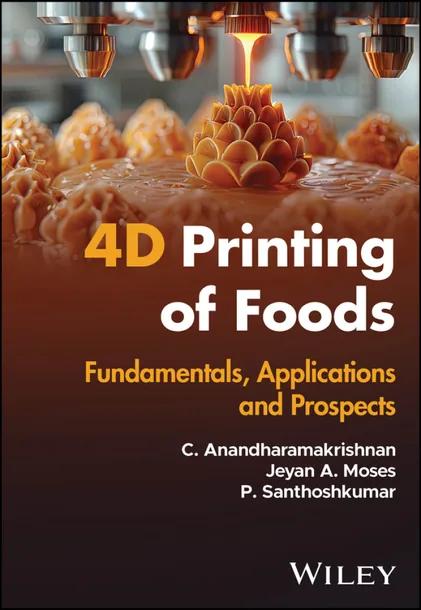
4D Printing of Foods
Fundamentals, Applications and Prospects
by C. Anandharamakrishnan, Jeyan A. Moses, P. Santhoshkumar
1st Edition
Publisher: Wiley-Blackwell
Book Details
| Print ISBN | 9781394305308 |
| eText ISBN | 9781394305254 |
| Publisher | Wiley-Blackwell |
| Publishing Year | 2025 |
| Edition | 1st Edition |
| Language | English |
| Pages | 336 |
The 1st Edition of 4D Printing of Foods presents a comprehensive technical reference on time-dependent food fabrication processes and dynamic material transformations. Designed for food engineers and biomaterials professionals, this book explains how targeted physical, chemical, and biological triggers modify printed matrix structures to alter physical and functional properties after deposition.
The content synthesizes core principles of stimulus responsiveness while establishing practical frameworks for material design, structural modeling, and process simulation. It systematically examines how responsive materials react across essential food attributes, outlining methods to control temporal changes in shape, color, nutritive value, texture, flavor, aroma, and cellular growth.
A defining feature of the volume is its prospective analysis of expanding capabilities across 4D, 5D, 6D, and 7D printing technologies. This comprehensive coverage provides digitalized food manufacturing professionals with the conceptual foundation required to integrate multi-dimensional printing strategies into advanced research and industrial food production.
Table of Contents
Chapter 1: Introduction to Food Printing Technology
- • 1.1 Introduction
- • 1.2 Advances in Food Customization
- • 1.2.1 Customization Approaches
- • 1.3 Additive Manufacturing and 3D Printing
- • 1.4 Fundamental Concepts of 3D Food Printing
- • 1.5 Nomenclature/Terminologies Related to Food Printing
- • 1.6 Food Printability
- • 1.6.1 Materials Classification
- • 1.7 3D Food Printing Types
- • 1.7.1 Extrusion-Based 3D Printing
- • 1.7.2 Inkjet 3D Printing
- • 1.7.3 Binder Jetting
- • 1.7.4 Selective Sintering
- • 1.7.5 Bioprinting
- • 1.7.6 Others
- • 1.8 Hardware Requirements and 3D Printer Configurations
- • 1.9 Software Requirements
- • 1.10 Conclusion
Chapter 2: 3D Food Printing and Emerging Applications
- • 2.1 Introduction
- • 2.2 Emerging Concepts in 3D Food Printing
- • 2.2.1 Multimaterial Printing
- • 2.2.1.1 Dual/Multinozzle Axial Printing
- • 2.2.1.2 Coaxial Nozzle Printing
- • 2.3 Application Segments – 3D Food Printing
- • 2.3.1 Personalizing Nutrients and Nutraceuticals
- • 2.3.2 Customizing Appearance
- • 2.3.3 Customizing Release of Target Molecules
- • 2.3.4 Healthier Food Options
- • 2.3.5 Foods for Special Needs
- • 2.3.6 Consumer Requirements: Conveniences and Variety
- • 2.3.7 Toward Waste Valorization and Cleaner Production
- • 2.3.8 Improving Food Packaging
- • 2.4 Conclusion
Chapter 3: Postprinting and Postprocessing: Need, Methods, and Quality Assessment
- • 3.1 Introduction
- • 3.2 Postprinting Stability and Applicability
- • 3.3 Postprocessing Methods and Impact on Quality
- • 3.4 Approaches for Quality Assessment
- • 3.4.1 Texture and Color Assessment
- • 3.4.2 Dimensional Assessment
- • 3.4.3 Sensory Evaluation
- • 3.4.4 Image Analysis
- • 3.4.5 Computer-Assisted Quality Evaluation
- • 3.4.6 Microstructure Imaging
- • 3.4.7 Structural Stability Assessment
- • 3.5 Challenges and Future Needs
- • 3.6 Scope for Four-Dimensional (4D) Printing
- • 3.7 Conclusion
Chapter 4: Fundamentals of 4D Printing Technology
- • 4.1 Introduction
- • 4.2 Fundamental Concepts and Definitions
- • 4.2.1 Stimulus and Material Design
- • 4.2.2 Modeling and Simulation
- • 4.3 Laws of 4D Printing
- • 4.4 Nature-Inspired Concepts in 4D Printing
- • 4.5 Materials in 4D Printing
- • 4.5.1 Single Material 4D Printing
- • 4.5.1.1 Stimulus Responsiveness by Single SME
- • 4.5.1.2 Stimulus Responsiveness by Multiple SME
- • 4.5.2 Multimaterial 4D Printing
- • 4.5.2.1 Materials Used in Multimaterial 4D Prints
- • 4.6 Printers in 4D Printing
- • 4.6.1 Printer Configurations
- • 4.6.2 Printing Variations
- • 4.7 Mathematical Modeling in 4D Printing
- • 4.8 Current State of the Art
- • 4.9 Conclusion
Chapter 5: Expanding Avenues in 4D Printing Technology
- • 5.1 Introduction
- • 5.2 Sector-Specific Applications
- • 5.2.1 Aerospace and Aeronautics
- • 5.2.2 Fashion and Textiles
- • 5.2.3 Defense
- • 5.2.4 Ceramics and Construction
- • 5.2.5 Renewable Energy
- • 5.3 Applications in Life Sciences
- • 5.3.1 Drug Delivery
- • 5.3.2 Tissue Engineering
- • 5.3.3 Bioprinting
- • 5.3.4 Biomedical and Healthcare
- • 5.4 Interdisciplinary Approaches
- • 5.4.1 Soft Robotics
- • 5.4.2 Sensors and Electronics
- • 5.4.3 Microfluidics
- • 5.4.4 Material Handling and Transportation
- • 5.5 Challenges and Research Needs
- • 5.6 Conclusion
Chapter 6: Printing Foods in the Fourth Dimension
- • 6.1 Introduction
- • 6.2 From 3D to 4D Printing
- • 6.3 Defining 4D Food Printing
- • 6.4 Stages in 4D Printing of Foods
- • 6.4.1 Preprinting
- • 6.4.1.1 Software
- • 6.4.1.2 Simulation and Modeling
- • 6.4.1.3 Smart/Intelligent Food Materials
- • 6.4.2 Printers and Printing Types
- • 6.4.3 Postprinting/Processing
- • 6.4.3.1 Postprinting Analysis
- • 6.4.3.2 Stimulus
- • 6.5 Role of Smart/Intelligent Materials in 4D Food Printing
- • 6.5.1 Polysaccharides
- • 6.5.2 Protein
- • 6.5.3 Bioactive Components
- • 6.5.4 Lipids
- • 6.5.5 Essential Oils
- • 6.5.6 Cells
- • 6.6 Dynamic/Intelligent Structure Changes in 4D Food
- • 6.6.1 Shape
- • 6.6.2 Color
- • 6.6.3 Nutrients
- • 6.6.4 Texture
- • 6.6.5 Taste
- • 6.6.6 Flavor/Aroma
- • 6.6.7 Live Cell Cultures
- • 6.7 Application Range – Dynamic/Intelligent Structure Changes
- • 6.8 Challenges and Future Aspects in 4D Food Printing
- • 6.9 Conclusion
Chapter 7: Stimuli in 4D Printing of Foods
- • 7.1 Introduction
- • 7.2 Engineering Structures Through Physical Stimuli
- • 7.2.1 Temperature
- • 7.2.2 Liquid/Water
- • 7.2.3 Radiation and Sound-Assisted Stimuli
- • 7.2.4 Prospective Physical Stimuli for 4D Food Printing
- • 7.2.4.1 Magnetic Field
- • 7.2.4.2 Electric Field
- • 7.2.4.3 Optical Field
- • 7.3 Engineering Structures Through Chemical Stimuli
- • 7.3.1 pH
- • 7.3.2 Ionic Concentration
- • 7.4 Engineering Structures Through Biological Stimuli
- • 7.4.1 Microbes
- • 7.4.2 Enzymes
- • 7.4.3 Glucose
- • 7.5 Stimuli Effects on Smart/Intelligent Materials
- • 7.6 Stimuli Effects on Sensory Properties of 4D-Printed Food
- • 7.7 Challenges Associated with Stimuli in 4D Food Printing
- • 7.8 Conclusion
Chapter 8: 5D, 6D, 7D Printing and Beyond
- • 8.1 Introduction
- • 8.2 Evolving from 4D Printing – Need and Approaches
- • 8.2.1 Smart Materials
- • 8.3 5D Printing
- • 8.3.1 5D Food Printing
- • 8.4 6D Printing
- • 8.5 7D Printing
- • 8.6 Current Research Status of 5D, 6D, and 7D Printing Technologies
- • 8.7 5D and 6D Printer Configurations
- • 8.8 5D and 6D Printing: Non-food Applications
- • 8.9 5D and 6D Printing: Food Applications
- • 8.10 Prospects and Opportunities in 5D, 6D, and 7D Printing
- • 8.11 Conclusion
Chapter 9: Consumer Perception Toward Food Printing Technologies
- • 9.1 Introduction
- • 9.2 Studies on Consumer Perception of Printed Foods
- • 9.2.1 Case Study I: 3D-Printed Snack Bar for Soldiers
- • 9.2.2 Case Study II: 3D-Printed Insect-Based Foods and 3D-Printed Meat
- • 9.3 Consumer Perception: 3D vs. 4D Food Printing
- • 9.4 Consumer Behavior and Food Choices Toward Food Printing
- • 9.4.1 Food Neophobia
- • 9.4.2 Technology Unfamiliarity
- • 9.5 Changing Consumer Dynamics: Increasing Awareness and Popularity
- • 9.6 Tools and Approaches for Enhancing Consumer Knowledge
- • 9.7 Conclusion
Chapter 10: Research and Commercialization Status: Food Printing Technologies
- • 10.1 Introduction
- • 10.2 Bibliometric Analysis – Food Printing Technologies
- • 10.2.1 Scientific Publications
- • 10.2.1.1 Search Criteria and Database
- • 10.2.1.2 Search Approach and Results
- • 10.2.2 Patents
- • 10.2.2.1 Search Criteria and Database
- • 10.2.2.2 Search Results
- • 10.3 Research Funding for Food Printing Technologies
- • 10.4 Current Commercialization Status and Globalization of Food Printing Technologies
- • 10.5 Techno-feasibility and Challenges
- • 10.5.1 Scalability
- • 10.5.2 Piracy and Counterfeiting
- • 10.5.3 Others
- • 10.6 Conclusion
Chapter 11: Digitalization and the Future of Food Printing Technology
- • 11.1 Introduction
- • 11.2 Futuristic Applications – 4D Onward Technologies
- • 11.2.1 Customized and Tailor-Made Foods
- • 11.2.2 Delivery Systems
- • 11.2.3 Vending Machines and Personalized Items
- • 11.2.4 Kitchen and Restaurant Printing
- • 11.2.5 Digital Gastronomy
- • 11.2.6 Retail Packaging
- • 11.3 Information and Communication Technology (ICT)-Assisted Concepts
- • 11.3.1 For Food Preparation
- • 11.3.1.1 Ai
- • 11.3.1.2 Robotic Printing
- • 11.3.2 For Advanced Quality Assessment
- • 11.3.2.1 Computer Vision
- • 11.3.2.2 Sensors
- • 11.3.3 For Robust Supply Chains
- • 11.3.3.1 Big Data
- • 11.3.3.2 Cloud Computing
- • 11.3.4 For Consumer Interfacing
- • 11.4 Sustainability in Food Printing Technology
- • 11.5 Conclusion
Customer Reviews
0.0
0 reviews
No reviews yet. Be the first to review this book!
Write a Review
Reviewed by GradeFocus Editorial Team
▶Research Sources (13)
- [PDF] 4D Printing of Foods by C. Anandharamakrishnan ... - Perlego
- 4D Printing of Foods : start reading for free
- 4D Printing of Foods - Librerías Gandhi
- Hornbook Treatises - Study Aids Collection | Search
- eBook: 4D Printing of Foods von C. Anandharamakrishnan | ISBN ...
- 4D Printing of Foods... | Buy | 9781394305308 - eCampus.com
- Thompson Learn.
- Four-Dimensional (4D) Printing of Dynamic Foods ... - PMC
- 4D Printing of Foods Fundamentals, Applications and Prospects
- 4D Printing of Foods - Hardcover [9781394305308]
- 4D Printing of Foods: Fundamentals, Applications and ...
- 3D and 4D food printing technologies
- 4 D Food Printing of Foods: A Future Path | PPTX