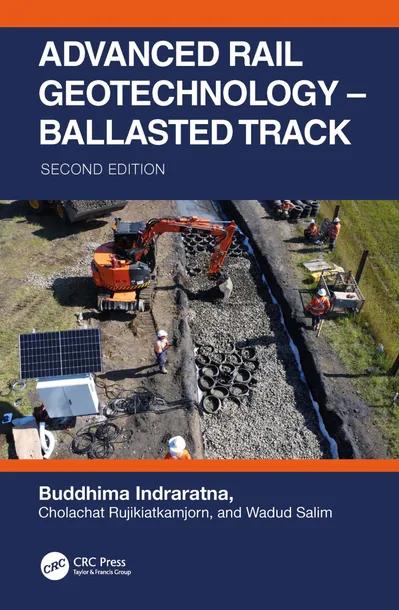
Advanced Rail Geotechnology – Ballasted Track
by Buddhima Indraratna, Cholachat Rujikiatkamjorn, Wadud Salim
2nd Edition
Publisher: CRC Press
Book Details
| Print ISBN | 9781032244914 |
| eText ISBN | 9781000925425 |
| Publisher | CRC Press |
| Publishing Year | 2024 |
| Edition | 2nd Edition |
| Language | English |
| Pages | 466 |
Advanced Rail Geotechnology – Ballasted Track, 2nd Edition, addresses the mechanical behavior and structural design of railway track substructures. Written for final-year civil engineering students, postgraduate educators, practising railway engineers, and track design researchers, this book details analytical tools for track infrastructure.
The content analyzes how fresh and recycled ballast deform, degrade, and maintain strength across monotonic, cyclic, and impact loading regimes using specialized geotechnical testing devices. The authors present a constitutive model incorporating particle breakage to establish a realistic stress-strain response. These mathematical formulations and numerical models undergo validation through controlled laboratory experimental simulations and instrumented field trials.
Computational coverage highlights discrete element modelling of ballast densification, particle interlocking, and breakage alongside finite element modelling of track structures. Non-destructive track condition testing, field instrumentation methods, revised ballast gradations, and bioengineering for track stabilisation complete the core analytical framework, supporting both advanced academic study and professional engineering practice.
Table of Contents
Chapter 1: Introduction
- • 1.1 Issues with track substructure
- • 1.1.1 Fouling
- • 1.1.2 Poor drainage
- • 1.1.3 Hydraulic erosion of ballast and sleepers
- • 1.1.4 Lateral buckling
- • 1.2 Types of track structure
- • 1.3 Carbon footprint and track modernisation
- • 1.4 Scope
- • References
Chapter 2: Track structure and rail load
- • 2.1 Types of track structure
- • 2.1.1 Ballasted track
- • 2.1.2 Slab track
- • 2.2 Components of a ballasted track
- • 2.2.1 Rails
- • 2.2.2 Fastening system
- • 2.2.3 Sleeper
- • 2.2.4 Ballast
- • 2.2.4.1 Functions of ballast
- • 2.2.4.2 Properties of ballast
- • 2.2.5 Subballast
- • 2.2.6 Subgrade
- • 2.3 Track forces
- • 2.3.1 Vertical forces
- • 2.3.1.1 Area method
- • 2.3.1.2 ORE method
- • 2.3.1.3 Equivalent dynamic wheel load
- • 2.3.1.4 Rail stress, speed, and impact factor
- • 2.3.2 Lateral forces
- • 2.3.3 Longitudinal forces
- • 2.3.4 Impact forces
- • 2.4 Load transfer mechanism
- • 2.5 Stress determination
- • 2.5.1 Odemark method
- • 2.5.2 Zimmermann method
- • 2.5.3 Trapezoidal approximation (2:1 method)
- • 2.5.4 AREMA recommendations
- • References
Chapter 3: Factors governing ballast behaviour
- • 3.1 Particle characteristics
- • 3.1.1 Particle size
- • 3.1.2 Particle shape
- • 3.1.3 Surface roughness
- • 3.1.4 Parent rock strength
- • 3.1.5 Particle crushing strength
- • 3.1.6 Resistance to attrition and weathering
- • 3.2 Aggregate characteristics
- • 3.2.1 Particle size distribution
- • 3.2.2 Void ratio (or density)
- • 3.2.3 Degree of saturation
- • 3.3 Loading characteristics
- • 3.3.1 Confining pressure
- • 3.3.2 Load history
- • 3.3.3 Current stress state
- • 3.3.4 Number of load cycles
- • 3.3.5 Frequency of loading
- • 3.3.6 Amplitude of loading
- • 3.4 Particle degradation
- • 3.4.1 Quantification of particle breakage
- • 3.4.2 Factors affecting particle breakage
- • 3.4.3 Effects of principal stress ratio on particle breakage
- • 3.4.4 Effects of confining pressure on particle breakage
- • 3.4.4.1 Dilatant unstable degradation zone
- • 3.4.4.2 Optimum degradation zone
- • 3.4.4.3 Compressive stable degradation zone
- • 3.5 Micromechanical aspects on particle angularity
- • References
Chapter 4: State-of-the-art laboratory testing and degradation assessment of ballast
- • 4.1 Monotonic triaxial testing
- • 4.1.1 Large-scale triaxial apparatus
- • 4.1.2 Characteristics of test ballast
- • 4.1.2.1 Source of ballast
- • 4.1.2.2 Properties of fresh ballast
- • 4.1.2.3 Properties of recycled ballast
- • 4.1.3 Preparation of ballast specimens
- • 4.1.4 Test procedure
- • 4.2 Single-grain crushing tests
- • 4.3 Cyclic triaxial testing
- • 4.3.1 Large prismoidal triaxial apparatus
- • 4.3.2 Materials tested
- • 4.3.2.1 Ballast, capping, and clay characteristics
- • 4.3.2.2 Characteristics of geosynthetics
- • 4.3.3 Preparation of test specimens
- • 4.3.4 Cyclic triaxial testing
- • 4.3.4.1 Magnitude of cyclic load
- • 4.3.4.2 Test procedure
- • 4.4 Impact testing
- • 4.4.1 Drop-weight impact testing equipment
- • 4.4.2 Test instrumentation
- • 4.4.3 Materials tested
- • 4.4.3.1 Ballast and sand characteristics
- • 4.4.3.2 Characteristics of shock mat
- • 4.4.4 Preparation of test specimens
- • 4.4.5 Impact testing programme
- • 4.4.5.1 Magnitude of impact load
- • 4.4.5.2 Test procedure
- • References
Chapter 5: Behaviour of ballast with and without geosynthetics and energy-absorbing mats
- • 5.1 Ballast response under monotonic loading
- • 5.1.1 Stress–strain behaviour
- • 5.1.2 Shear strength and stiffness
- • 5.1.3 Particle breakage in triaxial shearing
- • 5.1.4 Critical state of ballast
- • 5.2 Single-particle crushing strength
- • 5.3 Ballast response under cyclic loading
- • 5.3.1 Settlement response
- • 5.3.2 Strain characteristics
- • 5.3.3 Particle breakage
- • 5.4 Ballast response under repeated loading
- • 5.5 Effect of confining pressure
- • 5.6 Energy-absorbing materials: shock mats
- • References
Chapter 6: Existing track deformation models
- • 6.1 Plastic deformation of ballast
- • 6.2 Other plastic deformation models
- • 6.2.1 Critical state model
- • 6.2.2 Elasto-plastic constitutive models
- • 6.2.3 Bounding surface plasticity models
- • 6.3 Modelling of particle breakage
- • References
Chapter 7: A constitutive model for ballast
- • 7.1 Modelling of particle breakage
- • 7.1.1 Evaluation of ϕf for ballast
- • 7.1.2 Contribution of particle breakage to friction angle
- • 7.2 Constitutive modelling for monotonic loading
- • 7.2.1 Stress and strain parameters
- • 7.2.2 Incremental constitutive model
- • 7.3 Constitutive modelling for cyclic loading
- • 7.3.1 Shearing from an anisotropic initial stress state
- • 7.3.2 Cyclic loading model
- • 7.3.2.1 Conceptual model
- • 7.3.2.2 Mathematical model
- • 7.4 Model verification and discussion
- • 7.4.1 Numerical method
- • 7.4.2 Evaluation of model parameters
- • 7.4.3 Model predictions for monotonic loading
- • 7.4.4 Analytical model compared to FEM predictions
- • 7.4.5 Model predictions for cyclic loading
- • References
Chapter 8: Track drainage and use of geotextiles
- • 8.1 Drainage
- • 8.1.1 Subballast permeability
- • 8.1.2 Drainage requirements
- • 8.2 Fouling indices
- • 8.2.1 Fouling index and percentage of fouling
- • 8.2.2 Percentage void contamination
- • 8.2.3 Relative ballast fouling ratio
- • 8.3 Geosynthetics in rail track
- • 8.3.1 Types and functions of geosynthetics
- • 8.4 Use of geosynthetic vertical drains as a subsurface drainage
- • 8.4.1 Apparatus and test procedure
- • 8.4.2 Test results and analysis
- • References
Chapter 9: Role of subballast, its drainage, and filtration characteristics
- • 9.1 Subballast selection criteria
- • 9.1.1 Filtration and drainage criteria
- • 9.1.2 Case studies of subballast selection
- • 9.2 Empirical studies on granular filtration
- • 9.2.1 Natural resources conservation service (NRCS) method
- • 9.2.2 Self-filtration method
- • 9.3 Mathematical formulations in drainage and filtration
- • 9.3.1 Geometric and probabilistic modelling
- • 9.3.2 Particle infiltration models
- • 9.4 Constriction size distribution model
- • 9.4.1 Filter compaction
- • 9.4.2 Filter thickness
- • 9.4.3 Dominant filter constriction size
- • 9.4.4 Controlling filter constriction size
- • 9.4.5 Base soil representative parameter
- • 9.5 Constriction-based criteria for assessing filter effectiveness
- • 9.5.1 Dc95 model
- • 9.5.2 Dc35 model
- • 9.6 Implications on design guidelines
- • 9.7 Steady-state seepage hydraulics of porous media
- • 9.7.1 Development of Kozeny–Carman (KC) equation – a rationale
- • 9.7.2 Formulation for the effective diameter
- • 9.8 Subballast filtration behaviour under cyclic conditions
- • 9.8.1 Laboratory simulations
- • 9.8.2 Deformation characteristics of subballast under cyclic loading
- • 9.8.2.1 Pseudo-static loading
- • 9.8.2.2 Immediate response to cyclic loading
- • 9.8.3 Strain–porosity relationship of subballast under cyclic loading
- • 9.8.3.1 Pseudo-static loading
- • 9.8.3.2 Increased loading frequency
- • 9.8.4 Seepage hydraulics of subballast under cyclic loading
- • 9.8.4.1 Turbidity measurements and trapped fines
- • 9.8.4.2 Short-term drainage performance
- • 9.9 Time-dependent geo-hydraulic filtration model for particle migration under cyclic loading
- • 9.9.1 Time-based one-dimensional granular filter compression
- • 9.9.2 Accumulation factor
- • 9.9.3 Mathematical description of porosity reduction due to accumulated fines
- • 9.9.4 Time-based hydraulic conductivity model
- • References
Chapter 10: Field instrumentation for track performance verification
- • 10.1 Site geology and track construction
- • 10.1.1 Site investigation
- • 10.1.2 Track construction
- • 10.2 Field instrumentation
- • 10.2.1 Pressure cells
- • 10.2.2 Displacement transducers
- • 10.2.3 Settlement pegs
- • 10.2.4 Data acquisition system
- • 10.3 Data collection
- • 10.4 Results and discussion
- • 10.4.1 Vertical deformation of ballast both under rail and edge of sleeper
- • 10.4.2 Average deformation of ballast
- • 10.4.3 Average shear and volumetric strain of ballast
- • 10.4.4 In situ stresses across different layers
- • 10.4.5 Comparison of current results with previous literature
- • References
Chapter 11: Discrete element modelling (DEM) of ballast densification and breakage
- • 11.1 Discrete element method and PFC 2D
- • 11.1.1 Calculation cycle
- • 11.1.2 Contact constitutive model
- • 11.2 Modelling of particle breakage
- • 11.3 Numerical simulation of monotonic and cyclic behaviour of ballast using PFC 2D
- • 11.3.1 Cyclic biaxial test simulations
- • 11.4 Breakage behaviour
- • 11.4.1 Micromechanical investigation of breakage
- • 11.5 Mechanism of CF chains developed during cyclic loading
- • References
Chapter 12: Finite element modelling (FEM) of tracks and applications to case studies
- • 12.1 Use of geocomposite under railway track
- • 12.1.1 Finite element analysis
- • 12.1.2 Comparison of field results with FEM predictions
- • 12.2 Design process for short PVDS under railway track
- • 12.2.1 Preliminary design
- • 12.2.2 Comparison of field with numerical predictions
- • References
Chapter 13: Non-destructive testing and track condition assessment
- • 13.1 Laboratory model track
- • 13.1.1 The model track
- • 13.1.2 Preparation of the ballast sections
- • 13.2 The GPR method
- • 13.2.1 Theoretical background of GPR
- • 13.2.2 Acquisition and processing of GPR Data
- • 13.3 Factors affecting GPR
- • 13.3.1 Influence of antenna frequency
- • 13.3.2 Effect of radar-detectable geotextile
- • 13.3.3 Effect of moisture content
- • 13.3.4 Applying dielectric permittivity to identify the condition of ballast
- • 13.4 Multichannel analysis of surface wave method
- • 13.4.1 MASW survey
- • 13.4.2 Shear properties of clean and fouled ballast
- • 13.4.3 Data interpretation
- • References
Chapter 14: Track maintenance
- • 14.1 Track maintenance techniques
- • 14.1.1 Ballast tamping
- • 14.1.2 Stoneblowing
- • 14.1.3 Ballast cleaning and ballast renewal
- • 14.2 Track geotechnology and maintenance in cold regions
- • References
Chapter 15: Recommended ballast gradations
- • 15.1 Australian ballast specifications
- • 15.2 International railway ballast grading
- • 15.3 Gradation effects on settlement and ballast breakage
- • 15.4 Recommended ballast grading
- • 15.5 Conclusions
- • References
Chapter 16: Bioengineering for track stabilisation
- • 16.1 Introduction
- • 16.2 Conceptual modelling
- • 16.2.1 Soil suction
- • 16.2.2 Root distribution
- • 16.2.3 Potential transpiration
- • 16.3 Verification of the proposed root water uptake model
- • 16.3.1 Case study 1: Miram village (Western Victoria, Australia)
- • 16.3.2 Case study 2: Milton Keynes, United Kingdom
- • References
Chapter 17: Stabilisation of soft subgrade
- • 17.1 Introduction
- • 17.2 Failure of subgrade
- • 17.2.1 Mohr–Coulomb model
- • 17.2.2 Laboratory tests for determining shear strength parameters
- • 17.2.2.1 Direct shear test
- • 17.2.2.2 Triaxial test
- • 17.2.2.3 Pore pressure coefficients A and B
- • 17.2.3 Undrained shear strength
- • 17.3 Soil fluidisation (mud pumping)
- • 17.4 Fluidisation of subgrade under cyclic loads
- • 17.4.1 Roles of cyclic stress ratio, frequency, and density
- • 17.4.2 Stiffness degradation
- • 17.4.3 Upward fine migration
- • 17.5 Particle behaviour during fluidisation
- • 17.5.1 CFD-DEM approach
- • 17.5.2 Numerical simulations
- • 17.5.3 Undrained cyclic response of saturated subgrade
- • 17.6 Remediation to improve stability
- • 17.6.1 Addition of plastic fines
- • 17.6.2 Application of geosynthetics
- • 17.7 Site reconnaissance and soil characteristics at mud pumping site
- • 17.7.1 Descriptions of site investigation
- • 17.7.2 Field assessment
- • References
Chapter Appendix A: Derivation of partial derivatives of g(p, q) with respect to p and q from a first-order linear differential equation
Chapter Appendix B: Determination of model parameters from laboratory experimental results
Chapter Appendix C: A pictorial guide to track strengthening, field inspection, and instrumentation
Chapter Appendix D: Unique geotechnical and rail testing equipment
Chapter Appendix E: A circular economy perspective for track technologies – field trial at Chullora Technology Precinct
Customer Reviews
0.0
0 reviews
No reviews yet. Be the first to review this book!
Write a Review
Reviewed by GradeFocus Editorial Team
▶Research Sources (16)
- Advanced Rail Geotechnology – Ballasted Track
- Advanced Rail Geotechnology – Ballasted Track - Librerías Gandhi
- Catalogs | Graywolf Press
- About the Book - University of California Press
- Advanced Rail Geotechnology – Ballasted Track - Google Books
- Sourcebooks, LLC.
- https://lernerbooks.com/products/search_results?se...
- Please verify you are human - Captcha
- https://csu-fullerton.primo.exlibrisgroup.com/disc...
- Advanced Rail Geotechnology - Ballasted Track | Rent - Valore
- Advanced Rail Geotechnology – Ballasted Track - 2nd Edition - Buddhi
- Advanced Rail Geotechnology – Ballasted Track [2 
- Advanced Rail Geotechnology - Ballasted Track
- Advanced Rail Geotechnology - Ballasted Track - Booktopia
- (PDF) Advanced Rail Geotechnology - Ballasted Track - Academia.edu
- Advanced Rail Geotechnology-Ballasted Track - OPUS at UTS