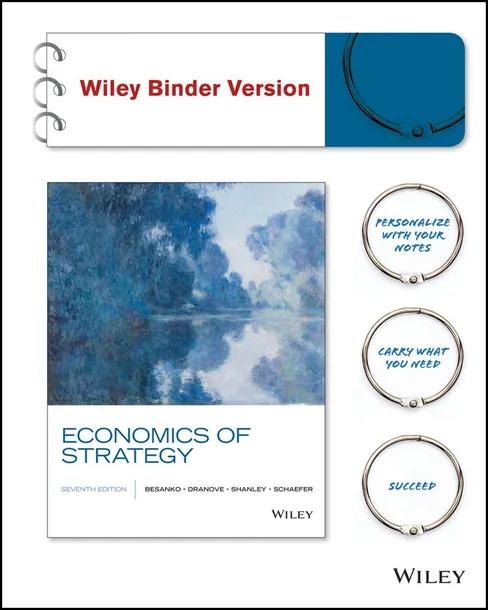
Economics of Strategy
by David Dranove, David Besanko, Mark Shanley
7th Edition
Publisher: Wiley
Book Details
| Print ISBN | 9781119042310 |
| eText ISBN | 9781119174776 |
| Publisher | Wiley |
| Publishing Year | 2016 |
| Edition | 7th Edition |
| Language | English |
| Pages | 544 |
Economics of Strategy, 7th Edition, is a textbook that translates advanced economic concepts into practical applications for business strategy. The work equips future managers with general economic principles to evaluate business problems and adapt firm strategies to shifting corporate environments.
The text examines core topics across firm boundaries, market competition, and internal organization. Key areas of discussion include competitive dynamics, strategic positioning for competitive advantage, and the economic foundations of value creation.
Developed for undergraduate courses in managerial economics and business strategy, this edition provides practical Financial Statement Analysis exercises that link to real companies across virtually every chapter.
Table of Contents
Chapter Introduction: Strategy and Economics
- • Why Study Strategy?
- • Why Economics?
- • The Need for Principles
- • So What’s the Problem?
- • A Framework for Strategy
- • Boundaries of the Firm
- • Market and Competitive Analysis
- • Positioning and Dynamics
- • Internal Organization
- • The Book
- • Endnotes
Chapter Economics Primer: Basic Principles
- • Costs
- • Cost Functions
- • Total Cost Functions
- • Fixed and Variable Costs
- • Average and Marginal Cost Functions
- • The Importance of the Time Period: Long-Run versus Short-Run Cost Functions
- • Sunk versus Avoidable Costs
- • Economic Costs and Profitability
- • Economic versus Accounting Costs
- • Economic Profit versus Accounting Profit
- • Demand and Revenues
- • Demand Curve
- • The Price Elasticity of Demand
- • Brand-Level versus Industry-Level Elasticities
- • Total Revenue and Marginal Revenue Functions
- • Theory of the Firm: Pricing and Output Decisions
- • Perfect Competition
- • Game Theory
- • Games in Matrix Form and the Concept of Nash Equilibrium
- • Game Trees and Subgame Perfection
- • Chapter Summary
- • Questions
- • Endnotes
Chapter 1: The Power of Principles: An Historical Perspective
- • Doing Business in 1840
- • Business Conditions in 1840: Life without a Modern Infrastructure
- • Transportation
- • Communications
- • Finance
- • Production Technology
- • Government
- • Doing Business in 1910
- • Business Conditions in 1910: A “Modern” Infrastructure
- • Doing Business Today
- • Modern Infrastructure
- • Infrastructure in Emerging Markets
- • Three Different Worlds: Consistent Principles, Changing Conditions, and Adaptive Strategies
- • Chapter Summary
- • Questions
- • Endnotes
Chapter 2: The Horizontal Boundaries of The Firm
- • Definitions
- • Definition of Economies of Scale
- • Definition of Economies of Scope
- • Scale Economies, Indivisibilities, and the Spreading of Fixed Costs
- • Economies of Scale Due to Spreading of Product-Specific Fixed Costs
- • Economies of Scale Due to Trade-offs among Alternative Technologies
- • Indivisibilities Are More Likely When Production is Capital Intensive
- • “The Division of Labor is Limited by the Extent of the Market”
- • Special Sources of Economies of Scale and Scope
- • Density
- • Purchasing
- • Advertising
- • Costs of Sending Messages per Potential Consumer
- • Advertising Reach and Umbrella Branding
- • Research and Development
- • Physical Properties of Production
- • Inventories
- • Complementarities and Strategic Fit
- • Sources of Diseconomies of Scale
- • Labor Costs and Firm Size
- • Spreading Specialized Resources Too Thin
- • Bureaucracy
- • Economies of Scale: A Summary
- • The Learning Curve
- • The Concept of the Learning Curve
- • Expanding Output to Obtain a Cost Advantage
- • Learning and Organization
- • The Learning Curve versus Economies of Scale
- • Diversification
- • Why Do Firms Diversify?
- • Efficiency-Based Reasons for Diversification
- • Scope Economies
- • Internal Capital Markets
- • Problematic Justifications for Diversification
- • Diversifying Shareholders’ Portfolios
- • Identifying Undervalued Firms
- • Reasons Not to Diversify
- • Managerial Reasons for Diversification
- • Benefits to Managers from Acquisitions
- • Problems of Corporate Governance
- • The Market for Corporate Control and Recent Changes in Corporate Governance
- • Performance of Diversified Firms
- • Chapter Summary
- • Questions
- • Endnotes
Chapter 3: The Vertical Boundaries of The Firm
- • Make versus Buy
- • Upstream, Downstream
- • Defining Boundaries
- • Some Make-or-Buy Fallacies
- • Avoiding Peak Prices
- • Tying Up Channels: Vertical Foreclosure
- • Reasons to “Buy”
- • Exploiting Scale and Learning Economies
- • Bureaucracy Effects: Avoiding Agency and Influence Costs
- • Agency Costs
- • Influence Costs
- • Organizational Design
- • Reasons to “Make”
- • The Economic Foundations of Contracts
- • Complete versus Incomplete Contracting
- • Bounded Rationality
- • Difficulties Specifying or Measuring Performance
- • Asymmetric Information
- • The Role of Contract Law
- • Coordination of Production Flows through the Vertical Chain
- • Leakage of Private Information
- • Transaction Costs
- • Relationship-Specific Assets
- • Forms of Asset Specificity
- • The Fundamental Transformation
- • Rents and Quasi-Rents
- • The Holdup Problem
- • Holdup and Ex Post Cooperation
- • The Holdup Problem and Transaction Costs
- • Contract Negotiation and Renegotiation
- • Investments to Improve _Ex Post_ Bargaining Positions
- • Distrust
- • Reduced Investment
- • Recap: From Relationship-Specific Assets to Transaction Costs
- • Summarizing Make-or-Buy Decisions: The Make-or-Buy Decision Tree
- • Chapter Summary
- • Questions
- • Endnotes
Chapter 4: Integration and Its Alternatives
- • What Does It Mean to Be “Integrated”?
- • The Property Rights Theory of the Firm
- • Alternative Forms of Organizing Transactions
- • Governance
- • Delegation
- • Recapping PRT
- • Path Dependence
- • Making the Integration Decision
- • Technical Efficiency versus Agency Efficiency
- • The Technical Efficiency/Agency Efficiency Trade-off
- • Real-World Evidence
- • Double Marginalization: A Final Integration Consideration
- • Alternatives to Vertical Integration
- • Tapered Integration: Make and Buy
- • Franchising
- • Strategic Alliances and Joint Ventures
- • Implicit Contracts and Long-Term Relationships
- • Business Groups
- • Keiretsu
- • Chaebol
- • Business Groups in Emerging Markets
- • Chapter Summary
- • Questions
- • Endnotes
Chapter 5: Competitors and Competition
- • Competitor Identification and Market Definition
- • The Basics of Market Definition and Competitor Identification
- • Putting Competitor Identification into Practice
- • Empirical Approaches to Competitor Identification
- • Geographic Competitor Identification
- • Measuring Market Structure
- • Market Structure and Competition
- • Perfect Competition
- • Many Sellers
- • Homogeneous Products
- • Excess Capacity
- • Monopoly
- • Monopolistic Competition
- • Demand for Differentiated Goods
- • Entry into Monopolistically Competitive Markets
- • Oligopoly
- • Cournot Quantity Competition
- • The Revenue Destruction Effect
- • Cournot’s Model in Practice
- • Bertrand Price Competition
- • Why Are Cournot and Bertrand Different?
- • Bertrand Price Competition When Products Are Horizontally Differentiated
- • Evidence on Market Structure and Performance
- • Price and Concentration
- • Chapter Summary
- • Questions
- • Endnotes
Chapter 6: Entry and Exit
- • Some Facts about Entry and Exit
- • Entry and Exit Decisions: Basic Concepts
- • Barriers to Entry
- • Bain’s Typology of Entry Conditions
- • Analyzing Entry Conditions: The Asymmetry Requirement
- • Structural Entry Barriers
- • Control of Essential Resources
- • Economies of Scale and Scope
- • Marketing Advantages of Incumbency
- • Barriers to Exit
- • Entry-Deterring Strategies
- • Limit Pricing
- • Is Strategic Limit Pricing Rational?
- • Predatory Pricing
- • The Chain-Store Paradox
- • Rescuing Limit Pricing and Predation: The Importance of Uncertainty and Reputation
- • Wars of Attrition
- • Predation and Capacity Expansion
- • Strategic Bundling
- • “Judo Economics”
- • Evidence on Entry-Deterring Behavior
- • Contestable Markets
- • An Entry Deterrence Checklist
- • Entering a New Market
- • Preemptive Entry and Rent-Seeking Behavior
- • Chapter Summary
- • Questions
- • Endnotes
Chapter 7: Dynamics: Competing Across Time
- • Microdynamics
- • The Strategic Benefits of Commitment
- • Strategic Substitutes and Strategic Complements
- • The Strategic Effect of Commitments
- • Tough and Soft Commitments
- • A Taxonomy of Commitment Strategies
- • The Informational Benefits of Flexibility
- • Real Options
- • A Framework for Analyzing Commitments
- • Competitive Discipline
- • Dynamic Pricing Rivalry and Tit-for-Tat Pricing
- • Why is Tit-for-Tat So Compelling?
- • Coordinating on the Right Price
- • Impediments to Coordination
- • The Misread Problem
- • Lumpiness of Orders
- • Information about the Sales Transaction
- • Volatility of Demand Conditions
- • Asymmetries among Firms and the Sustainability of Cooperative Prices
- • Price Sensitivity of Buyers and the Sustainability of Cooperative Pricing
- • Market Structure and the Sustainability of Cooperative Pricing: Summary
- • Facilitating Practices
- • Price Leadership
- • Advance Announcement of Price Changes
- • Most Favored Customer Clauses
- • Uniform Delivered Prices
- • Where Does Market Structure Come From?
- • Sutton’s Endogenous Sunk Costs
- • Innovation and Market Evolution
- • Learning and Industry Dynamics
- • Chapter Summary
- • Questions
- • Endnotes
Chapter 8: Industry Analysis
- • Performing a Five-Forces Analysis
- • Internal Rivalry
- • Entry
- • Substitutes and Complements
- • Supplier Power and Buyer Power
- • Strategies for Coping with the Five Forces
- • Coopetition and the Value Net
- • Applying the Five Forces: Some Industry Analyses
- • Chicago Hospital Markets Then and Now
- • Market Definition
- • Supplier Power
- • Buyer Power
- • Commercial Airframe Manufacturing
- • Barriers to Entry
- • Professional Sports
- • Conclusion
- • Professional Search Firms
- • Chapter Summary
- • Questions
- • Endnotes
Chapter 9: Strategic Positioning For Competitive Advantage
- • Competitive Advantage and Value Creation: Conceptual Foundations
- • Competitive Advantage Defined
- • Maximum Willingness-to-Pay and Consumer Surplus
- • From Maximum Willingness-to-Pay to Consumer Surplus
- • Value-Created
- • Value Creation and “Win–Win” Business Opportunities
- • Value Creation and Competitive Advantage
- • Analyzing Value Creation
- • Value Creation and the Value Chain
- • Value Creation, Resources, and Capabilities
- • Strategic Positioning: Cost Advantage and Benefit Advantage
- • Generic Strategies
- • The Strategic Logic of Cost Leadership
- • The Strategic Logic of Benefit Leadership
- • Extracting Profits from Cost and Benefit Advantage
- • Comparing Cost and Benefit Advantages
- • “Stuck in the Middle”
- • Diagnosing Cost and Benefit Drivers
- • Cost Drivers
- • Cost Drivers Related to Firm Size, Scope, and Cumulative Experience
- • Cost Drivers Independent of Firm Size, Scope, or Cumulative Experience
- • Cost Drivers Related to Organization of the Transactions
- • Benefit Drivers
- • Methods for Estimating and Characterizing Costs and Perceived Benefits
- • Estimating Costs
- • Estimating Benefits
- • Strategic Positioning: Broad Coverage versus Focus Strategies
- • Segmenting an Industry
- • Broad Coverage Strategies
- • Focus Strategies
- • Chapter Summary
- • Questions
- • Endnotes
Chapter 10: Information and Value Creation
- • The “Shopping Problem”
- • Unraveling
- • Alternatives to Disclosure
- • Nonprofit Firms
- • Report Cards
- • Multitasking: Teaching to the Test
- • What to Measure
- • Risk Adjustment
- • Presenting Report Card Results
- • Gaming Report Cards
- • The Certifier Market
- • Certification Bias
- • Matchmaking
- • When Sellers Search for Buyers
- • Chapter Summary
- • Questions
- • Endnotes
Chapter 11: Sustaining Competitive Advantage
- • Market Structure and Threats to Sustainability
- • Threats to Sustainability in Competitive and Monopolistically Competitive Markets
- • Threats to Sustainability under All Market Structures
- • Evidence: The Persistence of Profitability
- • The Resource-Based Theory of the Firm
- • Imperfect Mobility and Cospecialization
- • Isolating Mechanisms
- • Impediments to Imitation
- • Legal Restrictions
- • Superior Access to Inputs or Customers
- • The Winner’s Curse
- • Market Size and Scale Economies
- • Intangible Barriers to Imitation
- • Causal Ambiguity
- • Dependence on Historical Circumstances
- • Social Complexity
- • Early-Mover Advantages
- • Learning Curve
- • Reputation and Buyer Uncertainty
- • Buyer Switching Costs
- • Network Effects
- • Networks and Standards
- • Competing “For the Market” versus “In the Market”
- • Knocking Off a Dominant Standard
- • Early-Mover Disadvantages
- • Imperfect Imitability and Industry Equilibrium
- • Creating Advantage and Creative Destruction
- • Disruptive Technologies
- • The Productivity Effect
- • The Sunk Cost Effect
- • The Replacement Effect
- • The Efficiency Effect
- • Disruption versus the Resource-Based Theory of the Firm
- • Innovation and the Market for Ideas
- • Evolutionary Economics and Dynamic Capabilities
- • The Environment
- • Factor Conditions
- • Demand Conditions
- • Related Supplier or Support Industries
- • Strategy, Structure, and Rivalry
- • Chapter Summary
- • Questions
- • Endnotes
Chapter 12: Performance Measurement and Incentives
- • The Principal–Agent Relationship
- • Combating Agency Problems
- • Performance-Based Incentives
- • Problems with Performance-Based Incentives
- • Preferences over Risky Outcomes
- • Risk Sharing
- • Risk and Incentives
- • Performance Measures That Fail to Reflect All Desired Actions
- • Selecting Performance Measures: Managing Trade-offs between Costs
- • Do Pay-for-Performance Incentives Work?
- • Implicit Incentive Contracts
- • Subjective Performance Evaluation
- • Promotion Tournaments
- • Efficiency Wages and the Threat of Termination
- • Incentives in Teams
- • Chapter Summary
- • Questions
- • Endnotes
Chapter 13: Strategy and Structure
- • An Introduction to Structure
- • Individuals, Teams, and Hierarchies
- • Complex Hierarchy
- • Departmentalization
- • Coordination and Control
- • Approaches to Coordination
- • Types of Organizational Structures
- • Functional Structure (U-form)
- • Multidivisional Structure (M-form)
- • Matrix Structure
- • Matrix or Division? A Model of Optimal Structure
- • Network Structure
- • Why Are There So Few Structural Types?
- • Strategy-Environment Coherence
- • Technology and Task Interdependence
- • Information Processing
- • Structure Follows Strategy
- • Strategy, Structure, and the Multinational Firm
- • Hybrid Organizations
- • Chapter Summary
- • Questions
- • Endnotes
Chapter 14: Environment, Power, and Culture
- • The Social Context of Firm Behavior
- • Internal Context
- • Power
- • The Sources of Power
- • Structural Views of Power
- • Do Successful Organizations Need Powerful Managers?
- • The Decision to Allocate Formal Power to Individuals
- • Culture
- • Culture Complements Formal Controls
- • Culture Facilitates Cooperation and Reduces Bargaining Costs
- • Culture, Inertia, and Performance
- • A Word of Caution about Culture
- • External Context, Institutions, and Strategies
- • Institutions and Regulation
- • Interfirm Resource Dependence Relationships
- • Industry Logics: Beliefs, Values, and Behavioral Norms
- • Chapter Summary
- • Questions
- • Endnotes
Customer Reviews
0.0
0 reviews
No reviews yet. Be the first to review this book!
Write a Review
Reviewed by GradeFocus Editorial Team