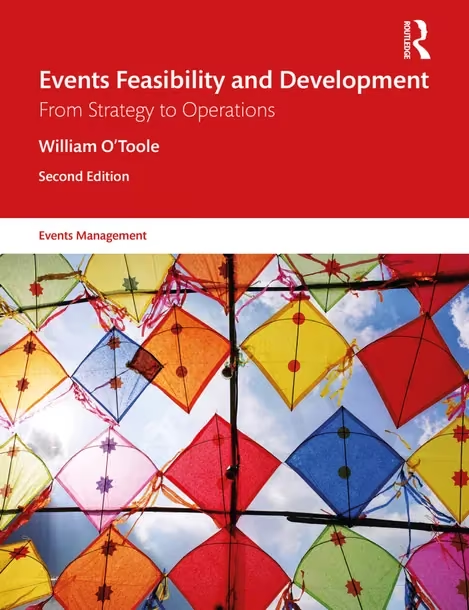
Events Feasibility and Development
From Strategy to Operations
by William O'Toole
2nd Edition
Publisher: Routledge
Book Details
| Print ISBN | 9781032000879 |
| eText ISBN | 9781000478228 |
| Publisher | Routledge |
| Publishing Year | 2022 |
| Edition | 2nd Edition |
| Language | English |
| Pages | 312 |
Events Feasibility and Development: From Strategy to Operations, 2nd Edition, is a textbook by William O'Toole examining event development and management across the global events sector. The volume presents professional techniques refined through international applications to guide planning from strategic development to site delivery.
Coverage addresses strategic, management, and operational feasibility. The text explains how organizations and destinations manage event portfolios, establish management systems across the event life cycle, and assess operational readiness using metrics and feasibility studies.
Intended for event management students, the 2022 edition expands on the Events Sector Maturity Model, introducing post-pandemic solutions and new case studies. Chapters provide exhibits, questions, and structured bullet points to support study and practice.
Table of Contents
Chapter 1: Events Sector Maturity Model
- • 1.1 Introduction
- • 1.2 The phases
- • 1.3 Maturity Assessment tables
- • 1.4 Discussion
Chapter 2: How to develop an events strategy
- • 2.1 Introduction
- • 2.2 Strategy checklist
- • 2.3 Events program as a portfolio
- • 2.4 The event portfolio as an asset
- • 2.5 Limitation of portfolio management
- • 2.6 Cascade of objectives
- • 2.7 Discussion
Chapter 3: Preparing the strategy
- • 3.1 Introduction
- • 3.1 Decision criteria
- • 3.2 Situation analysis
- • 3.3 Stakeholder consultation
- • 3.4 Strategy template
- • 3.5 Legal and Regulatory Environment
- • 3.6 Venues
- • 3.7 Discussion
Chapter 4: Event support: directing the development
- • 4.1 Introduction
- • 4.2 Event support
- • 4.3 Event Typology
- • 4.4 Discussion
Chapter 5: Implement the strategy
- • 5.1 Introduction
- • 5.2 Events unit
- • 5.3 Events agencies
- • 5.4 Discussion
Chapter 6: Techniques and tools for events development
- • 6.1 Introduction
- • 6.2 Bidding and requests for tender
- • 6.3 Hallmark/flagship events
- • 6.4 The Integrated Country Promotion
- • 6.5 The Events Precinct
- • 6.6 Licensing
- • 6.7 Events Forum
- • 6.8 Discussion
Chapter 7: Building competency: associations, awards and training
- • 7.1 Introduction
- • 7.2 Event Associations
- • 7.3 Event Awards
- • 7.4 Event guide or manual
- • 7.5 Building competency
- • 7.6 Discussion topics
- • 7.7 Section 1: Wrap up
Chapter 8: Management models and the business case
- • 8.1 Introduction
- • 8.2 A Model, Processes, System or a Body of Knowledge
- • 8.3 The Event Management Environment: Complexity and Uncertainty
- • 8.4 Phases of Event Management and the Event Life Cycle
- • 8.5 Intangibility of Outcomes
- • 8.6 The Business Case
- • 8.7 Discussion
Chapter 9: Setting up the management system
- • 9.1 Introduction
- • 9.2 Event project methodology
- • 9.3 Management Framework as a Spreadsheet
- • 9.4 The Event: Management Maturity Model
- • 9.5 Conclusion
- • 9.6 Discussion
Chapter 10: Event management processes
- • 10.1 Introduction
- • 10.2 From Domains to a Process Model
- • 10.3 Scope management
- • 10.4 Stakeholder management
- • 10.5 Sponsorship
- • 10.6 Event design
- • 10.7 Marketing process
- • 10.8 Financial process
- • 10.9 Conclusion
- • 10.10 Discussion
Chapter 11: Event management processes section two
- • 11.1 Introduction
- • 11.2 Time management process
- • 11.3 Risk management process
- • 11.4 Communication process
- • 11.5 Procurement Process
- • 11.6 Human resources (HR) process
- • 11.7 Discussion topics
- • 11.8 Exercise
- • 11.9 Section 2: Wrap up
Chapter 12: Event metrics and checklists
- • 12.1 Introduction
- • 12.2 Metrics
- • 12.3 Financial exposure profile
- • 12.4 Exposure, Resilience and Fragility
- • 12.5 Heuristics and the event checklist
- • 12.6 Discussion Topics
Chapter 13: Event operations: upstream design
- • 13.1 Introduction
- • 13.2 Operations as an outcome
- • 13.3 On the day
- • 13.4 Attendee Journey Map
- • 13.5 The Feasibility of the Event Site
- • 13.6 The feasibility study
- • 13.7 Conclusion
- • 13.8 Discussion
Chapter 14: Competency training and teaching event management
- • 14.1 Introduction
- • 14.2 On Course
- • 14.3 Self-Competency Assessment
- • 14.4 Conclusion
Customer Reviews
0.0
0 reviews
No reviews yet. Be the first to review this book!
Write a Review
Reviewed by GradeFocus Editorial Team
▶Research Sources (1)
Related Books
The Routledge Companion to Tour Guiding
Shailja Sharma
Events Management
Charles Bladen
Event Management for the Tourism and Hospitality Industries
Bonita M. Kolb
Restaurant Concepts, Management, and Operations
John R. Walker
Marketing for Hospitality and Tourism
Philip Kotler
Events Management
Nicole Ferdinand