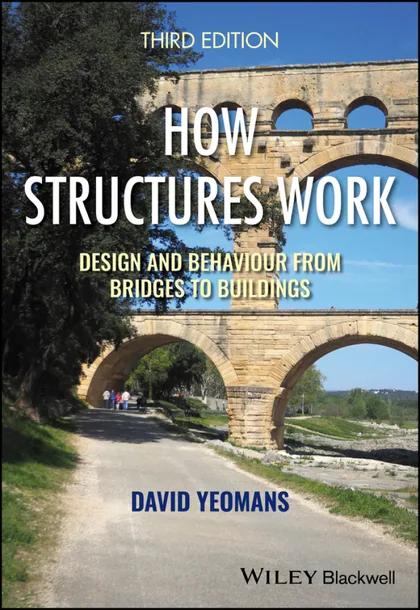
How Structures Work
Design and Behaviour from Bridges to Buildings
by David Yeomans
3rd Edition
Publisher: Wiley-Blackwell
Book Details
| Print ISBN | 9781394340132 |
| eText ISBN | 9781394340149 |
| Publisher | Wiley-Blackwell |
| Publishing Year | 2025 |
| Edition | 3rd Edition |
| Language | English |
| Pages | 288 |
How Structures Work, 3rd Edition, provides an introductory textbook on structural design and qualitative behavior across buildings and bridges. Formulated to explain physical principles without using complex mathematics, the volume guides readers through fundamental concepts that govern force flow and structural stability.
The text organizes its coverage through a structured sequence of load-bearing assemblies. Initial chapters examine brackets, beam stiffening techniques, girder bridges, arches, and suspension bridges. Coverage then expands to complete structural schemes, evaluating how forces transfer to the ground while analyzing load capacity in masonry walls, cavity walls, and timber, iron, or modern multistorey structural frames.
The material delivers essential grounding for introductory academic programs and professional references. It supports students of architecture, civil engineering, building surveying, and architectural history, while offering clear, non-technical explanations for building administrators and interested laypeople.
Table of Contents
Chapter 1: Brackets and Bridges
- • Cooper’s tragedy
- • The Forth Bridge
- • Members in compression
- • The Quebec Bridge
- • Forces in a bracket
- • The design process
- • Stresses
Chapter 2: Stiffening a Beam – Girder Bridges
- • The simple truss
- • Tension trusses
- • Girder bridges: The Forth Bridge
Chapter 3: Arches and Suspension Bridges
- • Building an arch
- • Blackfriars Bridge
- • Pontypridd Bridge
- • The forces in an arch
- • Practical issues
- • Forces within the arch ring
- • Edwards’s failure
- • An unexpected failure
- • Arch with point load
- • Iron and concrete arches
- • The suspension bridge
- • Arches in buildings: Flying buttresses
- • Arches in walls
Chapter 4: Bringing the Loads to the Ground – The Structural Scheme
- • Introduction
- • The alternatives
- • Nature of the loads
- • Choices
- • ‘Flow of forces’ or action and reaction
- • Describing the structure
- • Structures are three‐dimensional
- • Statically indeterminate structures
Chapter 5: Safe as Houses? – Walls
- • Bricks and mortar
- • Point loads and openings
- • Cavity walls
- • Thick walls
- • Foundation loads
- • Horizontal loads
- • Rafter thrusts
- • Foundation stresses
Chapter 6: Frames – A Problem of Stability
- • Timber framing
- • Construction of a barn
- • Bracing forces
- • Bending in the post
- • Light frame construction
- • The coming of iron
- • The frame today
- • The multistorey frame
- • Columns
Chapter 7: Floors and Beams – Deflections and Bending Moments
- • The need for science
- • Floors and deflections
- • The forces in the beam
- • Strain
- • Galileo’s cantilever
- • Finding the stresses
- • From cantilever to beam
- • Iron and steel beams
- • Cast iron
- • Reinforced concrete beams
- • Continuous beams
- • Shear
- • Two‐way floors
- • Other structures in bending
- • Prestressing
Chapter 8: Providing Shelter – Roofs
- • Common rafter roofs
- • Purlin roofs
- • Longitudinal stability
- • The roof truss
- • The coming of iron
- • Three‐dimensional roofs
Chapter 9: Structures in a Three‐Dimensional World
- • Vaults
- • The pointed vault
- • Elaborations on the basic vault form
- • Building vaults
- • Domes
- • Some historical examples
- • The modern three‐dimensional structure
- • Anticlastic forms
- • Structures in tension
- • Structures for their time and place
Chapter 10: Materials and Workmanship
- • Walling materials
- • Timber
- • Iron and steel
- • Compatibility of materials
- • Material development and design
Chapter 11: Additional Thoughts
- • Friction
- • Tension structures
- • The ‘cantilever’ stair
- • Modelling
Chapter Appendix: Some Elements of Grammar
Customer Reviews
0.0
0 reviews
No reviews yet. Be the first to review this book!
Write a Review
Reviewed by GradeFocus Editorial Team
▶Research Sources (14)
- How Structures Work, eBook by David Yeomans | 9781394340149
- 9781394340149 - How Structures Work: Design and Behaviour from ...
- [PDF] How Structures Work by David Yeomans, 3rd edition - Perlego
- Self-Help - Macmillan Publishers
- https://lernerbooks.com/products/search_results?se...
- Sign In - MyLibrary | Hal Leonard Online
- Captcha
- Thompson Learn.
- Education - Bookstore - Browse our nonfiction books | BrownWalker Press
- How Structures Work, 3rd Edition by David Yeomans - The Nile
- How Structures Work by David Yeomans - 9781394340132
- How Buildings Work - Edward Allen
- Design and Behaviour from Bridges to Buildings
- How Structures Work eBook by David Yeomans - EPUB