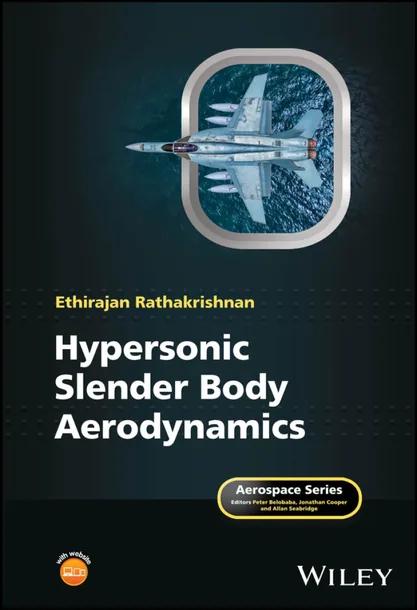
Hypersonic Slender Body Aerodynamics
by Ethirajan Rathakrishnan
1st Edition
Publisher: Wiley
Book Details
| Print ISBN | 9781394285631 |
| eText ISBN | 9781394285648 |
| Publisher | Wiley |
| Publishing Year | 2025 |
| Edition | 1st Edition |
| Language | English |
| Pages | 208 |
Hypersonic Slender Body Aerodynamics, 1st Edition, offers a structured presentation of slender body geometry and aerodynamic behavior across speed regimes ranging from incompressible to hypersonic flow. Written as an academic textbook by Ethirajan Rathakrishnan, the volume supports aerospace engineering studies by analyzing flow fields, aerodynamic forces, and thermal loads.
The content synthesizes core theoretical concepts, including the Mach number independence principle and approximate theories developed for caret wings. Foundational hypersonic topics detail atmospheric properties, general flow characteristics, governing equations, and hypersonic flow past a semi-wedge. Additional sections explore practical applications of slender-body theory, covering leading-edge heat transfer, sublimation phenomena, aerodynamic effects, nose bluntness, blast-wave theory, and thin shock layers.
Developed using class-tested course material, this volume provides structured academic instruction for coursework and technical reference. It targets undergraduate students of aerospace engineering, graduate students in the discipline, and practicing engineers working within aerospace research laboratories or industrial settings.
Table of Contents
Chapter 1: Basics
- • 1.1 Introduction
- • 1.2 Supersonic Transport Aircraft
- • 1.3 Wings of Supersonic Aircraft
- • 1.3.1 Sharp Leading Edge
- • 1.3.2 Ground Effect
- • 1.3.3 Viscous Effect
- • 1.4 Basic Equations
- • 1.4.1 Velocity Potential Function in Slender Body Theory
- • 1.5 Pressure Distribution on the Surface
- • 1.5.1 General Solution
- • 1.5.2 Transverse Flow
- • 1.5.3 Longitudinal Flow
- • 1.6 Theoretical Methods – Inviscid Flow
- • 1.6.1 Complex Analytic (Holomorphic) Function
- • 1.6.2 Pitching Moment About a Reference Axis (Axis Through cg)
- • 1.7 Stability Derivatives for Delta Wings
- • 1.7.1 Dynamic Stability Derivatives
- • 1.7.2 Unsteady Slender Body Theory
- • 1.8 Method of Vortex (Source and Sink) Distribution
- • 1.8.1 Longitudinal Flow Problem
- • 1.8.2 For Cross Sections with Sharp Corners
- • 1.8.3 General Solutions for Slender Configurations
- • 1.8.4 Space Influence for g(x,M∞)
- • 1.8.4 Longitudinal flow:
- • 1.9 Cone in Supersonic Flow
- • 1.10 Optimization (Supersonic Flow)
- • 1.10.1 Zero‐Lift Case (α=0)
- • 1.10.2 Optimization for Total Drag to Be a Minimum
- • 1.11 Lift‐Case
- • 1.12 Nonlinear Theories
- • 1.12.1 Hürlimann Model
- • 1.12.1.1 Delta Wings
- • 1.12.1.2 Gerten's Model
- • 1.12.2 Breakdown of Vortices
- • 1.13 Summary
- • Exercise Problems
Chapter 2: Hypersonic Aerodynamics (Slender Bodies)
- • 2.1 Introduction
- • 2.2 Mach Number Independence Principle
- • 2.3 Atmospheric Properties
- • 2.3.1 Atmospheric Model
- • 2.4 Hypersonic Flow Characteristics
- • 2.5 Governing Equations
- • 2.6 Comparison of Supersonic and Hypersonic Flow
- • 2.7 Re‐entry Problem
- • 2.7.1 Slender Body Geometry
- • 2.8 Flow Past a Semi‐wedge
- • 2.8.1 Pressure Coefficient for Hypersonic Flow
- • 2.9 Hypersonic Limiting Case
- • 2.10 Newtonian Formula
- • 2.11 Surface Pressure Distribution
- • 2.12 Modified Newtonian Formula
- • 2.13 Tangent Wedge or Tangent Cone Method
- • 2.14 Busemann Correction for Centrifugal Force
- • 2.15 Shock‐Expansion Method
- • 2.15.1 For Similar Flow
- • 2.15.2 For Slender Bodies with Minimum Pressure‐Drag in Symmetrical Flow in the Hypersonic Flow Region
- • 2.16 Theory of Slender Hypersonic Bodies
- • 2.16.1 Basic Equations
- • 2.16.2 New Coordinate System
- • 2.16.3 Boundary Conditions
- • 2.17 Principle of Equivalence for Slender Hypersonic Bodies
- • 2.18 Design of Three‐Dimensional Hypersonic Slender Bodies
- • 2.18.1 Cone Flow Wave‐Rider
- • 2.19 Caret‐Wing or Nonweiler Wing or Wave‐Rider
- • 2.19.1 Volume Parameter
- • 2.19.1 Approximate Newtonian Formula
- • 2.20 Off‐design Conditions for Caret‐Wings
- • 2.20.1 Hypersonic Slender Body Theory
- • 2.21 Approximate Theories for Caret‐Wings
- • 2.21.1 Two‐Dimensional Wedge Theory for Caret‐Wings
- • 2.21.2 Wedge‐Type Analysis
- • 2.21.3 Newtonian Approximation
- • 2.21.4 Extended Newtonian Formula
- • 2.21.4 Design Condition
- • 2.21.4 Detachment Condition
- • 2.21.5 Measurements Made at Braunschweing
- • 2.22 Supersonic Test Facilities
- • 2.22.1 Blowdown Tunnel (without heating)
- • 2.22.2 Blowdown Tunnel (with heating)
- • 2.22.3 Helium Tunnel
- • 2.22.4 Hot‐Shot Tunnel
- • 2.22.5 Gun‐Tunnel
- • 2.22.6 Shock‐Tunnel
- • 2.22.7 Arc‐Heated Tunnel
- • 2.22.8 Low‐Density Tunnel
- • 2.22.9 Ballistic Range
- • 2.22.10 Wedge Theory
- • 2.22.11 (L/D)max Variation with Freestream Mach Number M∞
- • 2.23 Comparison of Theoretical and Experimental Results
- • 2.23.1 Pressure Distribution
- • 2.24 Stability Derivatives
- • 2.25 Summary
- • Exercise Problems
Chapter 3: Application of Slender‐body Theory
- • 3.1 Introduction
- • 3.2 Leading‐Edge Heat Transfer
- • 3.3 Stagnation‐Point Heat Transfer
- • 3.4 Heat Transfer Limitations for Slender‐body Vehicles
- • 3.5 Sublimation
- • 3.6 Aerodynamic Effects
- • 3.7 Nose Bluntness
- • 3.8 Blast‐wave Theory
- • 3.9 Thin Shock Layers
- • 3.10 Summary
- • Exercise Problems
Chapter 4: Experimental Approach
- • 4.1 Introduction
- • 4.2 Drag of Slender Bodies
- • 4.2.1 Flat Plate Analogy
- • 4.2.1.1 Flat Plate Solution for Skin Friction
- • 4.2.1.2 Slenderness Ratio
- • 4.2.2 Shape Factor
- • 4.2.3 Blunt Afterbody Correction
- • 4.3 Axisymmetric Slender Bodies
- • 4.3.1 Potential Flow Solution
- • 4.3.2 Pressure Distribution
- • 4.4 Summary
- • Exercise Problems
Customer Reviews
0.0
0 reviews
No reviews yet. Be the first to review this book!
Write a Review
Reviewed by GradeFocus Editorial Team
▶Research Sources (12)
- Hypersonic Slender Body Aerodynamics, eBook by Ethirajan ...
- Hypersonic Slender Body Aerodynamics - E-bok (9781394285648)
- Hypersonic slender body aerodynamics - Catalog - UW-Madison ...
- Hypersonic Slender Body Aerodynamics - Porrúa
- https://lernerbooks.com/products/search_results?se...
- Please verify you are human - Captcha
- Hypersonic Slender Body Aerodynamics - Rathakrishnan, Ethirajan ...
- Thompson Learn.
- Hypersonic Slender Body Aerodynamics (Aerospace ...
- Application of Slender‐body Theory
- Hypersonic Slender Body Aerodynamics
- Hypersonic Slender Body Aerodynamics