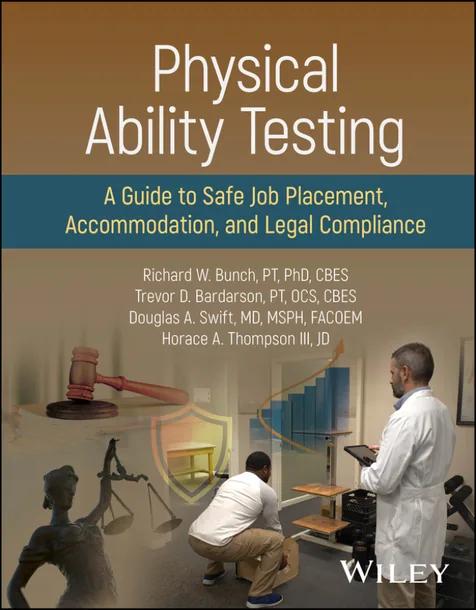
Physical Ability Testing
A Guide to Safe Job Placement, Accommodation, and Legal Compliance
by Richard W. Bunch, Trevor D. Bardarson, Douglas A. Swift
1st Edition
Publisher: Wiley-Blackwell
Book Details
| Print ISBN | 9781119272274 |
| eText ISBN | 9781119272304 |
| Publisher | Wiley-Blackwell |
| Publishing Year | 2025 |
| Edition | 1st Edition |
| Language | English |
| Pages | 480 |
Physical Ability Testing, 1st Edition, is an academic textbook focused on establishing physical ability testing programs that support safe job placement and legal compliance. The text is written for human resource professionals, safety personnel, ergonomists, and risk management specialists who oversee organizational employment screening procedures.
The narrative outlines systematic methods to design and conduct physical ability tests tailored to specific job demands. It presents clear approaches for reducing disparate impact among protected groups, focusing on fair evaluation safeguards for older workers, pregnant women, and individuals with disabilities during candidate testing.
As a defining pedagogical feature, the textbook integrates practical analysis of relevant court decisions alongside published scientific literature on work physiology. This balanced structure helps prospective evaluators and program administrators construct defensible assessment protocols for organizational practice.
Table of Contents
Chapter 1: Introduction to Physical Ability Testing
- • 1.1 The Physical Ability Test
- • 1.2 Impact of PATs on Safety
- • 1.3 Qualifications to Perform a Physical Ability Test
- • 1.4 Essential Job Functions – The Foundation of the PAT Program
- • 1.5 Types of PATs
- • 1.6 Contents of a Post-offer PAT
- • 1.7 The Basic Design of the PAT Protocol
- • 1.8 The Predictive Value of a PAT – Relation to “Direct Threat” Defense
- • 1.9 Benefits of Physical Ability Testing
- • 1.10 PAT vs Functional Capacity Evaluation
- • 1.11 Validity of Effort During Functional Testing
Chapter 2: Assessing Physical Ability to Work
- • 2.1 Assessing the Gap Between Physical Ability and Work Demands
- • 2.2 Employment Medical Examinations
- • 2.3 Assessing Risk, Capacity, and Tolerance to Work
- • 2.3.1 Assessing Work Risk
- • 2.3.2 Assessing Work Capacity
- • 2.3.3 Assessing Work Tolerance
- • 2.4 Assessing Impact of Impairments and Disability on Work Ability
- • 2.5 Lift Strength Capacity Tests
- • 2.5.1 Isometric Lift Tests
- • 2.5.2 Isokinetic Lift Tests
- • 2.5.3 Dynamic Lift Tests
- • 2.6 Cardiopulmonary Tests to Determine Work Fitness
- • 2.7 Limitations of Medical Imaging for Assessing Physical Ability to Work
Chapter 3: Avoiding Employment Discrimination
- • 3.1 Employment Discrimination – Responsibilities of Employer and Evaluator
- • 3.2 Discrimination Based on Disparate Impact of a PAT
- • 3.3 PAT Compliance with Antidiscrimination Laws
- • 3.4 Disparate Impact and the Four-fifths Rule
- • 3.5 Discrimination Related to Disability – ADA and ADAAA
- • 3.6 Discrimination Related to Drugs
- • 3.7 Discrimination Related to Obesity
- • 3.7.1 Addressing Obesity with PATs
- • 3.8 Discrimination Related to Pregnancy
- • 3.8.1 The Risks of Physical Ability Testing During Pregnancy
- • 3.8.2 Recommended Lifting Limits During Uncomplicated Pregnancies
- • 3.8.3 Lifting Thresholds for Pregnant Workers
- • 3.8.4 Accommodating Pregnancy When Administering PATs
- • 3.9 Discrimination Related to Age and Gender
- • 3.9.1 Age-based Disparity
- • 3.9.2 Gender-based Disparity
- • 3.10 Discrimination Related to Hearing Disabilities
- • 3.11 Discrimination Related to Visual Disabilities
- • 3.12 Discrimination Related to Artificial Intelligence
- • 3.12.1 How AI Technology Can Lead to Discrimination
- • 3.12.2 Ai Compliance with Title VII
- • 3.12.3 AI Compliance with ADA
Chapter 4: Disability and Interactive Accommodation
- • 4.1 Introduction
- • 4.2 Accommodation Timing and Inquiries
- • 4.3 Role of the PAT in Determining Accommodations
- • 4.4 Initiating an Accommodation Review
- • 4.5 Verifying a Covered Disability Under the ADA
- • 4.6 When an Accommodation Request Is Reasonable
- • 4.7 When an Accommodation Request Is Not Reasonable
- • 4.8 Disclosing Information Regarding Accommodations
- • 4.9 Choosing Accommodations – Employer vs Employee
- • 4.10 Response Time to Provide Reasonable Accommodation
- • 4.11 Reasonable Accommodations Related to the Hiring Process
- • 4.12 Types of Accommodations Related to Performing Essential Job Functions
- • 4.13 Accommodating Employees Covered by ADA and FMLA
- • 4.14 Undue Hardship
- • 4.15 Interactive Accommodation Review: Step-by-step Guide
Chapter 5: Physical Demands Analysis
- • 5.1 Introduction
- • 5.2 Role of Ergonomics in Determining Essential Physical Demands
- • 5.3 Project Planning
- • 5.4 The PDA Process
- • 5.5 Assessing Postural Demands
- • 5.6 Assessing Repetitive Motions
- • 5.7 Assessing Lift Demands
- • 5.8 Assessing Multi-person Lifts
- • 5.9 Assessing Carry Demands
- • 5.10 Assessing Push and Pull Demands
- • 5.10.1 Assessing Push/Pull Forces on Operating Valves
- • 5.11 Assessing Climbing Demands
- • 5.12 Assessing EE Demands
- • 5.13 Assessing Balance and Coordination Demands
- • 5.14 Assessing Vibration Exposure Demands
- • 5.15 Assessing Vision and Hearing Demands
- • 5.16 Assessing Environmental Demands
- • 5.17 Summary of PDA Steps
- • 5.18 The PDA Questionnaire
- • 5.19 Memorializing and Maintaining Current PDA Data
- • 5.19.1 Role for Healthcare Providers
- • 5.19.2 Defining Essential Functions
- • 5.19.3 Report Format and Level of Detail
- • 5.19.4 Required Report Elements
- • 5.19.5 Review and Finalization Process
- • 5.19.6 Ongoing Updates
- • 5.19.7 Organizational Structure of the FJD
Chapter 6: Validating Physical Ability Tests
- • 6.1 Introduction
- • 6.2 Uniform Guidelines on Employee Selection Procedures and Test Validation
- • 6.2.1 In summary
- • 6.3 Fairness of Testing and Disparate (Adverse) Impact
- • 6.3.1 Determining Disparate (Adverse) Impact of Test - The “Four-fifths Rule”
- • 6.4 Work Environment Factors That Threaten Validity and Reliability
- • 6.5 Testing Errors That Threaten Reliability
- • 6.6 The Three Basic Methods for Validating PATs
- • 6.6.1 Establishing Content Validity
- • 6.6.1.1 Steps for Conducting a Content Validation of a PAT
- • 6.6.2 Establishing Criterion-related Validity
- • 6.6.2.1 Types of Criterion-based Validity
- • 6.6.2.2 Steps for Conducting a Criterion-related Validation of a PAT
- • 6.6.2.3 Summary
- • 6.6.3 Establishing Construct Validity
- • 6.6.3.1 Steps for Conducting a Construct Validation of a PAT
- • 6.7 Combining Content and Criterion-related Validity
- • 6.8 Cost and Time Involved with Content Validation vs Criterion-related Validation
- • 6.9 Summary of Key Differences in Validation Approaches
- • 6.10 Legal Challenges to Validated Physical Ability Tests
- • 6.11 Steps Employers Can Take to Defend Against Legal Challenges
- • 6.12 Unacceptable Evidence for Validity
- • 6.13 Maintaining Ongoing Validity of a PAT Program
- • 6.14 References That Support the Validation Process
Chapter 7: Policies and Procedures for Test Evaluators
- • 7.1 Introduction
- • 7.2 The Role and Obligations of the Evaluator
- • 7.3 Liability Considerations for Evaluators Administering PATs
- • 7.4 Creation of PAT Protocols
- • 7.5 Standardization of the Test Environment
- • 7.6 Space and Equipment Requirements
- • 7.7 Timing of Medical Inquiries
- • 7.8 Qualifications for Administering a PAT
- • 7.9 Verification of Identity of Test Recipient and PAT Protocol
- • 7.10 Medical Consent and HIPAA Release Forms
- • 7.11 Medical Inquiries and Health Questionnaires
- • 7.12 Monitoring Heart Rate and Blood Pressure
- • 7.12.1 Pretest Recordings
- • 7.12.2 Monitoring Vitals During Testing
- • 7.13 Conducting the Physical Examination
- • 7.14 Accommodating Testing for Pregnant Individuals
- • 7.15 Assessing Symptomatic Test Recipients
- • 7.16 Assessing Test Recipients Taking Pain Medications
- • 7.17 Performing Physical Ability Tests
- • 7.17.1 Nonmaterial Handling Functional Tests
- • 7.17.1.1 Hand Dexterity Test
- • 7.17.1.2 Postural Tolerance Test
- • 7.17.1.3 Walking Test
- • 7.17.1.4 Stair Climbing Test
- • 7.17.1.5 Crawling Test
- • 7.17.2 Material Handling Functional Tests
- • 7.17.2.1 Lift Test
- • 7.17.2.2 Standardizing the Lift
- • 7.17.3 Progressive Dynamic Lift Test Methodology
- • 7.17.4 Policy for Lift Boxes
- • 7.17.5 Lift Test Policy for Assessing Target or Maximum Lift Capacity
- • 7.17.6 Performing Multiple Dynamic Lift Tests – The “Top-down” Method
- • 7.17.7 Carry Test
- • 7.17.8 Push–Pull Tests
- • 7.17.9 Isokinetic and Isometric Lift Tests
Customer Reviews
0.0
0 reviews
No reviews yet. Be the first to review this book!
Write a Review
Reviewed by GradeFocus Editorial Team
▶Research Sources (16)
- Physical Ability Testing A Guide... | Rent | 9781119272274
- Physical Ability Testing
- Physical Ability Testing : start reading for free
- Print Friendly Search Results
- Physical Ability Testing : A Guide to Safe Job Placement, ...
- Sign In - MyLibrary | Hal Leonard Online
- Study Aids Collection | Search
- Captcha
- Physical Ability Testing – Richard W. Bunch, Trevor D. Bardarson...
- Bookstore - Browse our nonfiction books
- Physical Ability Testing - Hardcover [9781119272274] | BookPal
- Physical Ability Testing A Guide to Safe Job Placement ...
- Physical Ability Testing by Richard W. Bunch | Wiley | 9781119272274
- Physical Ability Testing A Guide to Safe Job Placement ...
- Physical Ability Testing: A Guide to Safe Job Placement ... - Shulph Ink
- Physical Ability Testing by Richard W. Bunch, Hardcover ... - The Nile