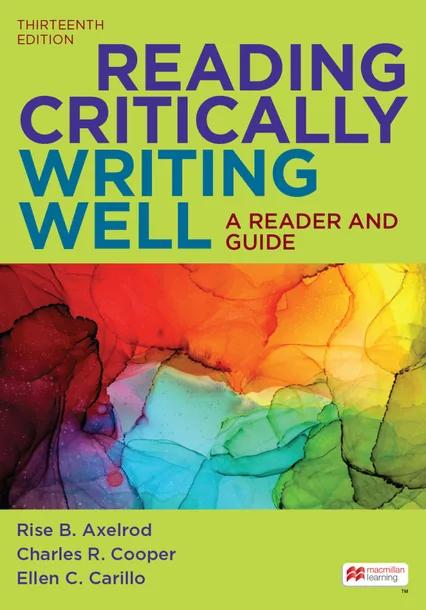
Reading Critically, Writing Well
A Reader and Guide
by Rise B. Axelrod, Charles R. Cooper, Ellen Carillo
13th Edition
Publisher: Bedford/St. Martin's
Book Details
| Print ISBN | 9781319332297 |
| eText ISBN | 9781319484811 |
| Publisher | Bedford/St. Martin's |
| Publishing Year | 2023 |
| Edition | 13th Edition |
| Language | English |
| Pages | 688 |
Reading Critically, Writing Well, 13th Edition, authored by Rise B. Axelrod, Charles R. Cooper, and Ellen Carillo, is an academic reader designed to guide college students in joining academic conversations through integrated reading and composition. Published by Bedford/St. Martin's in 2023, this volume connects foundational reading strategies directly to academic writing tasks.
The reader presents structured guidance on academic habits of mind paired with a detailed catalog of reading strategies. College students engage with explicit techniques for annotating, outlining, summarizing, paraphrasing, and synthesizing texts across various writing contexts.
Additional instruction addresses rhetorical sensitivity, evaluating logical arguments, analyzing underlying assumptions, and working with multimodality. This coverage supports undergraduate students as they develop critical analysis and systematic writing habits.
Table of Contents
Chapter 1: Academic Habits of Mind: From Reading Critically to Writing Well Joining the Academic Conversation
- • ■ ACTIVITY 1: Exploring Your Habits of Mind
- • Ben Greenman, The Online Curiosity Killer
- • Arjun Shankar and Mariam Durrani, Curiosity and Education: A White Paper
- • Mario Livio, Curious, from Why? What Makes Us Curious?
- • Susan Engel, The Case for Curiosity
- • ■ ACTIVITY 2: Honing Ideas through Discussion
- • ■ ACTIVITY 3: Developing Your Rhetorical Sensitivity
- • ■ ACTIVITY 4: Pulling It All Together
- • *Understanding Multimodality
- • From Reading Critically to Writing Well
- • The Writing Process
- • One Student’s Writing Process
- • ■ Brainstorming
- • ■ Outlining
- • ■ Peer Review Feedback
- • ■ Instructor Feedback
- • ■ Revised Outline
Chapter 2: A Catalog of Reading Strategies
- • Annotating
- • Martin Luther King Jr., An Annotated Sample from “Letter from Birmingham Jail”
- • Taking Inventory
- • Outlining
- • Mapping
- • Summarizing
- • Paraphrasing
- • Skimming
- • Synthesizing
- • Analyzing Assumptions
- • Contextualizing
- • Exploring the Significance of Figurative Language
- • Analyzing Visuals
- • *Analyzing Data Visualizations
- • Looking for Patterns of Opposition
- • Reflecting on Challenges to Your Beliefs and Values
- • Comparing and Contrasting Related Readings
- • Lewis H. Van Dusen Jr., Legitimate Pressures and Illegitimate Results
- • Evaluating the Logic of an Argument
- • Recognizing Logical Fallacies
- • Recognizing Emotional Manipulation
- • Judging the Writer’s Credibility
- • Reading Like a Writer
Chapter 3: Autobiography and literacy narratives
- • Rhetorical Situations for Autobiographies and Literacy Narratives
- • ■ THINKING ABOUT AUTOBIOGRAPHY and Literacy Narratives
- • A GUIDE TO READING AUTOBIOGRAPHY and literacy narratives
- • Annie Dillard, An American Childhood (Annotated Essay)
- • Reading for Meaning
- • Reading Like a Writer
- • READINGS
- • David Sedaris, Me Talk Pretty One Day
- • Molly Montgomery, Literacy Narrative: In Search of Dumplings and Dead Poets
- • *Elissa Washuta, Wednesday Addams Is Just Another Settler
- • ■ COMBINING READING STRATEGIES: Contextualizing in Order to Reflect on Challenges to Your Beliefs and Values
- • Rhea Jameson, Mrs. Maxon (Student Essay)
- • ■ WRITING TO LEARN AUTOBIOGRAPHY and Literacy Narratives
- • A GUIDE TO WRITING AUTOBIOGRAPHY and Literacy narratives
- • ■ THE WRITING ASSIGNMENT
- • Writing Your Draft
- • Reviewing and Improving the Draft
- • A PEER REVIEW GUIDE
- • TROUBLESHOOTING YOUR DRAFT
- • ■ REFLECTING ON AUTOBIOGRAPHY
Chapter 4: Reflection
- • Rhetorical Situations for Reflections
- • ■ THINKING ABOUT REFLECTION
- • A GUIDE TO READING REFLECTIVE ESSAYS
- • Brent Staples, Black Men and Public Space (Annotated Essay)
- • Reading for Meaning
- • Reading Like a Writer
- • READINGS
- • Jacqueline Woodson, The Pain of the Watermelon Joke
- • Manuel Muñoz, Leave Your Name at the Border
- • Maya Rupert, I, Wonder: Imagining a Black Wonder Woman
- • Samantha Wright, Starving for Control (Student Essay)
- • ■ COMBINING READING STRATEGIES: Comparing and Contrasting Related Readings to Recognize Emotional Manipulation
- • ■ WRITING TO LEARN REFLECTION
- • A GUIDE TO WRITING REFLECTIVE ESSAYS
- • ■ THE WRITING ASSIGNMENT
- • Writing Your Draft
- • Reviewing and Improving the Draft
- • A PEER REVIEW GUIDE
- • TROUBLESHOOTING YOUR DRAFT
- • ■ REFLECTING ON REFLECTION
Chapter 5: Understanding Through Inquiry
- • Rhetorical Situations for Inquiry-Driven Writing
- • ■ THINKING ABOUT INQUIRY
- • A GUIDE TO READING: INQUIRY-DRIVEN WRITING
- • *Tyler Stiem, Statue Wars: What Should We Do with Troublesome Monuments? (Annotated Essay)
- • Reading for Meaning
- • Reading Like a Writer
- • READINGS
- • *Marion Winik, What Are Friends For?
- • *Angelica Puzio, Why Is There Such a Gender Gap in COVID-19 Vaccination Rates?
- • Reading Like A Writer
- • *Alex Samuels, Juneteenth Challenges a Narrative about American History
- • ■ COMBINING READING STRATEGIES: Contextualizing in Order to Compare and Contrast Related Readings
- • *Maya Gomez, Should Kidney Donors Be Compensated? (Student Essay)
- • A Guide To Writing Inquiry-Driven Essays
- • The Writing Assignment
- • Writing Your Draft
- • Reviewing and Improving the Draft
- • A PEER REVIEW GUIDE
- • TROUBLESHOOTING YOUR DRAFT
- • ■ REFLECTING ON OBSERVATION
Chapter 6: Explaining Concepts
- • Rhetorical Situations for Concept Explanations
- • ■ THINKING ABOUT CONCEPT EXPLANATION
- • A GUIDE TO READING CONCEPT EXPLANATIONS
- • Susan Cain, Shyness: Evolutionary Tactic? (Annotated Essay)
- • Reading for Meaning
- • Reading Like a Writer
- • READINGS
- • John Tierney, Do You Suffer from Decision Fatigue?
- • Jeff Howe, The Rise of Crowdsourcing
- • ■ COMBINING READING STRATEGIES: Synthesizing Information from Sources to Support Claims and Provide Context
- • *Lesley Wexler and Jennifer K. Robbennolt, #MeToo and Restorative Justice
- • *Rosa Alexander, The Meme-ing of Trigger Warnings (Student Essay)
- • ■ WRITING TO LEARN CONCEPT EXPLANATION
- • A GUIDE TO WRITING ESSAYS EXPLAINING CONCEPTS
- • ■ THE WRITING ASSIGNMENT
- • Writing Your Draft
- • Reviewing and Improving the Draft
- • A PEER REVIEW GUIDE
- • TROUBLESHOOTING YOUR DRAFT
- • ■ REFLECTING ON CONCEPT EXPLANATION
Chapter 7: Evaluation
- • Rhetorical Situations for Evaluations
- • ■ THINKING ABOUT EVALUATION
- • A GUIDE TO READING EVALUATIONS
- • Amitai Etzioni, Working at McDonald’s (Annotated Essay)
- • Reading for Meaning
- • Reading Like a Writer
- • READINGS
- • Matthew Hertogs, Typing vs. Handwriting Notes: An Evaluation of the Effects of Transcription Method on Student Learning
- • Ian Bogost, Brands Are Not Our Friends
- • Christine Rosen, The Myth of Multitasking
- • ■ COMBINING READING STRATEGIES: Comparing and Contrasting Related Readings to Judge a Writer’s Credibility
- • Christine Romano, Jessica Statsky’s “Children Need to Play, Not Compete”: An Evaluation (Student Essay)
- • ■ WRITING TO LEARN EVALUATION
- • A GUIDE TO WRITING EVALUATIONS
- • ■ THE WRITING ASSIGNMENT
- • Writing Your Draft
- • Reviewing and Improving the Draft
- • A PEER REVIEW GUIDE
- • TROUBLESHOOTING YOUR DRAFT
- • ■ REFLECTING ON EVALUATION
Chapter 8: Arguing for a Position
- • Rhetorical Situations for Position Arguments
- • ■ THINKING ABOUT POSITION ARGUMENT
- • A GUIDE TO READING ESSAYS ARGUING FOR A POSITION
- • *David Wallace-Wells, People Don’t Trust Public-Health Experts Because Public-Health Experts Don’t Trust People (Annotated Essay)
- • Reading for Meaning
- • Reading Like a Writer
- • READINGS
- • *Scott Nolen, The Seatbelt Approach to the Opioid Crisis
- • *Samantha Allen, The Rainbow Will Always Mean Pride
- • Daniel J. Solove, Why Privacy Matters Even If You Have “Nothing to Hide”
- • Jessica Statsky, Children Need to Play, Not Compete (Student Essay)
- • ■ COMBINING READING STRATEGIES: Comparing and Contrasting to Analyze Visuals
- • ■ WRITING TO LEARN POSITION ARGUMENT
- • A GUIDE TO WRITING POSITION ARGUMENTS
- • ■ THE WRITING ASSIGNMENT
- • Writing Your Draft
- • Reviewing and Improving the Draft
- • A PEER REVIEW GUIDE
- • TROUBLESHOOTING YOUR DRAFT
- • ■ REFLECTING ON POSITION ARGUMENT
Chapter 9: Speculating About Causes or Effects
- • Rhetorical Situations for Speculating about Causes or Effects
- • ■ THINKING ABOUT SPECULATIONS ABOUT CAUSES OR EFFECTS
- • A GUIDE TO READING ESSAYS SPECULATING ABOUT CAUSES OR EFFECTS
- • *Kim Wong-Shing, How Horror Movies Can Help Mental Health, According to Science (Annotated Essay)
- • Reading for Meaning
- • Reading Like a Writer
- • READINGS
- • Anna Maria Barry-Jester, Patterns of Death in the South Still Show the Outlines of Slavery
- • C Thi Nguyen, Escape the Echo Chamber
- • Nicholas Carr, Is Google Making Us Stupid?
- • ■ COMBINING READING STRATEGIES: Contextualizing in Order to Analyze Visuals
- • Clayton Pangelinan, #socialnetworking: Why It’s Really So Popular (Student Essay)
- • ■ WRITING TO LEARN SPECULATIONS ABOUT CAUSES OR EFFECTS
- • A GUIDE TO WRITING ESSAYS SPECULATING ABOUT CAUSES OR EFFECTS
- • ■ THE WRITING ASSIGNMENT
- • Writing Your Draft
- • Reviewing and Improving the Draft
- • A PEER REVIEW GUIDE
- • TROUBLESHOOTING YOUR DRAFT
- • ■ REFLECTING ON SPECULATIONS ABOUT CAUSES OR EFFECTS
Chapter 10: Proposal to Solve a Problem
- • Rhetorical Situations for Proposals
- • ■ THINKING ABOUT PROPOSALS
- • A GUIDE TO READING PROPOSALS
- • Alice Wong, The Last Straw (Annotated Essay)
- • Reading for Meaning
- • Reading Like a Writer
- • READINGS
- • Maryanne Wolf, Skim Reading Is the New Normal
- • ■ COMBINING READING STRATEGIES: Looking for Patterns of Opposition to Analyze Assumptions
- • *Ben Miller, Graduate School Debt
- • Neva Goodwin, Meaningful Work — A Radical Proposal
- • *Patrick O’Malley, More Testing, More Learning (Annotated Student Essay)
- • ■ WRITING TO LEARN PROPOSALS
- • A GUIDE TO WRITING PROPOSALS
- • ■ THE WRITING ASSIGNMENT
- • Writing Your Draft
- • Reviewing and Improving the Draft
- • A PEER REVIEW GUIDE
- • TROUBLESHOOTING YOUR DRAFT
- • ■ REFLECTING ON PROPOSALS TO SOLVE A PROBLEM
Chapter 11: Multi-Genre Writing: Pulling It All Together
- • Rhetorical Situations for Multi-Genre Writing
- • ■ THINKING ABOUT multi-genre writing
- • A GUIDE TO READING multi-genre essays
- • Atul Gawande, The Heroism of Incremental Care
- • Reading for Meaning
- • Reading Like a Writer: Explaining Concepts
- • Reading Like a Writer: Reflection
- • Reading Like a Writer: Arguing for a Position
- • Reading Like a Writer: The Rhetorical Situation in Multi-Genre Writing
- • READINGS
- • Wesley Morris, Who Gets to Decide What Belongs in the “Canon”?
- • Reading Like a Writer: Speculating about Causes and Effects
- • Tajja Isen, How Can We Expand the Way We Write about Our Identities?
- • Reading Like a Writer: Proposal to Solve a Problem
- • *Laura Beth Nielsen, The Case for Restricting Hate Speech
- • Reading Like a Writer: Evaluation
- • Aru Terbor, A Deeper Look at Empathetic and Altruistic Behavior (Student Essay)
- • ■ WRITING TO LEARN Multi-Genre Essays
- • A GUIDE TO WRITING multi-genre essays
- • ■ THE WRITING ASSIGNMENT
- • Writing Your Draft
- • Reviewing and Improving the Draft
- • A PEER REVIEW GUIDE
- • TROUBLESHOOTING YOUR DRAFT
- • ■ REFLECTING ON WRITING MULTI-GENRE ESSAYS
Chapter 12: Strategies for Research and Documentation
- • PLANNING A RESEARCH PROJECT
- • Analyzing Your Rhetorical Situation and Setting a Schedule
- • Choosing a Topic and Getting an Overview
- • Focusing Your Topic and Drafting Research Questions
- • Establishing a Research Log
- • Creating a Working Bibliography
- • Annotating Your Working Bibliography
- • Taking Notes on Your Sources
- • FINDING SOURCES
- • Searching Library Catalogs and Databases
- • Searching for Government Documents and Statistical Information
- • Searching for Websites and Interactive Sources
- • CONDUCTING FIELD RESEARCH
- • Conducting Observational Studies
- • Conducting Interviews
- • Conducting Surveys
- • EVALUATING SOURCES
- • Choosing Relevant Sources
- • Choosing Credible Sources
- • USING SOURCES
- • Synthesizing Sources
- • Acknowledging Sources and Avoiding Plagiarism
- • Using Information from Sources to Support Your Claims
- • CITING AND DOCUMENTING SOURCES IN MLA Style
- • Using In-Text Citations
- • ■ DIRECTORY TO IN-TEXT CITATION MODELS
- • Creating a List of Works Cited
- • ■ DIRECTORY TO WORKS-CITED-LIST MODELS
- • CITING AND DOCUMENTING SOURCES IN APA Style
- • Creating a List of References
- • ■ DIRECTORY TO REFERENCE-LIST MODELS
Customer Reviews
0.0
0 reviews
No reviews yet. Be the first to review this book!
Write a Review
Reviewed by GradeFocus Editorial Team
▶Research Sources (10)
- Reading Critically, Writing Well, 13th Edition
- Reading Critically, Writing Well, 13e-9781319484811
- Reading Critically, Writing Well
- Reading Critically, Writing Well 13th Edition | Rise B. Axelrod
- Reading Critically, Writing Well: A Reader and Guide
- Books | Thoughtful Learning K-12
- Reading Critically, Writing Well A Reader and Guide
- Reading Critically, Writing Well... | Rent | 9781319332297
- looking for "reading critically, writing well" 13th edition
- Reading Critically, Writing Well A Reader and Guide