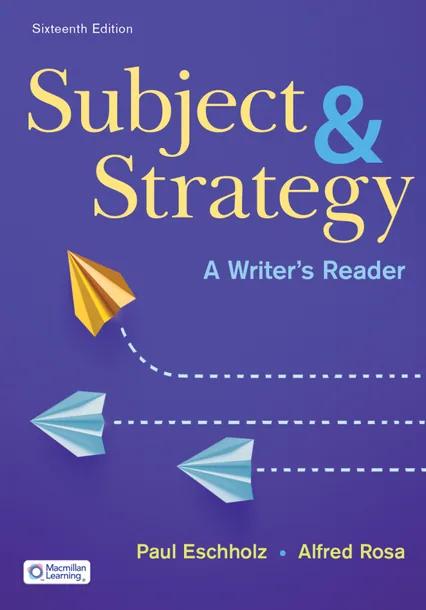
Subject and Strategy
A Writer's Reader
by Paul Eschholz, Alfred Rosa
16th Edition
Publisher: Bedford/St. Martin's
Book Details
| Print ISBN | 9781319244606 |
| eText ISBN | 9781319421106 |
| Publisher | Bedford/St. Martin's |
| Publishing Year | 2022 |
| Edition | 16th Edition |
| Language | English |
Subject and Strategy: A Writer's Reader, 16th Edition, is a reader published by Bedford/St. Martin's. The text pairs diverse readings with practical writing strategies applicable to any college course, affirming students in their ongoing development as writers.
Instruction centers on active and critical reading, core rhetorical modes of exposition and argument, and methods for writing with sources. A thematic collection of 63 readings addresses significant social issues and topics of curiosity, such as the impact of climate change.
Designed to guide students as they craft essays, the volume includes guided practice questions that help writers analyze rhetorical choices and refine their drafts.
Table of Contents
Chapter 1: Reading Actively and Critically
- • Reading Actively: Developing a Basic Understanding of the Essay
- • Step 1: Prepare Yourself to Read the Selection
- • Step 2: Read the Selection:
- • Cherokee Paul McDonald, A View from the Bridge
- • Step 3: Read the Selection a Second Time, Annotating the Text
- • An Example: Student Annotations for “A View from the Bridge”
- • Student Reflection: Julie Dwire on Annotating a Reading
- • Step 4: Outline and Summarize the Selection
- • An Example: Julie Dwire’s Summary of “A View from the Bridge”
- • Step 5: Answer the Questions on Subject and Questions on Strategy
- • An Example: Julie Dwire Answers Study Questions
- • Student Reflection: Julie Dwire on Answering Study Questions
- • Reading Critically: Taking Your Analysis to Another Level
- • Identifying the Thesis
- • Identifying the Purpose
- • Evaluating Evidence
- • Identifying Tone
- • Identifying Assumptions and Biases
- • Evaluating the Overall Effectiveness of an Essay
- • From Reading to Writing
- • Reading Photographs and Visual Texts
Chapter 2: Writing
- • Developing an Effective Writing Process
- • Step 1: Understand Your Assignment
- • Step 2: Gather Ideas and Formulate a Thesis
- • Step 3: Organize and Write Your First Draft
- • Step 4: Revise Your Essay
- • Step 5: Edit and Proofread Your Essay
- • A Student Essay in Progress
- • Step 1: Keith’s Assignment
- • Step 2: Keith’s Ideas
- • Step 3: Keith’s First Draft
- • Step 4: Keith’s Revised Essay
- • Step 5: Keith’s Edited Essay
- • Keith Eldred, Secular Mantras (student essay)
Chapter 3: Writers on Writing
- • Jhumpa Lahiri, I Am, in Italian, a Tougher, Freer, Writer
- • Russell Baker, Discovering the Power of My Words
- • Anne Lamott, Shitty First Drafts
- • Linda S. Flower, Writing for an Audience
- • Stephen King, Reading to Write
Chapter 4: Narration
- • Understanding Narration as a Writing Strategy
- • Using Narration Across the Disciplines
- • Practical Advice for Writing an Essay of Narration
- • Andrew Kauser, Challenging My Fears (student essay)
- • Junot Díaz, The Terror
- • David P. Bardeen, Not Close Enough for Comfort
- • Toni Morrison, The Work You Do, The Person You Are
- • Ocean Vuong, Surrendering
Chapter 5: Description
- • Understanding Description as a Writing Strategy
- • Using Description Across the Disciplines
- • Practical Advice for Writing an Essay of Description
- • Jim Tassé, Trailcheck (student essay)
- • Jeannette Walls, A Woman on the Street
- • Robert Ramírez, The Barrio
- • Maya Angelou, Sister Flowers
- • Rochelle Riley, Can’t Help Lovin’ Dat Winter of Mine
Chapter 6: Illustration
- • Understanding Illustration as a Writing Strategy
- • Using Illustration Across the Disciplines
- • Practical Advice for Writing an Essay of Illustration
- • Paula Kersch, Weight Management: More Than a Matter of Good Looks (student essay)
- • Natalie Goldberg, Be Specific
- • Ben Crump, A Memorable Lesson
- • Jennifer Ackerman, The Genius of Birds
- • Rebecca Solnit, Men Explain Things to Me
Chapter 7: Process Analysis
- • Understanding Process Analysis as a Writing Strategy
- • Using Process Analysis Across the Disciplines
- • Practical Advice for Writing an Essay of Process Analysis
- • William Peterson, Juggling Is Easier Than You Think (student essay)
- • Mortimer Adler, How to Mark a Book
- • Cody Cassidy and Paul Doherty, What Would Happen If You Were Attacked by a Great White Shark?
- • Alicia Ault, How Do Spiders Make Their Webs?
- • Katherine Luck, How to Write Haiku
Chapter 8: Comparison and Contrast
- • Understanding Comparison and Contrast as a Writing Strategy
- • Using Comparison and Contrast Across the Disciplines
- • Practical Advice for Writing an Essay of Comparison and Contrast
- • Barbara Bowman, Guns and Cameras (student essay)
- • Suzanne Britt, Neat People vs. Sloppy People
- • Kayann Short, Soil versus Dirt: A Reverie on Getting Down to Earth
- • Andrew Vachss, The Difference between Sick and Evil
- • Aleksandr Solzhenitsyn, Exile in America
Chapter 9: Division and Classification
- • Understanding Division and Classification as a Writing Strategy
- • Using Division and Classification Across the Disciplines
- • Practical Advice for Writing an Essay of Division and Classification
- • Katie Angeles, The Forgotten Personality Type (student essay)
- • Judith Viorst, The Truth about Lying
- • Richard Lederer, All-American Dialects
- • Amy Tan, Mother Tongue
- • Martin Luther King Jr., Three Ways of Meeting Oppression
Chapter 10: Definition
- • Understanding Definition as a Writing Strategy
- • Using Definition Across the Disciplines
- • Practical Advice for Writing an Essay of Definition
- • Howard Solomon Jr., Best Friends (student essay)
- • Jo Goodwin Parker, What Is Poverty?
- • Deborah M. Roffman, What Does Boys Will Be Boys Really Mean?
- • Mark Peters, Virtue Signaling and Other Inane Platitudes
- • N. Scott Momaday, The Sacred Spell of Words
Chapter 11: Cause and Effect Analysis
- • Understanding Cause and Effect Analysis as a Writing Strategy
- • Using Cause and Effect Analysis Across the Disciplines
- • Practical Advice for Writing an Essay of Cause and Effect Analysis
- • Kevin Cunningham, Gentrification (student essay)
- • Jon Katz, How Boys Become Men
- • Michael Jonas, The Downside of Diversity
- • Illyanna Maisonet, Why Spam Guisada Is the Perfect Dish to Make Right Now
- • Anthony Abraham Jack, I Was a Low-Income College Student: Classes Weren’t the Hard Part
Chapter 12: Argumentation
- • Understanding Argumentation as a Writing Strategy
- • Using Argumentation Across the Disciplines
- • Practical Advice for Writing an Essay of Argumentation
- • Mona Sablon, The Case for Art in the Time of a Pandemic (student essay)
- • Abraham Lincoln, Second Inaugural Address
- • Andrea Long Chu, My New Vagina Won’t Make Me Happy
- • Chimamanda Ngozi Adichie, We Should All Be Feminists
- • Ta-Nehisi Coates, The Paranoid Style of American Policing
- • James Temple, Suppressing Fires Has Failed. Here’s What California Needs to Do Instead
- • ARGUMENT CLUSTER: Race and Privilege: How to Address A System of Bias?
- • Ward Connerly, America Is Not a Racist Country
- • Rahawa Haile, Going It Alone
- • Marvin Blakely, A Long Road to Hope
- • ARGUMENT CLUSTER: Individualism and Collectivism: Where Do We Find Ourselves?
- • Robert Ginsburg, Collectivism and Individualism: Reflections from a Pandemic
- • Robert Reich, What Good Do We Have in Common?
- • Tegan Tallullah, Why We Can’t Rely on Individuals to Fix Climate Change
Chapter 13: Writing with Sources
- • What Does It Mean to Write with Sources?
- • Writing with Sources
- • Learning to Summarize, Paraphrase, and Quote from Your Sources
- • Avoiding Plagiarism
- • Katherine Kachnowski, Skin Cancer Is Not Just for Grandparents: Dispelling Widespread Misconceptions about This Disease (student essay)
- • Lily Huang, What Climate Change Means to Glacier National Park
- • Daniel James Brown, Competitive Rowing
- • Donna Hicks, Activate Empathy
Chapter 14: A Brief Guide to Researching and Documenting Essays
- • Establishing a Realistic Schedule
- • Finding and Using Sources
- • Evaluating Your Sources
- • Analyzing Your Sources
- • Developing a Working Bibliography for Your Sources
- • Taking Notes
- • Documenting Sources
- • In-Text Citations
- • List of Works Cited
Chapter 15: Editing for Grammar, Punctuation, and Sentence Style
- • Run-Ons: Fused Sentences and Comma Splices
- • Sentence Fragments
- • Comma Faults
- • Subject-Verb Agreement
- • Unclear Pronoun References
- • Pronoun-Antecedent Agreement
- • Dangling and Misplaced Modifiers
- • Faulty Parallelism
- • Weak Nouns and Verbs
- • Shifts in Verb Tense, Mood, and Voice
- • Wordiness
- • Sentence Variety
Customer Reviews
0.0
0 reviews
No reviews yet. Be the first to review this book!
Write a Review
Reviewed by GradeFocus Editorial Team