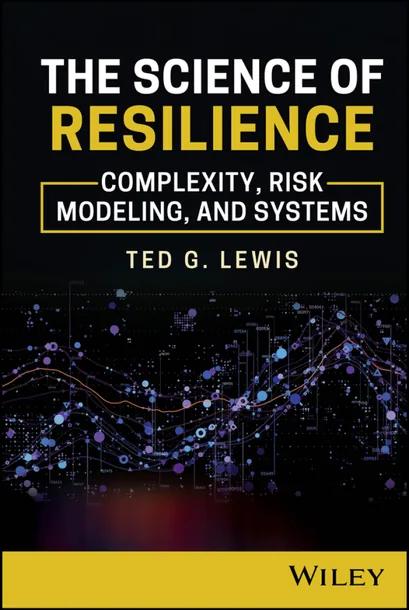
The Science of Resilience
Complexity, Risk Modeling, and Systems
by Ted G. Lewis
1st Edition
Publisher: Wiley-Blackwell
Book Details
| Print ISBN | 9781394354924 |
| eText ISBN | 9781394354931 |
| Publisher | Wiley-Blackwell |
| Publishing Year | 2025 |
| Edition | 1st Edition |
| Language | English |
| Pages | 224 |
In The Science of Resilience, 1st Edition, author Ted G. Lewis presents a comprehensive framework for studying system vulnerability and structural endurance. Written as a textbook for graduate students, engineering and systems design professionals, and complexity science researchers, the text treats resilience as an integrated systems problem. It constructs theoretical foundations using models and analogies derived from physics, engineering, ecology, cyber security, and finance.
The teaching progression emphasizes quantitative modeling alongside practical system behaviors. The text explains phase change dynamics and demonstrates how to apply these concepts to general complex systems. It integrates mathematical models with real-world scenarios across physical, economic, and social environments, helping readers analyze complex failure modes directly.
Author Ted G. Lewis was inducted into the Oregon State University Engineering Hall of Fame in 2021. His technical background supports a rigorous textbook suitable for graduate-level courses in risk modeling, industrial engineering, and technology management.
Table of Contents
Chapter 1: Sandpiles, Long Tails, and Complex Catastrophes
- • The Many Faces of Resilience
- • Sandpile as Metaphor
- • Blocks and Springs
- • Computing Exceedance Probability
- • Two Versions of Exceedance
- • Comments
- • References
Chapter 2: Wildfires, Self-Organization, and Phase Change
- • California Wildfires
- • Percolated Forests
- • Why Does This Occur?
- • Time Resilience
- • Herd Immunity
- • Gause’s Emergent Forest
- • Punctuated Equilibrium
- • Comments
- • References
Chapter 3: Nuclear Disaster, Fault Trees, and the Kill Chain
- • PRA and Fault Trees
- • The Hundred-Year Flood
- • Modeling Threats
- • Modeling TMI-2 Risk
- • Minimization of Fault Tree Risk
- • Maximizing Threat – The Rational Adversary
- • Redundant TMI- 2
- • Cyber Kill Chain
- • Comments
Chapter 4: Avalanches, Complex Network, and the Day Power Went Out
- • What Happened on August 14th
- • Network Basics
- • Spectral Radius
- • Network Avalanches
- • Bottlenecks and Resilient Walks
- • Blocking Node Resilience
- • Networks That Sync
- • Comments
- • References
Chapter 5: Surges, Overloads, and the Transformer Matrix
- • The Transformer Matrix
- • Surges and N-1 Testing
- • Surges and Overloading
- • Increasing Capacity and the Braess Paradox
- • Estimating Vulnerability, V
- • Comments
Chapter 6: Emergence, Optimization, and the Competitive Exclusion Principle
- • Efficient Hubs
- • Optimizing Links
- • Maximizing Clusters
- • Dynamic State Space
- • Competitive Exclusion Principle is Degree-Emergence
- • Resilient Sync Networks Cooperate
- • A Theory of Heartbeat
- • Comments
- • References
Chapter 7: Population Resilience, Biological Avalanches, and the COVID- 19 Pandemic
- • Risk and Resilience
- • Epidemics as Avalanches
- • A Multi-Factor Model
- • Comments
- • References
Chapter 8: Flashmob Avalanches, Disinformation, and Herd Mentality
- • A Digital Flashmob
- • Resilience: Applying Control Theory to Disinformation
- • Controlling Chaos
- • Comments
- • Reference
Chapter 9: Enrichment, Extinction, and the Tragedy of the Commons
- • Too Much Money
- • Predator and Prey
- • Plausible Extinction Events
- • Resilience of Predator–Prey Systems
- • Minsky Moments
- • Comments
- • References
Chapter 10: Resilient Cyber Security and Fault Tree Resilience
- • Correlation With Uptick in Physical Incidents
- • Detecting Malware With YARA Patterns
- • Fault Tree Resilience
- • An Industrial Control System
- • Increasing Resilience via Blocking Nodes
- • Tracing Fault Tree Paths Along Avalanches
- • Increasing Security by Investing in Vulnerability Reduction
- • Comments
- • Reference
Chapter 11: Distributed Resilience, Restructuring, and the Crash of 2008
- • Too Connected to Fail
- • Restructuring by Node Splitting
- • Bushy versus Branchy Restructuring
- • Improving Flow Resilience
- • The Great Texas Freeze
- • Comments
Customer Reviews
0.0
0 reviews
No reviews yet. Be the first to review this book!
Write a Review
Reviewed by GradeFocus Editorial Team
▶Research Sources (14)
- [PDF] The Science of Resilience by Ted G. Lewis
- The Science of Resilience: Complexity, Risk Modeling, And...
- The Science of Resilience... | Rent | 9781394354924
- Captcha - Erie2 BOCES | Erie BOCES
- The Science of Resilience, eBook by Ted G. Lewis
- Scaffolding
- Thompson Learn.
- The Science of Resilience Complexity, Risk ...
- Professor Leah Litman shares 3 Books (ahem, 4) that she's ...
- The Science of Resilience Complexity, Risk Modeling, and ...
- The Science of Resilience : Ted G. Lewis : 9781394354924
- science resilience complexity risk modeling systems by Ted G ...
- The Science of Resilience : Complexity, Risk Modeling, ...
- The Science of Resilience: Complexity, Risk Modeling, and ...