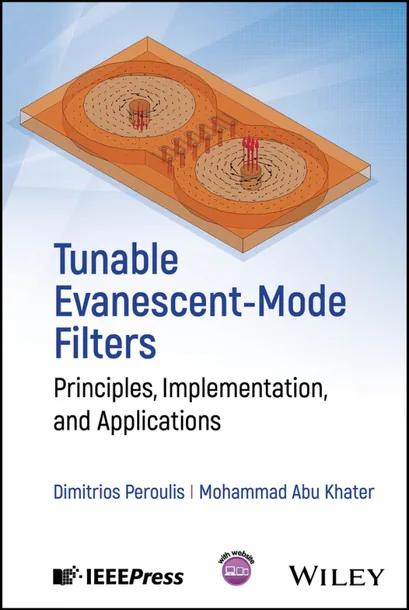
Tunable Evanescent-Mode Filters
Principles, Implementation, and Applications
by Dimitrios Peroulis, Mohammad Abu Khater
1st Edition
Publisher: Wiley-IEEE Press
Book Details
| Print ISBN | 9781394216802 |
| eText ISBN | 9781394216826 |
| Publisher | Wiley-IEEE Press |
| Publishing Year | 2025 |
| Edition | 1st Edition |
| Language | English |
| Pages | 320 |
In Tunable Evanescent-Mode Filters, 1st Edition, authors Dimitrios Peroulis and Mohammad Abu Khater deliver a reference covering design principles, implementation technologies, and practical applications. Formulated for beginners in tunable RF systems as well as advanced researchers in tunable RF systems, this volume addresses the technical demand for structured reference material in radio-frequency engineering.
The theoretical portion of the text establishes essential concepts in high-frequency hardware design. Key principle topics include filter anatomy, coupling matrix derivations, and routing diagrams. Detailed sections explain the behavior of evanescent-mode resonators, offering the mathematical and physical basis needed to evaluate dynamic filter topologies and circuit performance.
Practical design examples guide readers through specific configurations, including Chebyshev bandpass filters and Butterworth bandstop filters. Technical explanations throughout the text are reinforced by clear illustrations, step-by-step worked-out examples, and physical hardware demonstrations, ensuring clear context for researchers developing high-performance RF components.
Table of Contents
Chapter 1: Background
- • 1.1 Introduction
- • 1.1.1 Filters Necessity
- • 1.1.2 Alternative Filtering Methods
- • 1.2 Filter Anatomy and Representation
- • 1.2.1 The Basic Coupling Matrix (M Matrix)
- • 1.2.2 Coupling-Routing Diagrams
- • 1.2.3 Additions to the Coupling Matrix for Synthesis of Advanced and Practical Filter Responses
- • 1.2.3.1 Positive and Negative Coupling Values
- • 1.2.3.2 Finite Resonator Quality Factors
- • 1.2.3.3 Resonator Frequency Tuning
- • 1.2.3.4 Non-Resonating Nodes
- • 1.2.3.5 Complex Impedance Loads
- • 1.3 Tunable Resonators in Filters
- • 1.3.1 Planar Tunable Resonators
- • 1.3.2 Ferrimagnetic Tunable Resonators
- • 1.3.3 Evanescent-Mode 3-D Tunable Resonators
Chapter 2: Evanescent-Mode Resonators
- • 2.1 Physical Structure
- • 2.2 Analysis
- • 2.2.1 Coaxial Cable Approximation
- • 2.2.1.1 Unloaded Quality Factor
- • 2.2.2 Tapered Resonator Model
- • 2.2.2.1 Frequency Tuning Ratio
- • 2.2.3 Tuning Range and Quality Factor Co-optimization
- • 2.3 Coupling Techniques
- • 2.3.1 External Coupling
- • 2.3.2 Inter-Resonator Coupling
- • 2.4 Coupling Values Polarity
- • 2.4.1 External Coupling Polarity
- • 2.4.2 Inter-Resonator Coupling Polarity
- • 2.5 Advanced Evanescent-Mode Structures
- • 2.5.1 Dual-Mode Resonators
- • 2.5.2 Fractional Mode Resonators
- • 2.6 Filter Examples
- • 2.6.1 Chebyshev Bandpass Filter
- • 2.6.2 Butterworth Bandstop Filter
Chapter 3: Printed Circuit Board Technology
- • 3.1 Evanescent-Mode Resonator Structure
- • 3.1.1 Practical Considerations
- • 3.2 Tunable Membrane
- • 3.2.1 Piezoelectric Disk Tuners
- • 3.2.2 Contactless Mechanical Actuators
Chapter 4: Silicon Microfabrication
- • 4.1 Generic Structure
- • 4.2 MEMS Tuner Design
- • 4.3 Microfabrication Process
- • 4.3.1 MEMS Tuner Microfabrication
- • 4.3.2 Evanescent-Mode Resonator Microfabrication
- • 4.3.3 Bias Electrode Microfabrication
- • 4.3.4 Filter Assembly
- • 4.4 Mechanical Model and Power Handling
Chapter 5: Injection Molding
- • 5.1 Manufacturing Technology
- • 5.1.1 Device Concept
- • 5.1.2 Injection Molding Technology
- • 5.1.3 Material Selection
- • 5.1.4 Design for Moldability
- • 5.2 Resonator and Filter RF Design
- • 5.2.1 Resonator
- • 5.2.2 Filter
- • 5.3 Fabrication and Measurements
- • 5.3.1 Resonator
- • 5.3.2 Filter Performance Measurements
- • 5.3.3 Power Handling
- • 5.4 Discussion
- • 5.5 Conclusion
- • 5.6 How to Choose the Right Manufacturing Technology
- • 5.7 How to Choose the Right Actuator for the Filter
Chapter 6: Absorptive Bandstop Filters
- • 6.1 Design Principles of Absorptive Filters
- • 6.1.1 Analysis of a Two-Pole Absorptive Bandstop Filter
- • 6.1.2 W-Band Absorptive Bandstop Filter
- • 6.1.2.1 Filter Design
- • 6.1.2.2 Fabrication and Measurements
- • 6.2 Triplet Quasi-absorptive Topology
- • 6.2.1 Quasi-absorptive Filter Design and Implementation
- • 6.2.1.1 Measured Results
Chapter 7: Bandwidth and Passband Control
- • 7.1 Bandwidth Control for Bandpass Filters
- • 7.1.1 Filter Design
- • 7.1.1.1 Bandwidth Variation
- • 7.1.1.2 Quality Factor Impact
- • 7.1.1.3 Impedance Matching
- • 7.1.1.4 Simulated Results
- • 7.1.2 Filter Implementation
- • 7.2 BSF Bandwidth Control
- • 7.2.1 Constant Bandwidth Coupling Concept
- • 7.2.1.1 BW Variation Versus T-Line Length and Tuning Range
- • 7.2.1.2 Phase Variation
- • 7.2.2 Constant Bandwidth Filter Design
- • 7.2.2.1 External Coupling
- • 7.2.2.2 External Coupling Structures: Polarity Design
- • 7.2.2.3 Inter-Resonator Coupling
- • 7.2.3 Fabrication and Measurements
- • 7.2.3.1 Constant FBW Filter
- • 7.2.3.2 Constant ABW Filter
- • 7.2.3.3 Four-Pole Filter
Chapter 8: High-Order and Fractional-Order Evanescent-Mode Filters
- • 8.1 High-Order Evanescent-Mode Filters
- • 8.1.1 Independently Tunable Dual-Mode Evanescent-Mode Filter
- • 8.1.1.1 Resonator Design
- • 8.1.1.2 Filter Design
- • 8.1.1.3 Experimental Validation
- • 8.1.2 High Selectivity Dual-Mode Filters
- • 8.1.2.1 Resonator Design
- • 8.1.2.2 Constant Absolute Bandwidth BPF Filter
- • 8.1.2.3 Filter A: Implementation and Validation
- • 8.1.2.4 Filter B: Implementation and Validation
- • 8.1.2.5 Filter C: Implementation and Validation
- • 8.1.2.6 Filter D: Implementation and Validation
- • 8.1.3 Four-Wedge Evanescent-Mode Resonator
- • 8.1.3.1 Bandpass Filter Design
- • 8.1.3.2 Design Example
- • 8.2 Tunable Half-Mode SIW Filter
Chapter 9: Advanced Evanescent-Mode Filter Structures
- • 9.1 Bandpass-to-bandstop Reconfigurable Filter
- • 9.1.1 Bandpass-to-bandstop Filter Theory
- • 9.1.1.1 Coupling Structure to Switch M 01 and M 03 Simultaneously
- • 9.1.2 Bandpass-to-bandstop Reconfigurable Filter Design
- • 9.1.3 Measured Results
- • 9.2 Field-programmable Filter Array
- • 9.2.1 Positive-to-negative Coupling Structure
- • 9.2.2 Response Enhancements Enabled By Positive-to-negative Inter-Resonator Coupling
- • 9.2.2.1 Zero Net Coupling State Enhancement Using Destructive Interference
- • 9.2.2.2 Local Stopband Attenuation Enhancement Technique
- • 9.2.3 Resonator Array Design and Fabrication
- • 9.2.4 Measured Results
Chapter 10: Passive Applications
- • 10.1 Impedance Tuner
- • 10.1.1 Design and Fabrication
- • 10.1.2 Measured Results
- • 10.2 Single-ended (SE) and Balanced (BAL) Diplexers
- • 10.2.1 Dual-Mode Diplexing Concept
- • 10.2.1.1 Diplexing Architecture
- • 10.2.1.2 Resonant Frequency Misalignment
- • 10.2.1.3 Inter-Resonator Coupling
- • 10.2.2 SE–SE Diplexer Implementation and Measurements
- • 10.2.2.1 External Coupling
- • 10.2.2.2 Measured Results
- • 10.2.3 SE–BAL Diplexer Implementation and Measurements
- • 10.2.3.1 External Coupling
- • 10.2.3.2 Measured Results
- • 10.2.4 BAL–BAL Diplexer Implementation and Measurements
- • 10.2.4.1 External Coupling
- • 10.2.4.2 Measured Results
- • 10.3 Tunable Filtering Rat-race Couplers Based on Half- and Full-mode Evanescent-mode Resonators
- • 10.3.1 Design
- • 10.3.2 Full-mode Rat-race Coupler
- • 10.3.2.1 Experimental Validation
- • 10.3.3 Half-mode Rat-race Coupler
- • 10.3.3.1 Half-mode Structure
- • 10.3.3.2 Experimental Validation
Chapter 11: Active Applications
- • 11.1 Co-Design of Power Amplifiers and High-Q Filters
- • 11.1.1 Filter Design
- • 11.1.2 Transistor Characterization
- • 11.1.3 Matching Filter Design
- • 11.1.3.1 Fundamental and Harmonic Matchings
- • 11.1.4 PA Design
- • 11.1.5 Experimental Results
- • 11.1.6 Co-Design of PA and Three-Pole High-Q Tunable Filter
- • 11.2 Phase-Locked Loop
- • 11.2.1 Frequency Synthesizer Architecture and Phase Noise Model
- • 11.2.2 Circuit Design and Optimizations
- • 11.2.2.1 Evanescent-Mode Cavity Resonator
- • 11.2.2.2 Voltage-Controlled Oscillator Design
- • 11.2.2.3 Phase-Locked Loop Design
- • 11.2.2.4 Measured Results
- • 11.3 Balanced–Balanced Tunable Filtering LNA
- • 11.3.1 Cavity Resonator-LNA Co-Design
- • 11.3.1.1 Evanescent-Mode Resonators
- • 11.3.1.2 Lna
- • 11.3.2 Implementation and Measured Results
Chapter 12: Monitoring and Control
- • 12.1 Monitoring and Control of PCB-based Resonators: Diplexer Example
- • 12.1.1 System Architecture
- • 12.1.1.1 Diplexer
- • 12.1.1.2 Resonators Monitoring and Control
- • 12.1.1.3 Spectrum Sensing
- • 12.1.2 Control Loop Analysis
- • 12.1.3 Design Details
- • 12.1.3.1 Diplexer Structure
- • 12.1.3.2 Oscillator and Frequency Counter
- • 12.1.3.3 Control Unit and Charge Pump
- • 12.1.4 Implementation and Measurements
- • 12.1.4.1 Implementation
- • 12.1.4.2 Monitoring Performance
- • 12.1.4.3 RF Performance
- • 12.1.4.4 Spectrum-aware Measurements
- • 12.2 Monitoring and Control
Customer Reviews
0.0
0 reviews
No reviews yet. Be the first to review this book!
Write a Review
Reviewed by GradeFocus Editorial Team
▶Research Sources (15)
- [PDF] Tunable Evanescent-Mode Filters by Dimitrios Peroulis ...
- Details for: Tunable evanescent-mode filters : principles ...
- Tunable Evanescent-Mode Filters, eBook by Dimitrios Peroulis ...
- Tunable Evanescent-Mode Filters - Dimitrios Peroulis ... - Bokklubben
- Captcha - Erie2 BOCES | Erie BOCES
- Print Friendly Search Results
- Thompson Learn.
- Tunable Evanescent-Mode Filters : Principles, Implementation, and ...
- In Print: 'Tunable Evanescent-Mode Filters: Principles ...
- Tunable Evanescent-Mode Filters
- Tunable Evanescent-Mode Filters Principles, Implementation ...
- Tunable Evanescent‐Mode Filters: Principles, ...
- TUNABLE FILTER BANK USING EVANESCENT MODE ...
- RF and Microwave Filters - Discussion of Filter Techniques
- Tunable Evanescent-Mode Filters, (Hardcover)