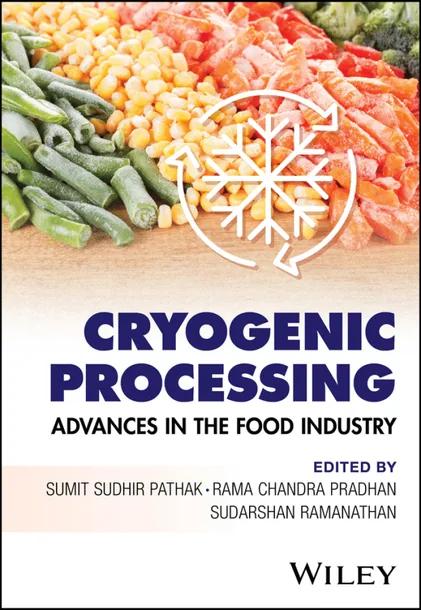
Cryogenic Processing
Advances in the Food Industry
by Sumit Sudhir Pathak, Rama Chandra Pradhan, Sudarshan Ramanathan
1st Edition
Publisher: Wiley-Blackwell
Book Details
| Print ISBN | 9781394280087 |
| eText ISBN | 9781394280094 |
| Publisher | Wiley-Blackwell |
| Publishing Year | 2026 |
| Edition | 1st Edition |
| Language | English |
| Pages | 322 |
Published in 2026, Cryogenic Processing: Advances in the Food Industry, 1st Edition, is a textbook that presents low-temperature engineering principles and industrial preservation methods. Authors Sumit Sudhir Pathak, Rama Chandra Pradhan, and Sudarshan Ramanathan examine molecular foundations, industrial design engineering, structural material transformations, and commercial cryogenic freezing and chilling systems.
The volume details specialized applications across major food sectors. Text sections examine preservation methods for fruits, vegetables, dairy products, plant-based foods, meat, poultry, and marine products. Additional coverage focuses on cryogenic grinding technologies used in spice processing, alongside low-temperature processing methods for herbal medicine and vegan food products.
Published by Wiley-Blackwell, this 322-page hardcover textbook supports structured academic study, course delivery, and professional engineering research. The text is designed for postgraduate scholars, graduate students, university instructors, and industry researchers working in food process engineering, post-harvest science, and food technology.
Table of Contents
Chapter 1: Cryogenics: An Overview and Introduction
- • 1.1 Introduction
- • 1.2 Historical Developments of Cryogenics
- • 1.3 Fundamental Concepts of Cryogenics
- • 1.4 Cryogenic Equipment and Systems
- • 1.5 Impacts and Application of Cryogenics
- • 1.6 Influence of Cryogenics in Food
- • 1.7 Safety in Cryogenics
- • 1.8 Limitations and Challenges in Cryogenics
- • 1.9 Summary and Structure of the Book
- • 1.10 Conclusion
Chapter 2: Molecular Foundations of Cryogenic Processes: A Chemical Perspective
- • 2.1 Introduction
- • 2.2 Thermodynamic Principles of Cryogenic Systems
- • 2.3 Kinetic and Molecular Motion in Cryogenic Conditions
- • 2.4 Intermolecular Forces and Structural Stabilization
- • 2.5 Cryogenic Effects on Biomolecules
- • 2.6 Water Behaviour and Ice Crystallization in Cryogenic Processing in the Food Industry
- • 2.7 Role of Cryogens: Liquid Nitrogen and Carbon Dioxide
- • 2.8 Implications for Food Structure and Quality
- • 2.9 Molecular Basis of Bioactive Stabilization
- • 2.10 Emerging Trends and Future Directions
- • 2.11 Conclusion and Summary
Chapter 3: Cryogenic Impact on Food Material Properties: Structural and Functional Transformations
- • 3.1 Introduction
- • 3.2 Fundamentals of Cryogenic Processing in Food Industry
- • 3.3 Structural Alterations in Cryogenically Treated Food Materials
- • 3.4 Functional Enhancements and Impacts on Food Quality
- • 3.5 Applications of Cryogenic Processing
- • 3.6 Future Directions and Challenges
- • 3.7 Conclusion
Chapter 4: Industrial Design and Engineering Aspects in Cryogenic Applications
- • 4.1 Introduction
- • 4.2 Fundamental Principles of Cryogenics
- • 4.3 Industrial Role of Cryogenics in the Food Processing
- • 4.4 Industrial Design and Engineering Considerations in Food Processing Applications
- • 4.5 Role of LN 2 and LCO 2 in Food Processing Applications
- • 4.6 Key Design Elements of Cryogenic Equipment for Food Processing Applications
- • 4.7 Challenges and Future Trends
- • 4.8 Conclusion and Summary
Chapter 5: Cryogenic Freezing Process for the Preservation of Fruits and Vegetables
- • 5.1 Introduction
- • 5.2 Overview of Cryogenics in Food Processing
- • 5.3 Conventional Freezing Methods for Fruits and Vegetables
- • 5.4 Cryogenic Freezing Techniques
- • 5.5 Case Studies on Cryogenic Freezing of Fruits and Vegetables
- • 5.6 Advantages and Limitations of Cryogenic Freezing
- • 5.7 Conclusion
Chapter 6: Cold Revolution: Cryogenic Innovations in Dairy Production and Preservation
- • 6.1 Introduction
- • 6.2 Cryogenics in Dairy Production and Preservation
- • 6.3 Cryogenic Processing of Dairy Products
- • 6.4 Cryogenic Drying: A Revolution in Milk Powder Production
- • 6.5 Ice Cream and Frozen Desserts
- • 6.6 Cryogenic Technology in Fermented Milk Processing
- • 6.7 Cryogenic Preservation of Cultures and Enzymes
- • 6.8 Cryogenic Technology in Value- Added Dairy Products
- • 6.9 Technological Evolution of Cryogenic Systems
- • 6.10 Challenges and Future Prospects
- • 6.11 Conclusion
Chapter 7: Advanced Cryogenic Applications in Plant- Based Food Preservation
- • 7.1 Introduction
- • 7.2 Emerging Trend for Plant- Based Foods
- • 7.3 Basic Principles and Cryogenic Techniques for Plant- Based Product Development
- • 7.4 Engineering Challenges in Cryogenic Plant- Based Food Processing
- • 7.5 Conclusion and Future Perspective
Chapter 8: Frosty Enhancements: Cryogenic Approaches in Meat, Poultry, and Marine Product Processing
- • 8.1 Introduction
- • 8.2 Cryobiology: Principles and Methods
- • 8.3 Cryogenic Freezers for Meat, Poultry, and Marine Products
- • 8.4 Effect of Cryogenic Processing on Quality Changes of Meats
- • 8.5 Effect of Cryogenic Processing on Quality Changes of Marine/Aquatic Products
- • 8.6 Cryogenic Freezing of Shrimp
- • 8.7 Major Considerations for Design and Safety
- • 8.8 Safety Measures in Cryogenics
- • 8.9 Conclusion
Chapter 9: Spice Chills: Cryogenic Technologies in Spice Processing
- • 9.1 Introduction
- • 9.2 Overview of Conventional Spice Processing Techniques
- • 9.3 Cryogenic Grinding Technology
- • 9.4 Design and Engineering of Cryogenic Grinding Equipment
- • 9.5 Impact on Spice Quality and Preservation
- • 9.6 Challenges and Limitations of Cryogenic Grinding
- • 9.7 Conclusion
Chapter 10: Preserving Natures Remedies: Cryogenic Applications in Herbal Medicine Processing
- • 10.1 Introduction
- • 10.2 Herbal Medicine Processing
- • 10.3 Quality Control for Phytomedicines
- • 10.4 Importance of Cryogenic Applications in Herbal Medicine Processing
- • 10.5 Conclusion
Chapter 11: Vegan Chills: Cryogenic Technologies for Vegan- Based Products
- • 11.1 Introduction
- • 11.2 Concept of Vegan Chills
- • 11.3 Concept of Cryogenic Techniques
- • 11.4 Cryogenic Principle and Mechanism
- • 11.5 Cryogenic Techniques for Vegan Products
- • 11.6 Effect of Cryogenic Processing on Quality Characteristics of Vegan Products
- • 11.7 Applications of Cryogenically Treated Vegan Products
- • 11.8 Consumer Attitudes Towards Frozen Vegan Products and Cryogenic Processing
- • 11.9 Future Perspectives and Challenges Associated with Production of Vegan Products
- • 11.10 Conclusion
Chapter 12: Impact of Cryogenics on Microbial Populations and Food Safety
- • 12.1 Introduction
- • 12.2 Overview of Cryogenics in Food Microbiology
- • 12.3 Role of Temperature in Microbial Survival and Proliferation
- • 12.4 Mechanisms of Microbial Inactivation Through Cryogenic Freezing
- • 12.5 Comparison of Cryogenic Freezing with Conventional Freezing Methods
- • 12.6 Safety Considerations in Cryogenic Processing
- • 12.7 Case Studies on Cryogenic Processing and Microbial Safety
- • 12.8 Challenges, Limitations, and Future Direction
- • 12.9 Conclusion
Chapter 13: Environmental Impact and Sustainability of Cryogenic Processing in Food Industries
- • 13.1 Introduction
- • 13.2 Technologies and Mechanisms
- • 13.3 Environmental Impact Analysis
- • 13.4 Challenges in Cryogenic Processing
- • 13.5 Benefits of Cryogenic Processing
- • 13.6 Sustainability Considerations
- • 13.7 Case Studies and Applications
- • 13.8 Future Directions in Cryogenic Processing
- • 13.9 Conclusion
Chapter 14: Advancements and Future Avenues in Cryo- Processing Technologies in Food
- • 14.1 Introduction
- • 14.2 Cryogens
- • 14.3 Advanced Cryogenic Processing in the Food Sector
- • 14.4 Cryogenic Grinding
- • 14.5 Advantages of Cryogenic Technology
- • 14.6 Challenges of Cryogenic Processing
- • 14.7 Integration of Artificial Intelligence in Cryogenic Processing
- • 14.8 Hybrid Cryogenic Systems
- • 14.9 Quantum Cryogenics in Food: A Theoretical Approach
- • 14.10 Precision Cryogenic Processing
- • 14.11 Advances in Cryogenic Equipment and Material Science
- • 14.12 Start- ups, Collaborations, and Commercial Innovations
- • 14.13 Future Goals of Cryogenics
- • 14.14 Technological Gap
- • 14.15 Vision 2030: Strategic Roadmap for Cryogenic Food Processing
- • 14.16 Conclusion
Customer Reviews
0.0
0 reviews
No reviews yet. Be the first to review this book!
Write a Review
Reviewed by GradeFocus Editorial Team
▶Research Sources (15)
- [PDF] Cryogenic Processing by Sumit Sudhir Pathak ... - Perlego
- Cryogenic Processing - Porrúa
- eBook: Cryogenic Processing von Sumit Sudhir Pathak | ISBN 978-1 ...
- Cryogenic Processing, eBook by Sumit Sudhir Pathak - Booktopia
- Cryogenic processing : advances in the food industry in ...
- Please verify you are human - Captcha
- Advanced Search | BiggerBooks
- Cryogenic Processing Advances in... | Buy | 9781394280087
- Cryogenic Processing - Hardcover [9781394280087]
- Cryogenic Processing by Rama Chandra Pradhan
- Cryogenic Processing : Sumit Sudhir Pathak (editor)
- Cryogenic Processing: Advances in the Food Industry
- Cryogenic Processing by Sumit Sudhir Pathak - The Nile
- Cryogenic Processing: Advances in the Food Industry
- Cryogenic Processing
Related Books
Edible Oil Blends
Mohamed Fawzy Ramadan
Interaction of Food Macromolecules
Ibrahim Khalifa
Food Engineering Automation with Robotics and AI
Abir Chakravorty
Non-Bovine Milk-Derived Bioactive Peptides
Subrota Hati
Advances in Edible Packaging Systems for Food Preservation
Zuhaib F. Bhat
Alternative Dairy Products and Technologies
Harjinder Singh