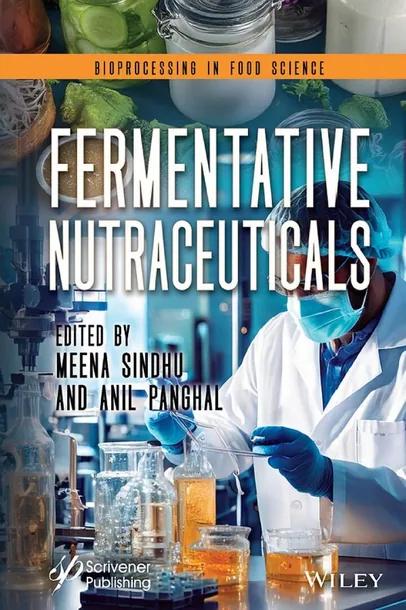
Fermentative Nutraceuticals
by Meena Sindhu, Anil Panghal
1st Edition
Publisher: Wiley-Scrivener
Book Details
| Print ISBN | 9781119775638 |
| eText ISBN | 9781119776536 |
| Publisher | Wiley-Scrivener |
| Publishing Year | 2025 |
| Edition | 1st Edition |
| Language | English |
| Pages | 352 |
The 1st Edition of Fermentative Nutraceuticals offers an academic examination of bioactive peptides derived from fermented foods and their functional health applications. Edited by Meena Sindhu and Anil Panghal, this publication clarifies how microbial activity during processing generates functional food components.
The text groups core topics around the physiological actions of fermentation products. Specific chapters analyze how microbial peptides exhibit antioxidative, anticancer, and antidiabetic properties within biological systems. Additional sections explore food protection strategies, covering natural antimicrobials, biopreservative agents, bacteriophages, and endolysins designed to enhance stability.
Published within the Bioprocessing in Food Science series, the volume delivers practical guidance for design and analytical evaluation. It offers structured background material for students, academic researchers, product developers, and food industry professionals.
Table of Contents
Chapter 1: Bioactive Compounds and Their Benefits
- • 1.1 Introduction
- • 1.2 Bioactive Compounds of Microbial Origin
- • 1.3 Bioactive Compounds of Animal Origin
- • 1.4 Bioactive Compounds Derived from Mammals
- • 1.5 Bioactive Compounds of Endophytic Origin
- • 1.6 Conclusion
Chapter 2: Solid-State Fermentation of Plant-Based Food to Enhance Bioactive Components
- • 2.1 Terpenes/Terpinoids
- • 2.2 Alkaloids
- • 2.3 Phenolic/Ployphenolics
- • 2.4 Solid-State Fermentation
- • 2.5 Important Aspects of SSF
- • 2.6 Microorganisms Involved in SSF
- • 2.7 Solid-State Fermentation for the Enhancement of Bioactive Components
Chapter 3: Biopreservative Agents for Food Applications
- • 3.1 Introduction
- • 3.2 Need of Biopreservation
- • 3.3 Fermentation: A Crucial Aspect of Biopreservation
- • 3.4 Biopreservative Agents
- • 3.5 Natural Antimicrobials: Their Classification
- • 3.6 Antimicrobial Agents in Plants and Animals
- • 3.7 Bacteriophages and Endolysins: Applications in Food Industry
- • 3.8 Conclusion
Chapter 4: Bioactive Peptides From Fermented Pulses
- • 4.1 Introduction
- • 4.2 Methods of Bioactive Peptide Production
- • 4.3 Pharmacological Properties of Bioactive Peptides
Chapter 5: Physiological Activities of Bioactive Peptides Against Diabetes and Obesity
- • 5.1 Introduction
- • 5.2 Bioactive Peptides on Human Health
- • 5.3 Diversity in Production of Bioactive Peptides
- • 5.4 Purification and Characterization of Bioactive Peptides
- • 5.5 Conclusion
Chapter 6: Biosurfactant Production From Economical Sources
- • 6.1 Introduction
- • 6.2 Classification of Biosurfactants
- • 6.3 Biosurfactant Production
- • 6.4 Factors Influencing Biosurfactant Production
- • 6.5 Conventional Substrates for Biosurfactant Production
- • 6.6 Food Industry Byproducts for Biosurfactant Production
- • 6.7 Agro-Industrial Waste Utilization in Biosurfactant Production
- • 6.8 Economic Feasibility
- • 6.9 Applications of Biosurfactants
- • 6.10 Conclusion
Chapter 7: Biofortification of Food Using Fermentation
- • 7.1 Introduction
- • 7.2 The Need for Biofortification
- • 7.3 Why Biofortification via Fermentation?
- • 7.4 Nutrients that Have Been Fortified Using Fermentation Approaches
- • 7.5 Application of Biofortification
- • 7.6 Comparative Advantages
- • 7.7 Bioavailability and Efficacy of Micronutrients Provided by Fermented Biofortified Foods
- • 7.8 Conclusion
Chapter 8: Consumers and Health Claims of Nutraceuticals
- • 8.1 Introduction
- • 8.2 Consumers for Nutraceuticals
- • 8.3 Factors Influencing Consumer's Food Preferences
- • 8.4 Health Claims and Their Substantiation
- • 8.5 International Regulatory Framework for Nutraceuticals' Health Claims
- • 8.6 Clinical and In Vitro Studies Validating Nutraceuticals' Health Claims
- • 8.7 Conclusion
Chapter 9: Application of Bacteriocin in Wine
- • 9.1 Introduction
- • 9.2 Bacteriocin
- • 9.3 Immobilized Cells Against Free Cell of LAB-Producing Bacteriocin
- • 9.4 Potential Application of Bacteriocin in Food Industry
- • 9.5 Bacteriocin in Wine
- • 9.6 Factor Affecting Activity of Bacteriocin
- • 9.7 Safety and Regulatory Consideration of Bacteriocin
- • 9.8 Conclusion
Chapter 10: Current Trends in Fermentative Nutraceuticals
- • 10.1 Introduction
- • 10.2 Phytochemicals
- • 10.3 Polyphenolic Compounds
- • 10.4 Alkaloids
- • 10.5 Terpenoids
- • 10.6 Prebiotics
- • 10.7 Polysaccharides
- • 10.8 Poly Amino Acids
- • 10.9 Polyunsaturated Fatty Acids
- • 10.10 Conclusions
Chapter 11: Bioactive Compounds in Fermented Seafood and Their Health Benefits
- • 11.1 Introduction
- • 11.2 Marine-Based Bioactive Compounds From Fermentation Process and Their Health Benefits
- • 11.3 Challenges and Future Aspects
Customer Reviews
0.0
0 reviews
No reviews yet. Be the first to review this book!
Write a Review
Reviewed by GradeFocus Editorial Team
▶Research Sources (14)
- Fermentative Nutraceuticals
- Study Aids Collection | Search
- Old Soul Supply Co.
- Literature & Thought
- Inklings Book Shoppe, LLC
- Explore insightful publications today - CSTnetwork.org
- WPD Books - Bindery Books
- Fermentative Nutraceuticals (Hardcover) by Meena Sindhu, Anil ...
- Fermentative Nutraceuticals - Bookswagon
- Fermentative Nutraceuticals - ritograk.fo
- Fermentative Nutraceuticals : John Wiley & Sons - Book2look
- Fermented Formulas: Traditional Processing Method Appeals to ...
- Fermentative Nutraceuticals (ebok) av
- Fermentation Biotechnology for Functional Foods - 1st Edition - Kalida
Related Books
Edible Oil Blends
Mohamed Fawzy Ramadan
Interaction of Food Macromolecules
Ibrahim Khalifa
Food Engineering Automation with Robotics and AI
Abir Chakravorty
Non-Bovine Milk-Derived Bioactive Peptides
Subrota Hati
Advances in Edible Packaging Systems for Food Preservation
Zuhaib F. Bhat
Alternative Dairy Products and Technologies
Harjinder Singh