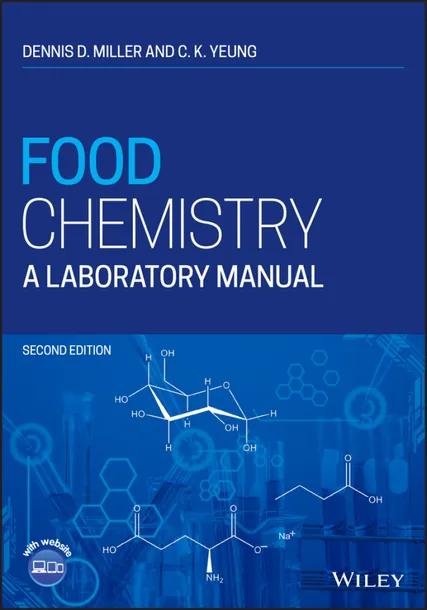
Food Chemistry
A Laboratory Manual
by Dennis D. Miller, C. K. Yeung
2nd Edition
Publisher: Wiley-Blackwell
Book Details
| Print ISBN | 9780470639313 |
| eText ISBN | 9781119714606 |
| Publisher | Wiley-Blackwell |
| Publishing Year | 2022 |
| Edition | 2nd Edition |
| Language | English |
| Pages | 224 |
Food Chemistry: A Laboratory Manual, 2nd Edition, presents laboratory exercises designed for courses that meet Institute of Food Technologists undergraduate education standards for food science degrees. Drawing on extensive classroom instruction, the manual supplies practical investigations suitable for a one-semester curriculum.
Investigations explore fundamental chemical behavior across food components, including chemical leavening agents, sugar properties, nonenzymatic browning, hydrocolloids, and protein functionality. Additional laboratory work examines lipid oxidation, caffeine in beverages, and food emulsions.
Each chapter provides introductory summaries of primary methodological concepts alongside guidance on interpreting experimental results. Adopting professors can access an online guide providing preparation notes and solutions.
Table of Contents
Chapter 1: Acids, Bases, and Buffers
- • 1.1 Learning Outcomes
- • 1.2 Introduction
- • 1.3 Apparatus and Instruments
- • 1.4 Reagents and Materials
- • 1.5 Procedures
- • 1.6 Problem Set
- • 1.7 References
- • 1.8 Suggested Reading
- • Answers to Problem Set
Chapter 2: Chemical Leavening Agents
- • 2.1 Learning Outcomes
- • 2.2 Introduction
- • 2.3 Apparatus and Instruments
- • 2.4 Reagents and Materials
- • 2.5 Procedures
- • 2.6 Problem Set
- • 2.7 Useful Formulas and Values
- • 2.8 References
- • 2.9 Suggested Reading
- • Answers to Problem Set
Chapter 3: Properties of Sugars
- • 3.1 Learning Outcomes
- • 3.2 Introduction
- • 3.3 Apparatus and Instruments
- • 3.4 Reagents and Materials
- • 3.5 Procedures
- • 3.6 Study Questions
- • 3.7 References
- • 3.8 Suggested Reading
Chapter 4: Nonenzymatic Browning
- • 4.1 Learning Outcomes
- • 4.2 Introduction
- • 4.3 Apparatus and Instruments
- • 4.4 Reagents and Materials
- • 4.5 Procedures
- • 4.6 Problem Set
- • 4.7 Study Questions
- • 4.8 References
- • 4.9 Suggested Reading
- • Answers to Problem Set
Chapter 5: Food Hydrocolloids
- • 5.1 Learning Outcomes
- • 5.2 Introduction
- • 5.3 Apparatus and Instruments
- • 5.4 Reagents and Materials
- • 5.5 Procedures
- • 5.6 Study Questions
- • 5.7 References
- • 5.8 Suggested Reading
Chapter 6: Functional Properties of Proteins
- • 6.1 Learning Outcomes
- • 6.2 Introduction
- • 6.3 Apparatus and Instruments
- • 6.4 Reagents and Materials
- • 6.5 Procedures
- • 6.6 Problem Set
- • 6.7 Study Questions
- • 6.8 References
- • 6.9 Suggested Reading
- • Answers to Problem Set
Chapter 7: Lactose
- • 7.1 Learning Outcomes
- • 7.2 Introduction
- • 7.3 Apparatus and Instruments
- • 7.4 Reagents and Materials
- • 7.5 Procedures
- • 7.6 Experimental Design
- • 7.7 Study Questions
- • 7.8 References
- • 7.9 Suggested Reading
Chapter 8: Enzymatic Browning: Kinetics of Polyphenoloxidase
- • 8.1 Learning Outcomes
- • 8.2 Introduction
- • 8.3 Apparatus and Instruments
- • 8.4 Reagents and Materials
- • 8.5 Procedures
- • 8.6 Problem Set
- • 8.7 Study Questions
- • 8.8 References
- • Answers to Problem Set
Chapter 9: Blanching Effectiveness
- • 9.1 Learning Outcomes
- • 9.2 Introduction
- • 9.3 Apparatus and Instruments
- • 9.4 Reagents and Materials
- • 9.5 Procedures
- • 9.6 Study Questions
- • 9.7 References
- • 9.8 Suggested Reading
Chapter 10: Lipid Oxidation
- • 10.1 Learning Outcomes
- • 10.2 Introduction
- • 10.3 Apparatus and Instruments
- • 10.4 Reagents and Materials
- • 10.5 Procedures: Lipid Oxidation in Turkey Meat
- • 10.6 Problem Set: Calculation of TBARS
- • 10.7 Study Questions
- • 10.8 References
- • 10.9 Suggested Reading
- • Answers to Problem Set
Chapter 11: Ascorbic Acid: Stability and Leachability
- • 11.1 Learning Outcomes
- • 11.2 Introduction
- • 11.3 Apparatus and Instruments
- • 11.4 Reagents and Materials
- • 11.5 Procedures
- • 11.6 Problem Set
- • 11.7 Study Questions
- • 11.8 References
- • Answers to Problem Set
Chapter 12: Hydrolytic Rancidity in Milk
- • 12.1 Learning Outcomes
- • 12.2 Introduction
- • 12.3 Apparatus and Instruments
- • 12.4 Reagents and Materials
- • 12.5 Treatments and Controls
- • 12.6 Procedures
- • 12.7 Problem Set
- • 12.8 Study Questions
- • 12.9 References
- • 12.10 Suggested Reading
- • Answers to Problem Set
Chapter 13: Caffeine in Beverages
- • 13.1 Learning Outcomes
- • 13.2 Introduction
- • 13.3 Apparatus and Instruments
- • 13.4 Reagents and Materials
- • 13.5 Operation of the HPLC
- • 13.6 Procedures
- • 13.7 Data Analysis
- • 13.8 References
- • 13.9 Suggested Reading
Chapter 14: Color Additives
- • 14.1 Learning Outcomes
- • 14.2 Introduction
- • 14.3 Apparatus and Instruments
- • 14.4 Reagents and Materials
- • 14.5 Procedures
- • 14.6 Study Questions
- • 14.7 References
- • 14.8 Suggested Reading
Chapter 15: Plant Pigments
- • 15.1 Learning Outcomes
- • 15.2 Introduction
- • 15.3 Apparatus and Instruments
- • 15.4 Reagents and Materials
- • 15.5 Procedures
- • 15.6 Study Questions
- • 15.7 References
- • 15.8 Suggested Reading
Chapter 16: Meat Pigments
- • 16.1 Learning Outcomes
- • 16.2 Introduction
- • 16.3 Apparatus and Instruments
- • 16.4 Reagents and Materials
- • 16.5 Procedures
- • 16.6 Study Questions
- • 16.7 References
- • 16.8 Suggested Reading
Chapter 17: Meat Tenderizers
- • 17.1 Learning Outcomes
- • 17.2 Introduction
- • 17.3 Apparatus and Instruments
- • 17.4 Reagents and Materials
- • 17.5 Procedures
- • 17.6 Study Questions
- • 17.7 References
- • 17.8 Suggested Reading
Chapter 18: Detection of Genetically Engineered Maize Varieties
- • 18.1 Learning Outcomes
- • 18.2 Introduction
- • 18.3 Apparatus and Instruments
- • 18.4 Reagents and Materials
- • 18.5 Procedures
- • 18.6 Study Questions
- • 18.7 References
- • 18.8 Suggested Reading
Chapter 19: Food Emulsions and Surfactants
- • 19.1 Learning Outcomes
- • 19.2 Introduction
- • 19.3 Part I – Butter Churning (Phase Inversion)
- • 19.4 Part II – Margarine Manufacture (Use of Surfactant for Semi-solid Foods)
- • 19.5 Part III – Dispersion of Eugenol in Water (Surfactant Solubilization Capacity)
- • 19.6 Part IV – Mayonnaise Stability
- • 19.7 References
- • 19.8 Suggested Reading
Chapter Appendix I: Conversion Factors
Chapter Appendix II: Concentration
- • Definition
- • Suggested Reading
Chapter Appendix III: Acids, Bases, Buffers, and pH Measurement
- • Review of pH and Acid–Base Equilibria
- • Acids and Bases
- • Acid/Base Equilibria
- • The pH Scale
- • pK
- • Buffers: Functions and Uses
- • Problems
- • Choosing a Buffer System
- • Preparation of Buffers
- • Activity and Ionic Strength
- • pH Measurement
- • Making pH Measurements
- • References
- • Suggested Reading
Chapter Appendix IV: Spectrophotometry
- • Introduction
- • Operation of a Spectrophotometer
- • Notes for Operators
- • Problem Set
- • References
- • Answers to Problem Set
Chapter Appendix V: Chromatography
- • What Is Chromatography?
- • Chromatography Terminology
- • Types of Chromatography
- • Adsorption Chromatography (AC)
- • Liquid–Liquid Partition Chromatography (LLPC)
- • Bonded Phase Chromatography (BPC)
- • Ion-Exchange Chromatography (IEC)
- • Gel Permeation Chromatography (GPC)
- • High-Performance Liquid Chromatography
- • The HPLC System
- • References
- • Suggested Reading
Chapter Appendix VI: Electrophoresis
- • Introduction
- • References
- • Suggested Reading
Chapter Appendix VII: Glossary
Customer Reviews
0.0
0 reviews
No reviews yet. Be the first to review this book!
Write a Review
Reviewed by GradeFocus Editorial Team
Related Books
Edible Oil Blends
Mohamed Fawzy Ramadan
Interaction of Food Macromolecules
Ibrahim Khalifa
Food Engineering Automation with Robotics and AI
Abir Chakravorty
Non-Bovine Milk-Derived Bioactive Peptides
Subrota Hati
Advances in Edible Packaging Systems for Food Preservation
Zuhaib F. Bhat
Alternative Dairy Products and Technologies
Harjinder Singh