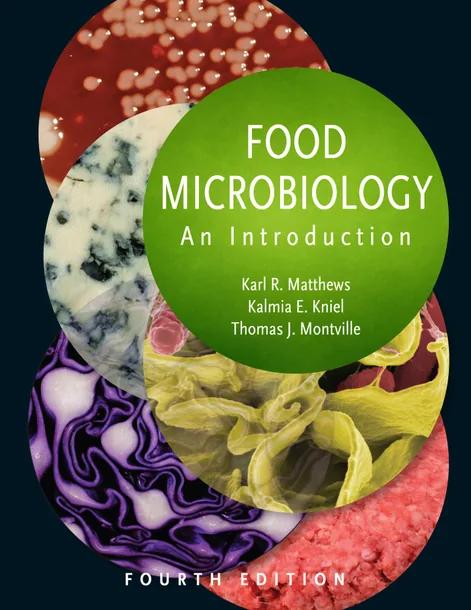
Food Microbiology
An Introduction
by Karl R. Matthews, Kalmia E. Kniel, Thomas J. Montville
4th Edition
Publisher: ASM Press
Book Details
| Print ISBN | 9781555819385 |
| eText ISBN | 9781555819392 |
| Publisher | ASM Press |
| Publishing Year | 2017 |
| Edition | 4th Edition |
| Language | English |
| Pages | 624 |
Food Microbiology: An Introduction, 4th Edition, provides structured coverage of foodborne microorganisms and their control across 29 chapters. Published by ASM Press in 2017, this textbook is organized to support teaching and classroom study in foundational food microbiology.
The text addresses the dynamics of microbial growth, survival, and death in foods, alongside techniques for microbial enumeration and rapid detection. It covers beneficial fermentations, common spoilage agents, major foodborne pathogens, and multiple preservation systems.
Learning resources include exercises for critical thinking skills with answers to selected questions, crossword puzzles with answers, and a subject glossary.
Table of Contents
Chapter 1: The Trajectory of Food Microbiology
Chapter 2: Microbial Growth, Survival, and Death in Foods
Chapter 3: Spores and Their Significance
Chapter 4: Detection and Enumeration of Microbes in Food
Chapter 5: Rapid and Automated Microbial Methods
Chapter 6: Indicator Microorganisms and Microbiological Criteria
Chapter 7: Regulatory Issues
Chapter 8: Bacillus cereus
Chapter 9: Campylobacter Species
Chapter 10: Clostridium botulinum
Chapter 11: Clostridium perfringens
Chapter 12: Enterohemorrhagic Escherichia coli
Chapter 13: Listeria monoctyogenes
Chapter 14: Salmonella Species
Chapter 15: Shigella Species
Chapter 16: Staphylococcus aureus
Chapter 17: Vibrio Species
Chapter 18: Yersinia enterocolitica
Chapter 19: Lactic Acid Bacteria and Their Fermentation Products
Chapter 20: Yeast-Based and Other Fermentations
Chapter 21: Spoilage Organisms
Chapter 22: Molds
Chapter 23: Parasites
Chapter 24: Viruses and Prions
Chapter 25: Chemical Antimicrobials
Chapter 26: Biologically Based Preservation and Probiotic Bacteria
Chapter 27: Physical Methods of Food Preservation
Chapter 28: Nonthermal Processing
Chapter 29: Sanitation and Related Practices
Customer Reviews
0.0
0 reviews
No reviews yet. Be the first to review this book!
Write a Review
Reviewed by GradeFocus Editorial Team
▶Research Sources (4)
Related Books
Edible Oil Blends
Mohamed Fawzy Ramadan
Interaction of Food Macromolecules
Ibrahim Khalifa
Food Engineering Automation with Robotics and AI
Abir Chakravorty
Non-Bovine Milk-Derived Bioactive Peptides
Subrota Hati
Advances in Edible Packaging Systems for Food Preservation
Zuhaib F. Bhat
Alternative Dairy Products and Technologies
Harjinder Singh