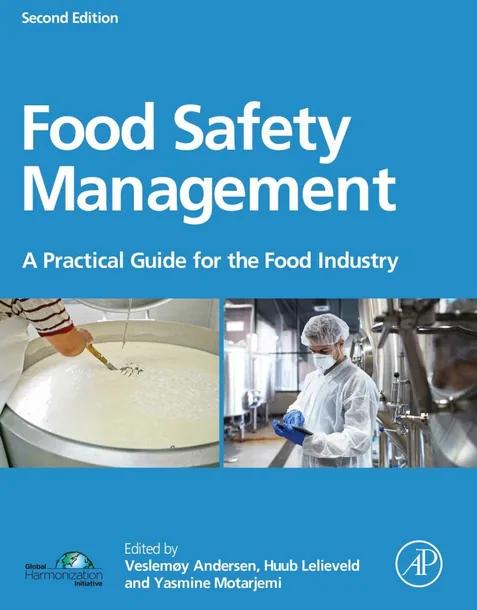
Food Safety Management
A Practical Guide for the Food Industry
by Veslemøy Andersen, Huub Lelieveld, Yasmine Motarjemi
2nd Edition
Publisher: Academic Press
Book Details
| Print ISBN | 9780128200131 |
| eText ISBN | 9780323902090 |
| Publisher | Academic Press |
| Publishing Year | 2023 |
| Edition | 2nd Edition |
| Language | English |
| Pages | 1158 |
Food Safety Management, 2nd Edition, is an academic textbook that provides an integrated approach to managing physical, chemical, and microbial risks across the food supply chain. Designed for university students, food safety managers, inspectors, and auditors, it outlines practical guidelines for implementing food safety assurance systems.
The text organizes its coverage around specific agricultural and processing sectors, addressing risk management in feed, dairy, meat, poultry, seafood, insect-based foods, fruits, and vegetables. It pairs processing controls, such as thermal treatment and non-thermal processing technologies, with facility infrastructure requirements like hygienic practice, site layout, building design, and equipment construction.
Additionally, the volume incorporates social and organizational dimensions of compliance, examining human factors, ethics, and whistleblowing within food safety management. This balance of technical hazard controls and institutional oversight supports advanced university courses and professional instruction for consultants, trainers, and scholars.
Table of Contents
Chapter 1: Food Safety Management: A Practical Guide for the Food Industry: The Story Behind the Book
Chapter 2: Fundamentals in Management of Food Safety in the Industrial Setting: Challenges and Outlook of the 21st Century
Chapter 3: Management of Safety in the Feed Chain
Chapter 4: Naturally Occurring Contaminants and Inherent Toxicants of Plant Origin
Chapter 5: Allergens
Chapter 6: Milk and Dairy Products
Chapter 7: Bakery and Farinaceous Products
Chapter 8: Meat and Meat Products
Chapter 9: Poultry Meat and Eggs
Chapter 10: Seafood
Chapter 11: Food Safety Management of Insect-Based Foods
Chapter 12: Fruits and Vegetables (Including Herbs)
Chapter 13: Coffee, Cocoa, and Derived Products (e.g., Chocolate)
Chapter 14: Confectionery and Bakery Products; Including Honey
Chapter 15: Edible Nuts, Oilseeds and Legumes
Chapter 16: Vegetable Oils and Fats
Chapter 17: Bottled and Drinking Water
Chapter 18: Pet Food
Chapter 19: Food Contact Materials
Chapter 20: Thermal Treatment
Chapter 21: Non-Thermal Processing Technologies
Chapter 22: Acids and Fermentation
Chapter 23: Chilling and Freezing
Chapter 24: Detection of Physical Hazards
Chapter 25: Principles and Systems for Quality and Food Safety Management
Chapter 26: The Use of Big Data in Food Safety Management: Predicting Food Safety Risks Using Big Data and Artificial Intelligence
Chapter 27: Hygiene in Primary Production
Chapter 28: Principles of Hygienic Practice in Food Processing and Manufacturing
Chapter 29: Site Selection, Site Layout, Building Design
Chapter 30: Hygienic Design of Food Processing Equipment
Chapter 31: Development of a Comprehensive Cleaning and Sanitizing Program for Food Production Facilities
Chapter 32: Personal Hygiene and Food Worker Health
Chapter 33: Pest Management
Chapter 34: Safe Handling of Food in Homes and Food Services
Chapter 35: Preventing and Managing Travel- Related Foodborne Disease
Chapter 36: Hazard Analysis and Critical Control Point System (HACCP)
Chapter 37: HACCP Misconceptions and Shortcomings
Chapter 38: Detection of Microbiological Hazards
Chapter 39: Management of Microbiological Hazards: Role of Testing as Verification
Chapter 40: Management of Chemical Contaminants
Chapter 41: Food Defense
Chapter 42: Effective and Efficient Leadership
Chapter 43: Human Factors in Food Safety Management
Chapter 44: Assessment of Food Safety Management Systems
Chapter 45: Incident Management and Root Cause Analysis
Chapter 46: Crisis Management
Chapter 47: Food Safety During Pandemics: A Focus on COVID-19
Chapter 48: The Role of International, Regional, and National Organizations in the Development of Standards
Chapter 49: Sustainability and Food Systems
Chapter 50: Climate Change and Food Safety
Chapter 51: Nutritional Trends and Health Claims
Chapter 52: Consumer Information and Labeling
Chapter 53: Misinformation About Food Safety
Chapter 54: Ethics in Food Safety Management
Chapter 55: Whistleblowing: An Essential Element of Public Health and Food Safety Management
Chapter 56: Training and Education
Customer Reviews
0.0
0 reviews
No reviews yet. Be the first to review this book!
Write a Review
Reviewed by GradeFocus Editorial Team
▶Research Sources (18)
- Food Safety Management - 2nd Edition
- 9780323902090
- Food Safety Management | Rent | 9780323902090
- [PDF] Food Safety Management by Veslemøy Andersen ...
- Food Safety Management
- Food Safety Management - Veslemoy Andersen
- Food Safety Management
- Sourcebooks, LLC.
- Non-Thermal Processing Technologies | Documents - Universitat de ...
- Food Safety Management
- Food Safety Management: A Practical Guide for the ...
- Food Safety Management by Unknown - 9780128200131
- Food Safety Management: A Practical Guide for the ... - Biblio
- Food Safety Textbooks, Guides, and Practice Exams
- (PDF) The Food Safety Management Program
- Food Safety Management Guide 2nd Ed. | PDF
- Food Safety Management Systems
- Food Safety Management: a Practical Guide for the Food ...
Related Books

Edible Oil Blends
Mohamed Fawzy Ramadan
Interaction of Food Macromolecules
Ibrahim Khalifa
Food Engineering Automation with Robotics and AI
Abir Chakravorty

Non-Bovine Milk-Derived Bioactive Peptides
Subrota Hati
Advances in Edible Packaging Systems for Food Preservation
Zuhaib F. Bhat
Alternative Dairy Products and Technologies
Harjinder Singh