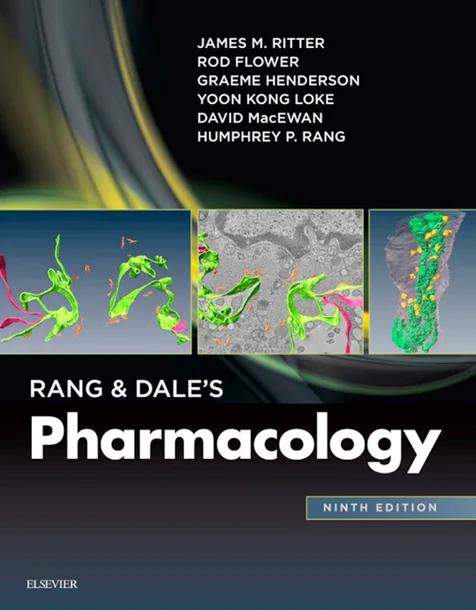
Rang & Dale's Pharmacology
by James M. Ritter, Rod J. Flower, Graeme Henderson
9th Edition
Publisher: Elsevier
Book Details
| Print ISBN | 9780702074486 |
| eText ISBN | 9780702074455 |
| Publisher | Elsevier |
| Publishing Year | 2018 |
| Edition | 9th Edition |
| Language | English |
| Pages | 808 |
Rang & Dale's Pharmacology, 9th Edition, presents core basic and clinical science principles for students and healthcare practitioners. It moves systematically from molecular receptor interactions to the clinical applications of major drug classes.
The volume addresses fundamental pharmacological mechanisms, chemical mediators, organ systems, and nervous system pharmacology. It also examines antimicrobial therapies, cancer treatments, and adverse drug effects.
Designed for learners in medicine, pharmacy, and pharmacology, the text is also noted by reviewer Carol L. Beck as well suited for graduate courses for MS, PhD, or MD/PhD students. Online resources supply more than 100 chapter-specific multiple-choice questions and six cases for self-assessment.
Table of Contents
Chapter 1: What is pharmacology?
Chapter 2: How drugs act: general principles
Chapter 3: How drugs act: molecular aspects
Chapter 4: How drugs act: cellular aspects excitation, contraction and secretion
Chapter 5: Biopharmaceuticals and gene therapy
Chapter 6: Cell proliferation, apoptosis, repair and regeneration
Chapter 7: Cellular mechanisms: host defence
Chapter 8: Method and measurement in pharmacology
Chapter 9: Absorption and distribution of drugs
Chapter 10: Drug metabolism and elimination
Chapter 11: Pharmacokinetics
Chapter 12: Individual Variation, Pharmacogenomics and Personalised Medicine
Chapter 13: Chemical mediators and the autonomic nervous system
Chapter 14: Cholinergic transmission
Chapter 15: Noradrenergic transmission
Chapter 16: 5-Hydroxytryptamine and the Pharmacology of Migraine
Chapter 17: Purines
Chapter 18: Local Hormones 1: Histamin and the Biologically Active Lipids.
Chapter 19: Local Hormones 2: Peptides and Proteins
Chapter 20: Cannabinoids
Chapter 21: Nitric oxide and other gaseous mediators
Chapter 22: The heart
Chapter 23: The vascular system
Chapter 24: Atherosclerosis and lipid metabolism
Chapter 25: Haemostasis and thrombosis
Chapter 26: Haemopoietic system
Chapter 27: Anti-inflammatory and immunosuppressant drugs
Chapter 28: Skin
Chapter 29: Respiratory system
Chapter 30: The Kidney and urinary system
Chapter 31: The Gastrointestinal tract
Chapter 32: The control of blood glucose and drug treatment of diabetes mellitus
Chapter 33: Obesity
Chapter 34: The Pituitary and the adrenal cortex
Chapter 35: Thyroid
Chapter 36: The reproductive system
Chapter 37: Bone metabolism
Chapter 38: Chemical transmission and drug action in the nervous system
Chapter 39: Amino acid transmitters
Chapter 40: Other transmitters and modulators
Chapter 41: Neurodegenerative diseases
Chapter 42: General anaesthetic agents
Chapter 43: Analgesic drugs
Chapter 44: Local anaesthetics and other drugs affecting sodium channels
Chapter 45: Anxiolytic and hypnotic drugs
Chapter 46: Antiepileptic drugs
Chapter 47: Antipsychotic drugs
Chapter 48: Antidepressant drugs
Chapter 49: CNS stimulants and psychotomimetic drugs
Chapter 50: Drug addiction, dependence and abuse
Chapter 51: Basic principles of antimicrobial chemotherapy
Chapter 52: Antibacterial drugs
Chapter 53: Antiviral drugs
Chapter 54: Antifungal drugs
Chapter 55: Antiprotozoal drugs
Chapter 56: Anthelmintic drugs
Chapter 57: Anti-cancer drugs
Chapter 58: Harmful effects of drugs
Chapter 59: Lifestyle drugs and drugs in sport
Chapter 60: Drug discovery and development
Customer Reviews
0.0
0 reviews
No reviews yet. Be the first to review this book!
Write a Review
Reviewed by GradeFocus Editorial Team